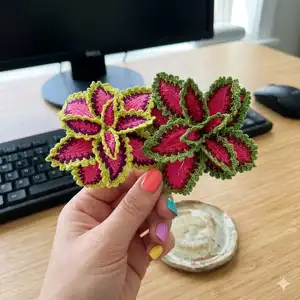
Make a realistic, eye-catching Watermelon Coleus plant in crochet using this detailed pattern. You will create layered, wired leaves with a textured long-stitch edge for a lifelike finish. The pattern includes yarn recommendations, wiring instructions, and step-by-step stitch guidance so you can assemble a beautiful potted plant for display or gifting. Perfect for crocheters who enjoy detailed, decorative projects.
Progress Tracker
0% Complete
— Pattern Instructions :
Infos :
Notes: When you see stitches in brackets, it means that all the ones in the bracket are worked in to one stitch. Example: (sc inc) means: 2sc worked in to one stitch. (3sc) means: 3sc in the same stitch. (3sc) x 2 means: 3sc in each of the next 2 stitches. Alternate (dc inc) and 1dc x 3 means: work 2dc in to the first stitch, then work 1dc in the next, then repeat the last 2 steps 2 more times.
Info :
Following the tutorial and using the recommended yarn, your finished plant will measure approx. 7"(18cm) tall without plant pot and 9"(23cm) in width Depending on how you shape the leaves. This plant is made of 12 leaves in total as shown in the image. However you can make it larger by making more leaves or smaller by making less leaves.
Info :
The sample arrangement uses leaf types labelled A, B, C, D and E. Refer to the photos for placement and proportions. Each leaf type has specific rounds and wiring instructions below.
— Leaf A :
Round 1 :
Ch25 Skip1 2sc 1hdc 1dc (dc inc) x 2 9dc 4hdc 3sc
Round 1 continued :
(3sc) in the last chain
Round 1 continued :
3sc 4hdc 9dc (dc inc) x 2 1dc 1hdc 2sc
Round 1 end :
(3sc) in the skipped chain from the beginning
Round 2 :
2sc 2hdc 1dc (dc inc) (1dc, 1tc) 1tc (tc inc) repeat the last 2 steps 1 more time 3tc 4dc 4hdc 3sc
Round 2 continued :
(3sc) center stitch, Going down the other side, 3sc 4hdc 4dc 3tc (tc inc) 1tc repeat the last 2 steps 1 more time (1tc, 1dc) (dc inc) 1dc 2hdc 3sc slst base chain
Info :
Work (3sc) in the center stitch at the tip before working down the other side to mirror the first side of the leaf.
Round 3 :
ch1 8sc (sc inc) 1sc repeat the last 2 steps 2 more times 17sc
Round 3 Info :
Work all the following stitches in to the center stitch at the tip of the leaf: (1hdc, ch4, skip1, 1sc, 1hdc down the chain, 1hdc). Pull the wire round and down equally.
Round 3 continued :
17sc 1sc (sc inc) repeat the last 2 steps 2 more times 8sc Slst in 1st stitch on the opposite side, CHANGE COLOUR
Round 4 :
ch1 4sc 1hdc Then work the first Long stitch sequence. Work 1hdc, Yarn over as to work another hdc but don't work it in to the next chain. Instead insert the hook in to the round below (underneath the wire round) and 1 stitch back (p1). So basically below and slightly diagonal from the last stitch you made. Pull the yarn through as you would usually do (p2) and pull the long stitch up (p3). Now pull through to complete the Long hdc the same as you would usually do (p4). So now you have done this sequence: (1hdc, 1Long hdc). In the next chain work 1slip stitch (p5), This chain may be hidden under the Long stitch so just check to make sure the slip stitch is worked in to the correct chain.
Round 4 continued :
Follow the sequence (1hdc, 1Long hdc) then continue to work 1dc (1dc, 1Long dc) Slst then 1dc (1tc, 1Long tc) Slst Repeat sequences as described across the round. Repeat 3 more times and continue as instructed to build the scalloped long stitch edge.
Round 4 continued :
2sc (3sc) center stitch
Info :
You have already completed the stitches above this line on the previous page for the first leaf. Continue to work the long stitch sequences and slip stitches as shown in photos to form the scalloped edge.
Round 4 going down the other side :
2sc slst 1hdc (1hdc, 1Long hdc) Repeat 1 more time slst 1dc (1dc, 1Long dc) Repeat 1 more time slst 1dc (1tc, 1Long tc) Repeat 3 more times slst (1dc, 1Long dc) 1dc Repeat 1 more time 1hdc (1hdc, 1Long hdc) 1hdc 5sc slst in 1st stitch on the opposite side
Round 5 :
ch1 4sc slst (in to the row below) (p1) 1sc (p2) 1hdc (p3) (hdc inc) (p4) slst (side of slst from the row below) (p1) Repeat 9 more times 3sc (1sc, ch3, skip1, 1sc, 1sc) Center stitch. Going down the other side, 3sc slst (side of slst) (hdc inc) 1hdc 1sc Repeat 9 more times slst (row below) 5sc CHANGE COLOR
Round 6 :
ch1 4sc Now work, 1dc next to the slip stitch from the previous round, So basically, push the hook in at the side of the slst we made in the previous round, pull the yarn up and complete the dc (p1). This stitch is repeated all around the petal where the slip stitches from the previous round are.
Round 6 continue :
Continue to work: 1hdc (p2) (sc dec) (p3) 1hdc (p4) 1dc (side of slst) (p1) Repeat the last 4 steps 9 more times 3hdc 2sc
Round 6 continued :
Work (3sc) in to the unworked skipped chain at the tip of the petal.
Round 6 going down the other side :
2sc 3hdc 1dc (side of slst) 1hdc (sc dec) 1hd 1dc (side of slst) Repeat 9 more times 5sc Slst in the 1st chain on the opposite side.
Round 7 :
(ch1, 1sc) 7sc (slst, ch2, 1dc, ch1) (1dc, ch2, slst) 2slst Repeat the last 4 steps 10 more times (1dc, 1tc, ch1, slst, 1dc) center Going down the other side 2slst (slst, ch2, 1dc, ch1) (1dc, ch2, slst) Repeat the last 4 steps 10 more times 8sc Leave a long tail, Wrap tight around the wire To cover approx. 2"(5cm).
Info :
Make 4 of Leaf A. After completing the rounds, insert florist wire and crochet the next round over the wire as described in the Leaf A Wire section.
— Leaf A Wire :
Info :
We will now crochet over the florist wire. Cut a piece of approximately 20"(50cm) and thread it through the stitch on your hook (p1 & 2). Crochet this whole next round over the wire (p3). Thread the wire through the hook and continue crocheting each stitch over the wire so the wire sits inside the leaf edge.
— Leaf A continued :
Round 3 :
ch1 8sc (sc inc) 1sc repeat the last 2 steps 2 more times 17sc Work all the following stitches in to the center stitch at the tip of the leaf: (1hdc, ch4, skip1, 1sc, 1hdc down the chain, 1hdc) Pull the wire round and down equally 17sc 1sc (sc inc) repeat the last 2 steps 2 more times 8sc Slst in 1st stitch on the opposite side CHANGE COLOUR
Round 4 :
ch1 4sc 1hdc Then work the first Long stitch sequence. Work 1hdc, Yarn over as to work another hdc but don't work it in to the next chain. Instead insert the hook in to the round below (underneath the wire round) and 1 stitch back (p1). Pull the yarn through as you would usually do (p2) and pull the long stitch up (p3). Now pull through to complete the Long hdc the same as you would usually do (p4). So you have done this sequence: (1hdc, 1Long hdc). In the next chain work 1slip stitch (p5). Continue as previous page sequences to make the scalloped edge, slst and repeats as shown.
Round 4 continued :
Continue to work 1dc (1dc, 1Long dc) Slst Repeat 3 more times 1dc (1tc, 1Long tc) Slst Repeat 1 more time 1hdc (1hdc, 1Long hdc) Slst Repeat 1 more time 2sc (3sc) center stitch
Round 4 other side :
Going down the other side. Rnd.4: 2sc slst 1hdc (1hdc, 1Long hdc) Repeat 1 more time slst 1dc (1dc, 1Long dc) Repeat 1 more time slst 1dc (1tc Long tc) Repeat 3 more times slst (1dc, 1Long dc) 1dc (1dc, 1Long dc) Repeat 1 more time 1hdc (1hdc, 1Long hdc) 1hdc 5sc slst in 1st stitch on the opposite side,
— Leaf A continued (Rounds 5-7) :
Round 5 :
ch1 4sc slst (in to the row below) (p1) 1sc (p2) 1hdc (p3) (hdc inc) (p4) slst (side of slst from the row below) (p1) Repeat 9 more times 3sc (1sc, ch3, skip1, 1sc, 1sc) Center stitch. Going down the other side, 3sc slst (side of slst) (hdc inc) 1hdc 1sc Repeat 9 more times slst (row below) 5sc Change color
Round 6 :
ch1 4sc Now work, 1dc next to the slip stitch from the previous round, push the hook in at the side of the slst we made in the previous round, pull the yarn up and complete the dc (p1). This stitch is repeated all around the petal where the slip stitches from the previous round are. Continue to work: 1hdc (p2) (sc dec) (p3) 1hdc (p4) 1dc (side of slst) (p1) Repeat the last 4 steps 9 more times 3hdc 2sc Work (3sc) in to the unworked skipped chain at the tip of the petal.
Round 7 :
(ch1, 1sc) 7sc (slst, ch2, 1dc, ch1) (1dc, ch2, slst) 2slst Repeat the last 4 steps 10 more times (1dc, 1tc, ch1, slst, 1dc) center (Going down the other side) 2slst (slst, ch2, 1dc, ch1) (1dc, ch2, slst) Repeat the last 4 steps 10 more times 8sc Leave a long tail, Wrap tight around the wire To cover approx. 2"(5cm).
Info :
After finishing Leaf A rounds and wrapping wire, shape the leaf by bending the wire and adjusting the scalloped edge. Make 4 of these leaves for assembly.
— Leaf B :
Info :
Make 2 of Leaf B. Leaf B follows similar rounds to Leaf A but with fewer chains and a narrower shape.
Round 1 :
Ch20 Skip1 2sc 1hdc 1dc (dc inc) x 2 6dc 3hdc 2sc
Round 1 continued :
(3sc) last chain 2sc 3hdc 6dc (dc inc) x 2 1dc 1hdc 2sc (3sc) in the skipped chain From the beginning
Round 2 :
2sc 2hdc 1dc (dc inc) x 2 1dc (dc inc) 1dc (dc inc) 3dc 3hdc 3sc (3sc) center 3sc 3hdc 3dc (dc inc) 1dc (dc inc) 1dc (dc inc) x 2 1dc 2hdc 3sc slst in to base chain
Info :
Insert Wire approx. 20"(50cm) as with Leaf A and crochet the next designated round over the wire. Change color when instructed.
Round 3 :
ch1 5sc Alternate (sc inc) and 1sc x 3 15sc (1hdc, ch4, skip1, 1sc,1hdc, 1hdc) center stitch 15sc 1sc and (sc inc) x 3 5sc Slst in 1st on opposite side. Change Color
— Leaf B continued :
Info :
Follow the long stitch explanation and scallop rounds similar to Leaf A to form the decorative edge. Work slip stitches to pick up previous round edges and create the picot-like scallops. After finishing, leave a long tail and wrap wire for approx. 2"(5cm).
— Insert Wire :
Info :
Cut a piece of approximately 20"(50cm). Thread it through the stitch on your hook and crochet the whole next round over the wire so it is enclosed in the round. Use this technique for both Leaf A and Leaf B where directed.
— Assembly :
Info :
Arrange leaves into a plant formation using the photos as a guide, wrapping and taping stems to form clusters. Insert wired stems into a prepared pot filled with cut florist foam or dry oasis and cover with pebbles or soil for finished presentation.
This Watermelon Coleus pattern brings vibrant, lifelike leaves into crochet with wired stems and decorative long-stitch edges. Make a set of leaves, wire them, and arrange them in a pot for a stunning handmade accent. Whether for your home or as a unique gift, this project is rewarding and beautiful. 🌿🧶