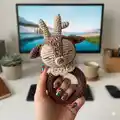
🧢 Beautiful ✨ Detailed πŸ’ Adorable

Rattle Deer Amigurumi Pattern

Rattle Deer Amigurumi Pattern
4.8β˜… Rating
2-4 Hours Time Needed
1.6K Made This
βœ‚οΈ

Intermediate Level

Ideal for those with basic crochet experience, featuring slightly more advanced stitches and techniques to expand your skills.

⏱️

Bite-Sized Project

Finishes in 2-4 hoursβ€”perfect for an afternoon of creative relaxation.

🎁

Tiny Treasure

Small, sweet, and gift-worthy creations that fit perfectly in the palm of your hand with detailed charm.

About This Rattle Deer Amigurumi Pattern

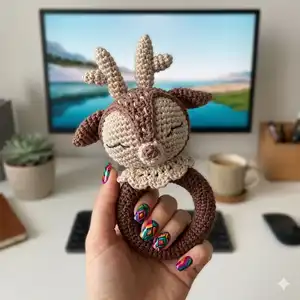
This pattern creates a sweet rattle deer amigurumi attached to a wooden ring β€” a perfect baby rattle and teether toy. Youll crochet the head, upper head piece, nose, horns, ears and a decorative collar, then assemble them around a wooden ring. The pattern includes clear round-by-round instructions and photo guidance for easy assembly. Techniques include working in a continuous spiral, invisible decreases and sewing small parts securely.

Rattle Deer Amigurumi Pattern crochet pattern - detailed view of completed project

Detailed step-by-step rounds guide you through shaping and finishing with recommended materials and substitutions. Photos show how to attach the upper head piece, embroider sleepy eyes and sew the head tightly to the wooden ring.

Why You'll Love This Rattle Deer Amigurumi Pattern

I absolutely love this pattern because it turns simple stitches into a tiny character full of personality. I enjoyed designing the layered upper head piece β€” it adds a lot of charm and hides the knots from embroidery. The rattle and wooden ring make it both tactile and practical, perfect for gifting to newborns. I also love how customizable it is β€” a few color changes and tiny accessories make each deer unique and special.

Rattle Deer Amigurumi Pattern step 1 - construction progress Rattle Deer Amigurumi Pattern step 2 - assembly progress Rattle Deer Amigurumi Pattern step 3 - details and accessories Rattle Deer Amigurumi Pattern step 4 - final assembly and finishing

Switch Things Up

I love customizing this pattern by changing colors to make seasonal or themed deer β€” try pastel shades for a baby shower or bright hues for a playful look.

If you want a larger rattle, I change to a thicker cotton yarn and a larger hook; conversely, a finer yarn and smaller hook make a dainty mini keychain version.

I often swap the wooden ring for a silicone teether ring if making the toy for teething babies, ensuring the silicone is food-grade and securely attached.

You can add embroidered freckles, a tiny bow, or a crocheted bowtie to give the deer more personality and make each piece unique.

I like to change the collar pattern to a simple scallop or picot edge for a different vintage or modern look β€” the collar is one of the easiest elements to personalize.

Try using variegated yarn for the upper head piece to create subtle stripes without extra sewing or color changes.

For a posable feel, I sometimes add a short piece of plastic-coated wire inside limbs or ears, but I only do this for display pieces and not for baby toys.

If you prefer safety eyes instead of embroidered eyes, choose ones with a strong washer and place them before stuffing, or keep embroidery for a fully baby-safe option.

I occasionally make matching sets by adjusting yarn colors so a whole nursery can have coordinating rattles, teethers and loveys.

When I want a luxe finish, I use a mercerized cotton or cotton blend for a smoother fabric and crisp stitch definition β€” it changes the look dramatically and is great for photo-worthy makes.

Common Mistakes & How to Fix Them

βœ— Working loosely around the wooden ring causes gaps and slipping fabric; keep tension firm and use a smaller hook for the rounds that go around the ring. βœ— Skipping stitch markers when working in continuous spiral leads to losing your beginning of round; place a marker or a contrasting yarn to mark the start of each round. βœ— Understuffing or overstuffing the head produces uneven shaping; stuff gradually, shaping as you go and use tweezers to push filling into tight places. βœ— Not counting stitches during increases and decreases creates uneven shaping; count stitches after each shaping round to ensure the correct stitch totals. βœ— Sewing parts on without pinning can result in asymmetry; pin or baste parts into position and check balance before permanently sewing.

Rattle Deer Amigurumi Pattern

Make an adorable rattle deer toy that fits perfectly in little hands. This pattern walks you through each step with clear rounds and photos so you can create a sweet, handmade baby rattle. Youll work small pieces like horns, ears, and a removable upper head piece to give the toy charming detail. Perfect for gifting or keeping as a treasured keepsake.

Intermediate 2-4 Hours

Materials Needed for Rattle Deer Amigurumi Pattern

β€” Main Fabric

  • 01
    Vita Cotton Lily 100% cotton, 1.75 oz/50g (approx 137 yds / 125 m) - 2 hanks (use proportions to match sample gauge)
  • 02
    Suggested substitute yarn: Scheepjes Catona (fingering / cotton) or Alpina Anabel
  • 03
    MC yarn (beige) - main body color, small amount for head and nose base (approx 80-90 yds / 75-80 m)
  • 04
    CC yarn (brown) - accent color for upper head, ears and collar (small amount approx 50-80 yds / 45-75 m)
  • 05
    Small amounts of contrast thread or yarn for embroidery (black floss for sleepy eyes)
  • 06
    Wooden ring (beech recommended) for the rattle attachment

β€” Tools Required

  • 01
    Crochet hook size 2.5mm (main work)
  • 02
    Crochet hook size 2.0mm (for working around wooden ring)
  • 03
    Wooden ring approx 2-3 in / 60-70 mm in diameter (beech recommended)
  • 04
    Rattle approx 1 in / 24-30 mm in diameter
  • 05
    Polyester stuffing
  • 06
    Scissors
  • 07
    Black embroidery floss or fingering weight yarn for eyes
  • 08
    Tapestry needle for sewing pieces and weaving ends
  • 09
    Stitch markers
  • 10
    Tweezers (optional) for stuffing into tight spaces
  • 11
    Pins for assembly (optional)

Progress Tracker

0% Complete

β€” Notes :

Info :

All pieces worked in a continuous spiral. Do not join to work in the rnd, just work sc in the next st. Place marker or use contrasting color yarn to mark beg of rnd. Use hook 2.5 mm or size matching your yarn and obtaining gauge. When work around the wooden ring, use smaller size hook, it will be easier to work.

β€” Working around the ring. Option 1 :

Info :

Work around the ring in a continuous spiral. The total number of sts depends on the size of your wooden ring and yarn. For my size ch10 using hook 2.5mm, then work around the ring using hook 2mm.

Info :

Join chain with sl st around the ring. Then sc in each st around. The first rnd is the most difficult. Then start to work in a continuous spiral, sc in each st. If it`s still uncomfortable to work, try to use smaller size hook. Pay attention to your tension, crochet around the ring tightly. If the fabric is moving loosely, rip it out and start over again with one st less.

Info :

Cont to work until the half or a bit less than half of the ring is covered. End with sl st. The beginning and the end of work should be inside of the ring. Weave in ends. Pull the end through the last rnd to tighten the fabric around the ring, and then pull it through the fabric inside the ring.

β€” Working around the ring. Option 2 :

Info :

If option 1 is too complicated for you, you can crochet a rectangle, working sc. For my ring size, ch20 and work for 9 rows. When the rectangle is finished, fold it over the ring and sew it, the fabric should be tight around the ring. The seam should be inside the ring. Weave in ends using tapestry needle.

β€” Head :

Info :

With MC work the head. Hereafter, the hook 2.5 mm

Round 1 :

6sc in magic ring (6)

Round 2 :

(inc) * 6 times (12)

Round 3 :

(inc, sc in next st) * 6 times (18)

Round 4 :

(inc, sc in next 2 sts) * 6 times (24)

Round 5 :

(inc, sc in next 3 sts) * 6 times (30)

Round 6 :

(inc, sc in next 4 sts) * 6 times (36)

Round 7 :

(inc, sc in next 5 sts) * 6 times (42)

Round 8 :

(inc, sc in next 6 sts) * 6 times (48)

Round 9-15 :

48sc (work even for 7 rnds) (48)

Round 16 :

(dec, sc in next 6 sts) * 6 times (42)

Round 17 :

(dec, sc in next 5 sts) * 6 times (36)

Round 18 :

(dec, sc in next 4 sts) * 6 times (30)

Round 19 :

(dec, sc in next 3 sts) * 6 times (24)

Info :

Stuff the head and put rattle inside.

Round 20 :

(dec, sc in next 2 sts) * 6 times (18)

Info :

Stuff the head tightly, for your convenience you can use tweezers.

Round 21 :

(dec, sc in next st) * 6 times (12)

Round 22 :

(dec) * 6 times (6)

Info :

Bind off rem 6 sts using a needle. Leave a long tail to sewing around a ring (approx 18-20in/45-50cm). The head is done.

β€” Upper head piece :

Info :

With CC work the upper head piece

Round 1 :

6sc into magic ring (6)

Round 2 :

(inc) * 6 times (12)

Round 3 :

(inc, sc in next st) * 6 times (18)

Round 4 :

(inc, sc in next 2 sts) * 6 times (24)

Round 5 :

(inc, sc in next 3 sts) * 6 times (30)

Round 6 :

(inc, sc in next 4 sts) * 6 times (36)

Round 7 :

(inc, sc in next 5 sts) * 6 times (42)

Round 8 :

(inc, sc in next 6 sts) * 6 times (48)

Round 9-13 :

sc in every st (work even for 5 rnds) (48)

Round 14 :

(dec, sc in next 6 sts) * 6 times (42)

Round 15 :

sc in every st (work 1 rnd even) (42)

Info :

Turn the piece and start to work flat.

Row 16 :

ch1, sc in next 6 sts, turn.

Row 17 :

ch1, sc in next 6 sts, turn.

Row 18 :

sc in next 5 sts starting from the 2nd st from the hook, turn.

Row 19 :

sc in next 4 sts starting from the 2nd st from the hook, turn.

Row 20 :

ch1, sc in next 4 sts, turn.

Row 21 :

sc in next 3 sts starting from the 2nd st from the hook, turn.

Row 22 :

sc in next 2 sts starting from the 2nd st from the hook, turn.

Row 23-25 :

ch1, sc in next 2 sts, turn.

Info :

Sc in every st to end of upper head piece. Sl st in next st, fasten off leaving a long tail approx 25-27 in (65-70 cm) for sewing to the head.

β€” Nose :

Info :

Work with MC yarn (beige).

Round 1 :

5sc into magic ring (5)

Round 2 :

(inc) * 5 times (10)

Round 3-5 :

sc in next 10 (work even for 3 rnds) (10)

Info :

Sl st in next st, fasten off leaving a tail for sewing.

Info :

With CC yarn (brown) work 6sc into magic ring for the nose tip, fasten off and sew it to the nose or embroider the tip of the nose using A yarn. Stuff the nose firmly.

β€” Horn :

Small horn (Make 2) :

With MC yarn work as foll: Rnd 1 - 6sc into magic ring = 6 sts. Rnd 2 - inc, sc in next 5 sts = 7 sts. Rnds 3-4 - sc in every st (work even for 2 rnds) = 7 sts. Sl st in next st, fasten off leaving a long tail for sewing. Stuff the horn. Rep for the 2nd horn.

Large horn (Make 2) :

With MC yarn work as foll: Rnd 1 - 6sc into magic ring = 6 sts. Rnd 2 - (inc, sc in next 2 sts) * 2 times = 8 sts. Rnds 3-10 - sc in every st (work even for 8 rnds) = 8 sts. Sl st in next st, fasten off leaving a long tail for sewing. Rep the same for the 2nd horn leaving longer tail approx 27in (70cm) to embroider the stripes above the nose. Stuff the horns.

β€” Ears (Make 2) :

Info :

With CC yarn work as foll:

Round 1 :

6 sc into magic ring = 6 sts

Round 2 :

(inc, sc in next 2 sts) * 2 times = 8 sts

Round 3 :

(inc, sc in next 3 sts) * 2 times = 10 sts

Round 4 :

(inc, sc in next 4 sts) * 2 times = 12 sts

Round 5 :

(inc, sc in next 5 sts) * 2 times = 14 sts

Round 6-9 :

sc in every st (work even for 4 rnds) = 14 sts

Info :

Sl st in next st, fasten off leaving a long tail for sewing to the head. Rep the same for the 2nd ear.

β€” Assembling :

Info :

Sew the nose to the head at level of row 6 from the last inc, attaching the upper head piece to the head, checking the right place for embroidering the nose. See photo-instructions for sewing the upper head piece and the nose.

Info :

Then outline the eyes and remove the upper head piece. With black embroidery floss or fingering weight yarn embroider sleepy eyes. You can bring the needle from the back side of the head. The upper head piece will hide all the knots, when attaching it. Embroider the eyes as it`s shown on the photo, mirror the 2nd eye. Pay attention to the symmetrical position of the eyes regarding to the nose. For your convenience attach the upper head piece. When eyes are finished, secure the thread on the back of the head and cut it.

Info :

Now sew the upper head piece. Attach it as it`s shown on the photo and sew it to the head around the edge.

Info :

Then sew small horns pieces to the large ones. Sew the horns to the head as it`s shown on the photo. Using a long tail, randomly embroider stripes on the nose. Check photo-instructions.

Info :

Fold ears as it`s shown on the photo and fix them in such position, then sew them to the head counting approx 2 sts from the horns. Mirror the same for the 2nd ear. The head is done.

Info :

With MC yarn tail sew the head to the wooden ring. When you sew the head to the ring, push it slightly, the neck shouldn`t be too thin. The head should be tightly attached to the ring, I recommend to sew it around twice.

β€” Collar :

Info :

Now make a collar.

Info :

With MC yarn ch22. Then work flat as foll:

Row 1 :

sc in 2nd st from the hook, sc in next 20 sts, turn.

Row 2 :

ch4, dc in 1st st, [sk1, dc in next st, ch1, dc in the same st] 10 times, turn.

Row 3 :

ch2, 2 dc in next ch space, sc in next st, [5 dc in next ch space, sc in next st] 10 times, 3 dc in last post. The collar is ready. Sew it as it`s shown on the photo.

Assembly Instructions

  • Sew the nose to the head at the level of row 6 from the last increase, ensuring it sits centered and secure before adding the nose tip.
  • Attach the upper head piece around the edge of the head, matching the photo reference and hiding embroidery knots under the piece.
  • Sew small horn pieces to the large horns, then attach horns to the top of the head and embroider stripes on the nose using the long tail.
  • Fold and position ears approximately 2 stitches from the horns, pin and sew each ear symmetrically to the head.
  • Sew the completed head to the wooden ring with the MC yarn tail, pushing slightly so the neck is not too thin and sewing around twice for security.
  • Make and sew the collar to the neck area as shown, using the three-row shell pattern and attaching neatly around the edge.

Important Notes

  • πŸ’‘Use stitch markers to mark the beginning of the round when working in continuous spiral to avoid losing track of rounds.
  • πŸ’‘Work tightly around the wooden ring and use the smaller hook for the ring rounds to prevent loose fabric and gaps.
  • πŸ’‘Stuff the head gradually and firmly, using tweezers to push stuffing into narrow areas for even shaping.
  • πŸ’‘Pin all parts in place before sewing to ensure correct positioning and symmetry; sew securely with a tapestry needle.

This tiny rattle deer is a delightful handmade keepsake you can make in an afternoon. Its layered head piece, tiny horns and embroidered sleepy eyes give it a ton of charm. Perfect for baby gifts, market stalls, or just because you love to crochet. 🧢🎁

You ask,

we answer.

FAQs

What size will the finished piece be?

The finished amigurumi rattle measures approximately the size of the wooden ring used (2-3 in / 60-70 mm), with the head sitting above it, so total height is roughly 9-12 cm depending on yarn and tension.

Can I use a different yarn weight for this pattern?

Yes, but it will change the final size; if you change yarn weight, adjust hook size accordingly and be prepared to modify the number of stitches around the ring or for the head to match proportions.

Do I need prior crochet experience for this pattern?

This pattern is rated Intermediate and assumes familiarity with working in continuous spiral, magic ring, increases and invisible decreases, as well as basic sewing techniques.

How long does this project typically take to complete?

Most crocheters complete this project in 2-4 hours, though time may vary based on experience, sewing and embroidery detail.

How should I attach the rattle safely?

Place the rattle inside the head before closing and secure the stuffing so the rattle cannot come loose; for baby-safe toys, ensure all parts are sewn tightly and avoid small detachable pieces for very young infants.