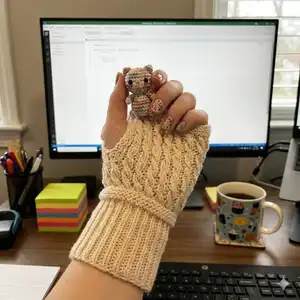
Keep your hands warm in style with these chic, customizable fingerless gloves. This pattern features a stretchy ribbed cuff and an elegant alpine stitch body that flatters every hand. You can make short or extended cuffs and follow clear, step-by-step instructions to get a polished finished pair. Perfect for gifting or a quick craft fair project.
Progress Tracker
0% Complete
— Cuff (3.5mm hook) :
Info :
The short and extended cuffs only differ in terms of the length of the foundation chain. Work rows marked A for the short cuff, or rows marked B for the extended cuff. The foundation chain can be made shorter or longer, as per preference. Note: Work SL STS loosely. Leave a long beg tail to use for joining later.
Row 1A (short cuff) :
CH 9 (9, 10, 11, 11), working in the top loop of CH, SL ST in 2nd CH from hook and in each CH across. Turn. (8, 8, 9, 10, 10 SL ST)
Row 2A :
CH 1, bloSLST in each SL ST across. Turn. (8, 8, 9, 10, 10 bloSLST)
Row 1B (extended cuff) :
CH 21 (23, 25, 27, 29), working in the top loop of CH, SL ST in 2nd CH from hook and in each CH across. Turn. (20, 22, 24, 26, 28 SL ST)
Row 2B :
CH 1, bloSLST in each SL ST across. Turn. (20, 22, 24, 26, 28 bloSLST)
Info :
Repeat row 2 until the cuff fits snugly around the wrist. End with an even number of rows. Note how many rows you work so you can repeat for the other glove. Sample shows a cuff with 64 rows for a wrist circumference of 16 cm (6¼”). Do not fasten off. Move to Body.
Info :
Note: The last ST in the row is easy to miss (photo 1), mark it so you don't accidentally skip it. Every couple of rows stop and pull the band horizontally to even out the stitches since they tend to tighten up (photos 2 & 3).
— Body (5mm hook) :
Info :
Note: From row 1 onward, the total ST count does not change. Rotate your work so that you are now working in the row ends.
Row 1 (RS) :
CH 1 and place 20 (24, 28, 32, 36) SC evenly across, working in between each of the ribbing ridges (photo 4). Turn. (20, 24, 28, 32, 36 ST)
Info :
Note: If you find it difficult to insert main hook through the gaps in between the bloSLST rows, use a smaller hook for Row 1 and work the SCs loosely (e.g., 4mm instead of 5mm).
Row 2 :
CH 1, SL ST in 1st ST and in each ST across. Turn.
Row 3 :
CH 1, bloSLST in 1st ST and in each ST across. Turn.
Info :
Important note: The length of the horizontal ribbing created in rows 2-6 should align with the ribbed cuff – it shouldn't pull the cuff in. In other words, the horizontal ribbing detail should never be narrower than the ribbed cuff when laid flat on the table. Otherwise, it will pull the glove in after seaming, which will make it difficult to fit around the wider part of the hand and sit too tightly around the wrist. Go to Adjustment Ideas for suggestions on how to avoid this.
Row 7 :
CH 2, bloDC in 1st ST and in each ST across. Turn.
Row 8 :
CH 1, SC in 1st ST and in each ST across. Turn.
Row 9 :
CH 2, FPDC around first DC from 2 rows below, SK 1st SC from prev row and DC in next SC, *FPDC around next DC from 2 rows below, SK next SC from prev row and DC in next SC. Repeat from * across. Turn.
Row 10 :
CH 1, SC in 1st ST and in each ST across. Turn.
Row 11 :
CH 2, DC in first SC from prev row, SK next FPDC from 2 rows below and FPDC around next DC, *DC in next SC from prev row, SK next FPDC from 2 rows below and FPDC around next DC. Repeat from * across until 2 STS rem. DC in last 2 STS. Turn.
Row 12 :
CH 1, SC in 1st ST and in each ST across. Turn.
Size 1 only :
Repeat rows 9-11, 1 more time. Go to row 17.
Size 2 only :
Repeat rows 9-11, 1 more time. Go to row 13.
Size 3 only :
Repeat rows 9-12, 2 more times, ending last rep at row 11 (7 total rows). Go to row 13.
Size 4 only :
Repeat rows 9-12, 3 more times, ending last rep at row 9 (9 total rows). Go to row 13.
Size 5 only :
Repeat rows 9-12, 3 more times, ending last rep at row 11 (11 total rows). Go to row 13.
Info :
Note: If making a custom length, end the alpine pattern either on row 9, or on row 11 and account for 1 cm (3/8”) for rows 13-17. Note how many rows you work so you can repeat for the other glove.
Rows 14-17 :
Repeat row 3.
Info :
Your last row will be on the WS. Fasten off, leaving a long tail and go to Assembly.
— Assembly :
Info :
We will now join the two sides of the glove using the mattress stitch.
Step 1 :
Fold the glove with RS facing out and use the beg tail to join together the ribbing, going through both loops of the last row of ribbing and both loops of the foundation chain. We're joining the ribbing on the RS in order to get a cleaner seam (see photos 5 and 6).
Step 2 :
Turn the glove inside out and fold it again. Roughly separate the glove in thirds using stitch markers (photo 7). Try the glove on at this point and adjust the placement of the stitch markers to find the best position of the thumb opening (photo 8).
Step 3 :
Continue using the beg tail to join the edges up to the first stitch marker. Still working with WS facing out, use the finishing tail to join the edges up to the second stitch marker.
Step 4 :
Check that the hole created fits the thumb comfortably and make any necessary adjustments. When you are happy with the fit, seam the edges again going in the opposite direction for a more secure join. Fasten off and go to Thumb.
— Thumb :
Thumb :
With RS facing out and using your main hook, join yarn with a SL ST anywhere along the open edge, CH 1 and place 2 SC in the side of every DC row and 1 SC in the side of every SC row. Go around and SL ST in top of 1st SC. Fasten off, weave in ends.
— Adjustment Ideas :
Info :
After assembly, the horizontal ribbing (rows 2-6) should sit snugly on the wrist and be stretchy enough to fit over the wider part of the hand. When laid flat, rows 2-6 of the body should have roughly the same width as the length of the ribbed cuff. If this section tends to pull the glove in, making it uncomfortable/difficult to fit around the wrist, try one or all of the following:
A :
Crochet rows 2-6 extra loosely, going up a full hook size if needed.
B :
Block the horizontal ribbing more aggressively to gain some stretch.
C :
If rows 2-6 still tend to taper in, modify the stitch count, like so: 1. Take your total row count for the ribbed cuff (let's say 48 for a hypothetical size 1), divide it by 2 and work that many stitches on rows 1-6 (24 STS). 2. On row 7, place as many bloDC2TOGs as you need in order to return to the stitch count written in the pattern for your size. In the example above, we need to work 4 bloDC2TOGs in order to return to the initial stitch count of 20. 3. Place the decreases so that the FPDCs from row 9 are worked around them. The corresponding written instructions in our example will look like this: Row 7: CH 2, bloDC2TOG, DC in next 7 STS, bloDC2TOG, DC in next 5 STS, bloDC2TOG, DC in next 3 STS, bloDC2TOG, DC in last ST (20 sts).
Info :
Below are 2 examples of how your glove should look like prior to seaming. Note how the horizontal ribbing is never narrower than the cuff.
— Consolidated Pattern :
Info :
Cuff (3.5mm hook) The short and extended cuffs only differ in terms of the length of the foundation chain. Work rows marked A for the short cuff, or rows marked B for the extended cuff. The foundation chain can be made shorter or longer, as per preference. Note: Work SL STS loosely. Leave a long beg tail to use for joining later.
Row 1A (short cuff) :
CH 9 (9, 10, 11, 11), working in the top loop of CH, SL ST in 2nd CH from hook and in each CH across. Turn. (8, 8, 9, 10, 10 SL ST)
Row 2A :
CH 1, bloSLST in each SL ST across. Turn. (8, 8, 9, 10, 10 bloSLST)
Row 1B (extended cuff) :
CH 21 (23, 25, 27, 29), working in the top loop of CH, SL ST in 2nd CH from hook and in each CH across. Turn. (20, 22, 24, 26, 28 SL ST)
Row 2B :
CH 1, bloSLST in each SL ST across. Turn. (20, 22, 24, 26, 28 bloSLST)
Info :
Repeat row 2 until the cuff fits snugly around the wrist. End with an even number of rows. Note how many rows you work so you can repeat for the other glove. Sample shows a cuff with 64 rows for a wrist circumference of 16 cm (6¼”). Do not fasten off. Move to Body. Note: The last ST in the row is easy to miss (photo 1), mark it so you don't accidentally skip it. Every couple of rows stop and pull the band horizontally to even out the stitches since they tend to tighten up (photos 2 & 3).
Body (5mm hook) :
Note: From row 1 onward, the total ST count does not change. Rotate your work so that you are now working in the row ends.
Row 1 (RS) :
CH 1 and place 20 (24, 28, 32, 36) SC evenly across, working in between each of the ribbing ridges (photo 4). Turn. (20, 24, 28, 32, 36 ST)
Row 2 :
CH 1, SL ST in 1st ST and in each ST across. Turn.
Row 3 :
CH 1, bloSLST in 1st ST and in each ST across. Turn.
Row 7 :
CH 2, bloDC in 1st ST and in each ST across. Turn.
Row 8 :
CH 1, SC in 1st ST and in each ST across. Turn.
Row 9 :
CH 2, FPDC around first DC from 2 rows below, SK 1st SC from prev row and DC in next SC, *FPDC around next DC from 2 rows below, SK next SC from prev row and DC in next SC. Repeat from * across. Turn.
Row 10 :
CH 1, SC in 1st ST and in each ST across. Turn.
Row 11 :
CH 2, DC in first SC from prev row, SK next FPDC from 2 rows below and FPDC around next DC, *DC in next SC from prev row, SK next FPDC from 2 rows below and FPDC around next DC. Repeat from * across until 2 STS rem. DC in last 2 STS. Turn.
Row 12 :
CH 1, SC in 1st ST and in each ST across. Turn.
Size notes :
Size 1 only: Repeat rows 9-11, 1 more time. Go to row 17. Size 2 only: Repeat rows 9-11, 1 more time. Go to row 13. Size 3 only: Repeat rows 9-12, 2 more times, ending last rep at row 11 (7 total rows). Go to row 13. Size 4 only: Repeat rows 9-12, 3 more times, ending last rep at row 9 (9 total rows). Go to row 13. Size 5 only: Repeat rows 9-12, 3 more times, ending last rep at row 11 (11 total rows). Go to row 13.
Rows 14-17 :
Repeat row 3. Your last row will be on the WS. Fasten off, leaving a long tail and go to Assembly.
Assembly :
Fold the glove and join the ribbing and sides using mattress stitch and the beg tail; fold and mark thirds to determine thumb placement; join edges up to stitch markers with beg and finishing tails; adjust hole for thumb and seam again in opposite direction for secure join. Fasten off.
Thumb :
With RS facing out, join yarn with a SL ST anywhere along the open edge, CH 1 and place 2 SC in the side of every DC row and 1 SC in the side of every SC row. Go around and SL ST in top of 1st SC. Fasten off, weave in ends.
These Cosmopolitan fingerless gloves are a quick and rewarding make that blend cosy function with pretty texture. Make them in matching hat and cowl sets or in contrasting colours for a fun twist. They are perfect for gifts, craft fairs, or a special treat for yourself. 🧶✨