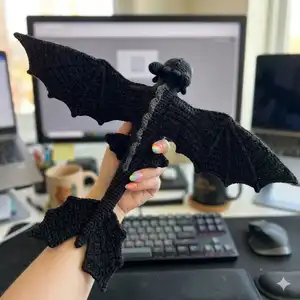
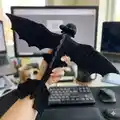
Bring the beloved dragon Toothless to life with this full-size plush pattern and sewing instructions. You will learn how to cut, sew, stuff and finish large wings, fins and detailed features using quilt batting and standard sewing tools. The pattern includes templates, tips for working with black fabric, and instructions for interchangeable tail fins with magnets for playful customization. Perfect for an ambitious maker who wants a dramatic, display-worthy plush.
Progress Tracker
0% Complete
— How to print the pattern document :
Step 1 :
Open the pattern document with Adobe Acrobat Reader/Pro DC. If you do not have this program installed yet, you can download it here: https://get.adobe.com/uk/reader/.
Step 2 :
Once the document is opened, go to Files > Print. In the Print dialog box, click the Poster button in the Page Sizing & Handling section.
Step 3 :
From there, apply the options described below: Tile Scale – Make sure this is on 100% if you want the original pattern size! Overlap – to determine the amount each tile overlaps the adjacent tiles. Giving some overlaps will help you put all pages together easier later on. Cut marks – to add guide marks to each page that help you trim the overlap (Optional). Labels – to add the filename and page number on each separate page (Optional). Please note that the Overlap, Cut marks and Labels functions can cause the need for extra pages. Check the overview on the window to see what works best for you with a minimal amount of pages!
Step 4 :
Click the Print button once all set. If you are using a different program where this is possible, you might want to print just the page with the scale on it first to check if it is correct, before printing the whole pattern. You can choose to print in colour or black & white, since the pattern document supports both and therefore will not cause any problems related to colour.
— Getting to know the pattern document :
Info :
Scale: To check if your pattern is printed at its original size (100%) and in the right proportions, measure the scale-square both in horizontal and vertical direction. If both sides are 2 inches in length, your print is successful!
Info :
Direction of fabric hairs: Every pattern piece has an orange arrow on it. This arrow is an indicator for the alignment of the pattern piece on your fabric. If you are using a hairy fabric like minky, align the pattern piece so that the arrow points in the same way as the hairs of your fabric.
Info :
Seam allowance: Every pattern piece is surrounded by three different lines. Each line represents a different amount of seam allowance that is included to the original pattern piece. You can choose between the listed allowances if you want to cut the fabric pieces directly alongside the pattern piece, or add your own allowance around the original piece, which are of course the solid lines.
Info :
Body A: Along the bottom side of the tail in the 'Body A' piece, there are blue marks that indicate where all the tailfins start and end. There should be enough space for 'Fin A', 'Fin B' and the small tail fins. Two marks closest to the legs show the placement of 'Fin A' and two marks at the end of the tail show the placement of 'Fin B'.
Info :
The text along the shape in the center of the body (wing profile) explains that it is very important to mark this shape onto your fabric before starting to sew, since this will later determine the placement of the wing in the body. (The grey part will be a hole for the 'shoulder' of the wing. This is sewn in a circle so that the shoulder can be stuffed from the body, giving the wing a firm base.)
Info :
Wing: The wing has a green line which indicates a second edge of the pattern piece. The wing has a top piece, which includes the darker part on the right side of the green line. The wing also has a bottom piece, but this piece ends after the green line and excludes the darker part. Both pieces can be cut including this part first, as it is best to cut off the part of the bottom piece just before sewing the wing into the body. Do not forget to take into account seam allowance while cutting for the bottom piece!
Info :
Wing decorative lines: The wing has a lot of decorative lines that will give shape to the wing; these are the lines that will be top-stitched once making the wings. Because you will be sewing over the wing that is stuffed with the quilt batting, your wing will get a lot more definition.
— Preparing the pieces :
Info :
How to cut the pieces from the fabric: Since you will need at least one original and one mirrored piece of fabric for almost each pattern piece, the easiest way to cut is to fold the fabric in half, with the right sides together (hairs of the fabric on the inside). This way you will automatically get one original and one mirrored piece that fit together perfectly.
Info :
Amount of pieces needed: Follow the table provided in the pattern to cut the correct number of originals and mirrored pieces. Cut one set from black fabric and one set from blue fabric for marked pieces where indicated. Fin B sets: cut 4 sets: 2x black fabric, 1x red and 1x brown for all tail fin options.
— A few tips before sewing :
Info :
Work Precisely: For the best results, working precisely is important. Use a pen or chalk to trace the original pattern piece (without seam allowance) on the backside of the fabric. For difficult parts, precisely sew these lines together using basting thread and stitching by hand first, then go over with the machine.
Info :
Prevent mistakes by double checking: Always double check cutting direction, folding the fabric correctly and sewing edges that need to remain open to avoid mistakes such as sewing two pieces together the wrong way around.
Info :
Prevent movement while sewing: Use basting thread and a needle at first to hold pieces together, especially with stretchy or hairy fabrics. Pins work only when pieces are the same shape and fit perfectly aligned.
Info :
Keep wrinkles away from your seamline: With opposite round shapes you will get folds; push folds away from the seam line before sewing under the presser foot for smooth seams.
Info :
Cut away excess seam allowance around sharp corners: Trim seam allowance carefully and clip corners as close as possible without cutting the seam to get crisp edges when turned right side out.
Info :
Always sew the right sides together: When sewing pieces together you should always face the wrong sides out while stitching, so the finished piece will show the right sides on the outside after turning.
— Part 1: The head :
Info :
Eyes & Nose: There are many ways you can use to create the eyes and nose on the side pieces of the head. If you have an embroidery machine you can use that, but if you do not, embroidering the eyes and nose by hand will probably give the best results. If you do not feel comfortable with embroidery, you can use fabric or paint to create the look you wish.
Info :
Spikes & Ears Step 1: For the spikes, take two pieces, one original and one mirrored, and sew them right sides together, leaving open the end that needs to be attached to the side of the head later. Sew along the orange lines shown once pieces are on top of each other with right sides together.
Step 2 :
For the ears, start by taking the three back pieces of the ear. Sew both the left and the right piece to the center piece as shown. Since you will be sewing them right sides together, the pieces will bend in opposite directions; pay attention to wrinkles when sewing.
Step 3 :
Now that the back piece of the ear is complete, take the front piece and sew the front and back pieces right sides together. They should fit on top of each other and lay fairly flat. Sew along the orange line shown. The right ear is now complete; mark each ear when finished to tell left from right.
Info :
Assembly of the head Parts needed: Ears, Head back, Head sides (including eyes & nose), Head top, Spikes (Side, top & head).
Step 1 :
Start by taking the two side pieces and cutting them in the shape of the actual pattern piece. Put them right sides together and sew along the shortest edge as shown in the figure.
Step 2 :
Next, take the top pieces and sew them right sides together, with the head spikes in between. Make sure the spikes are trimmed and turned right sides out before sewing them in between. Align the row of spikes so they seem to stand apart; sew along the line drawn, preferably a few millimetres more towards the left than the right.
Step 3 :
As the top of the head is now ready, you can sew it to the completed side pieces.
Step 4 :
Then take the back piece and sew that to the edges of the top and side of the head, leaving the holes for the ears and spikes open. Only sew the little lines that create holes for the ears and top spikes, as shown in the figure.
Step 5 :
Take the ears and top spikes and sew them right sides together to the head. Turn them so the right sides are out and line up the inner side of the ear to the corresponding inner side of the head so the front of the ear will be attached to the head top piece. Sew in a circle so ears and spikes can be stuffed together with the head. For spikes, sewing these small circles by hand may be easier.
Step 6 :
For the side spikes, they need to be partly sewn between the side and head back pieces. Line them up right sides together and sew the remaining parts of the head back piece to the head side pieces with the spikes in between. Leave the holes meant for the two biggest side spikes unsewn so they can be stuffed from the head later.
Info :
When you have attached both the ears and the spikes, the outer edge of the 'Head back' piece should be fully attached. The preparation of the head is now finished!
— Part 2: Wings and fins :
Info :
How to work with polyester quilt batting: For this pattern you will need polyester quilt batting. The material gives you the ability to create firmer wings with beautiful detailing. For this Toothless pattern, a double layer of the thickest type was used. A medium thickness will keep tailfins flexible; thicker batting will give more depth. Thicker batting can make top-stitching more difficult to keep flat on the back side.
Info :
Once you have your material and fabric pieces ready, lay them on top of the quilt batting and cut exactly around the edges so fabric and batting fit on top of each other perfectly. The following pieces need quilt batting: Back fins (1 layer), Fin A (2), Fin B (2), Fin foot (1), Small tail fins (1), Wing (2).
Info :
How to add detail: You will need a random color of sewing thread that stands out on your fabric, or basting thread. Trace black lines on pattern pieces of wings and fins and use the sewing machine to top-stitch the guidelines after turning parts right sides out. For double lines make one guideline and use a double needle or sew one line, remove guideline, then sew second line next to it.
Info :
Sewing the wings Step 1: To make a wing, make sure an original and mirrored wing piece are laying right sides together on top of the quilt batting. Sew around the edges as shown, leaving open the edge that will be attached to the body later.
Step 2 :
Now flip the wing so the right sides are out and start sewing the guidelines by hand. After that, go over with your sewing machine. The lines you should top-stitch onto the wing are the orange lines shown in the figure.
Step 3 :
Do the same thing for the other wing.
Info :
Sewing the fins - Back fins Step 4: For the back fins, split all of the pieces in two sets. Each set consists of a blue and black fabric piece that fit right sides together and a single layered quilt batting piece. When pieces are laid as original pattern (not mirrored), one should have blue piece on top and the other the black piece to create left and right parts. Sew along the edge of each piece.
Step 5 :
Before flipping right sides out, place/glue your magnets at the top corners of the fins on the blue fabric, so magnets of the left and right piece will bring the blue inner sides together. When magnets are secured, trim and turn pieces.
Step 6 :
Small tail fins: For the tail fins that are on the side of the tail, take a set of two fabric pieces and one piece of single layered quilt batting and sew along the outer edge. Trim excess fabric in corners and flip right sides out.
Step 7 :
Fin A: This fin is done in the exact same way as the wings. Put two pieces right sides together on top of the quilt batting, sew around the edges leaving open the edge that will be attached to the body later. Flip right sides out and add detail lines with guidelines and the sewing machine.
Step 8 :
Fin B: Follow the same method one more time for the brown and black 'Fins B'.
Step 9 :
For the red interchangeable tail fin, take the white skull appliqué first. Top-stitch with a zig-zag stitch on the original 'Fin B' piece, not the mirrored one.
Step 10 :
Put the piece with the appliqué back in place with the quilt batting and the mirrored piece, and sew them together like the other fins. Flip them right sides out and sew over the skull when adding the detail.
Step 11 :
Take all of the 'Bands A, B & C' pieces. The black interchangeable fin will get black bands. The brown and red fins will both get brown bands. Start by taking all of the 'Bands B' and 'Bands C' and sew them right sides together, leaving the left edge open.
Step 12 :
Turn the bands right sides out. If you want to install the buttons/snaps partly from the inside, do this now.
Step 13 :
Then take two 'Band B' and two 'Band C' parts and place them in between the 'Band A' pieces as shown. Sew along the outer edges (top, bottom and right) of 'Band A'.
Step 14 :
Flip the Band A piece right sides out and put it around the open edge of 'Fin B'. Fold seam allowance inwards on both sides and top-stitch the left side of 'Band A' into place.
Step 15 :
Repeat steps 13 and 14 for the other 2 'Fins B'. The wings and fins are now ready.
— Part 3: Legs :
Preparing the nails Step 1 :
Sew one line to create the nails on their pattern piece. It is easiest to draw the line on the fabric first. Cut into sets of four and trim away as much of the extra fabric around the nails as possible, except for the horizontal edges of the nails, as you will still need the allowance there.
Preparing the fins Step 2 :
Take two pieces, put them right sides together on top of the quilt batting and sew around the outer edge. Trim the allowance on the outer sides. Do the same for the other front legs' fin.
Assembly of the legs Info :
Parts needed: Fins Foot, Foot (bottom pieces), Front Legs, Hips, Nails, Rear Legs.
Step 3 :
Sew the Front Legs right sides together, placing the fin piece in between so that the right sides of the fins are against the right sides of the leg and the fin piece is inside the leg. Leave the bottom part and 'outside' part open.
Step 4 :
Take the bottom pieces 'Foot'. Sew these right sides together to the bottom of the legs, with the point facing to the back of the leg. Place the nails in between the two pieces following the same way used for the fins, pointing nails inside the leg with right sides of the nails together with the right sides of the leg pieces.
Info :
Place nails so you are sewing over the ends of every nail again, not over the allowance, as that will give Toothless nails that are attached to each other.
This Toothless plush pattern is a labor of love designed to create a dramatic, display-quality dragon with realistic wing ribs and interchangeable fins. The detailed instructions walk you through cutting, batting, sewing and finishing for an impressive final result. Whether youre making it as a gift or a centerpiece, this plush will inspire smiles and stories. 🐉🧵