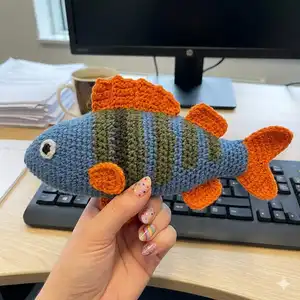
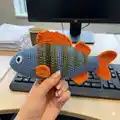
Make a cozy, graphic crochet sweater featuring a bold intarsia fish motif. This pattern guides you through panels, graphing, neckline shaping, sleeves, and ribbing with clear instructions and helpful sizing notes. Youll learn HDC construction, carrying yarn vs intarsia techniques, and how to center the fish graph for any size. Wearable, comfortable, and highly customizable — perfect for making a handmade wardrobe staple.
Progress Tracker
0% Complete
— Front panel :
Foundation row :
CH (55, 61, 68, 76, 82, 88, 97, 103, 109).
R1 :
HDC in the third CH from your hook. HDC until the end of the row for a total of (53, 59, 66, 74, 80, 86, 95, 101, 107) STS. CH 2 and TO.
R2 :
HDC in each ST until the end of the row. CH2 and TO.
For sizes XS-S :
Repeat R2 20 times, for a total of 22 rows.
For sizes M-L :
Repeat R2 24 times, for a total of 26 rows.
For sizes XL-2XL :
Repeat R2 30 times, for a total of 32 rows.
For sizes 3XL-4XL :
Repeat R2 36 times, for a total of 38 rows.
For size 5XL :
Repeat R2 42 times, for a total of 44 rows.
Info :
Now we start the fish graph. There are two sizes of the graph: a bigger fish and a smaller one. Recommendation: sizes XS–M use the smaller graph; sizes L and up use the bigger graph to ensure padding on the sides so the fish is visible when panels wrap around.
Info :
The bigger fish measures 34cm in width and 18cm in height. The smaller fish measures 28cm in width and 16cm in height.
Info :
It is important that you start the fish on an odd row: XS/S: 23, M/L: 27, XL/2XL: 33, 3XL-4XL: 39, 5XL: 45.
— Smaller fish graph (XS, S, M) :
Graph info :
The smaller fish is 39 STS wide and 16 R tall. To center placement, detract 39 from your number of STS and divide that number by 2. The final number is the STS from each side (left and right) before referring to the graph.
Example :
Size XS is 53 STS wide. 53 – 39 = 14. 14/2 = 7. There should be 7 STS of your background color on each side of the graph.
On an odd row :
(23, 23, 27), with your foundation chain tail facing left: HDC (7, 10, 13). Enter graph, starting at bottom right.
During graph :
After the 39th HDC of each row, HDC (7, 10, 13) until end of the row. Repeat for 16 rows, until the end of the graph.
Exit graph :
Exit graph and HDC in each STS for 14 rows, for a total of (52, 52, 56) rows.
— Bigger fish graph (L and up) :
Graph info :
The bigger fish is 47 STS wide and 21 R tall. To center placement, detract 47 from your number of STS and divide that number by 2. The final number is the number of STS from each side (left and right) before referring to the graph.
Example :
Size L is 74 STS wide. 74 – 47 = 27. 27/2 = 13.5. Make 13 STS on one side and 14 STS on the other to center the graph.
On an odd row :
(27, 33, 33, 39, 39, 45) with your foundation chain tail facing left: HDC (13, 16, 19, 24, 27, 30). Enter graph starting at bottom right.
During graph :
After the 47th HDC of each row, HDC (14, 17, 20, 24, 27, 30) until the end of the row. Repeat for 21 rows until the end of the graph.
Exit graph :
Exit graph and HDC in each STS for 9 rows, for a total of (56, 62, 62, 68, 68, 74) rows.
— Bigger fish graph cont. :
Note :
If you get a fraction when you calculate fish placement and divide your STS count in two, e.g. 66 - 39 = 27 and 27/2 = 13.5, then HDC 13, enter graph, then HDC 14 after you exit the graph. Since the fish is not symmetrical, one stitch difference from the center won't be visible.
— Neckline shaping – Front :
Start neckline :
At row (53, 53, 57, 57, 63, 63, 69, 69, 75) we will start the neckline shaping/shoulder extensions. The shoulder extensions are worked separately, meaning you do the left and right side one at a time.
Step 1 :
HDC (19, 22, 25, 29, 32, 35, 40, 43, 46). CH2 and TO.
Step 2 :
HDC2TOG. HDC until the end of the row. CH2 and TO.
Repeat :
Repeat step 1 and 2 for 8 rows, alternating between decreases. At the end of row 8, fasten off.
Make other side :
To make the other side, count STS from the edge and add a stitch marker in the (19, 22, 25, 29, 32, 35, 40, 43, 46)th ST. Attach your yarn by your stitch marker.
Attach yarn step 1 :
HDC until the end of the row (19, 22, 25, 29, 32, 35, 40, 43, 46). CH2 and TO.
Attach yarn step 2 :
HDC until there are two STS left on the row. HDC2TOG. CH2 and TO.
Repeat :
Repeat step 1 and 2 for 8 rows, alternating between decreases. At the end of row 8, fasten off.
Info :
You should have a total of (60, 60, 64, 64, 72, 72, 78, 78, 84) rows for the front panel after neckline shaping.
— Back panel :
Info :
The back panel is the same as the front, minus the fish graph. You may add text or a graph on the back or keep it simple.
Foundation row :
CH (55, 61, 68, 76, 82, 88, 97, 103, 109).
R1 :
HDC in the third CH from your hook. HDC until the end of the row for a total of (53, 59, 66, 74, 80, 86, 95, 101, 107) STS. CH 2 and TO.
R2 :
HDC in each ST until the end of the row. CH2 and TO.
For sizes XS-S :
Repeat R2 54 times, for a total of 56 rows.
For size M-L :
Repeat R2 58 times, for a total of 60 rows.
For sizes XL-2XL :
Repeat R2 66 times, for a total of 68 rows.
For sizes 3XL-4XL :
Repeat R2 72 times, for a total of 74 rows.
For size 5XL :
Repeat R2 78 times, for a total of 80 rows.
Info :
... or repeat for however many rows you made your front panel, minus four (for the back panel's shoulder extensions).
— Neckline shaping – Back :
Start back neckline :
At row (57, 57, 61, 61, 69, 69, 75, 75, 81) we will start the neckline shaping/shoulder extensions for the back panel.
Step 1 :
HDC (17, 20, 23, 27, 30, 33, 38, 41, 44). CH2 and TO.
Step 2 :
HDC2TOG. HDC until the end of the row. CH2 and TO.
Repeat :
Repeat step 1 and 2 for 4 rows, alternating between decreases. At the end of row four, fasten off.
Make other side :
To make the other side, count STS from the edge and add a stitch marker in the (17, 20, 23, 27, 30, 33, 38, 41, 44)th ST.
Attach yarn :
HDC until the end of the row. CH2 and TO. HDC until there are two STS left on the row. HDC2TOG. CH2 and TO.
Repeat :
Repeat step 1 and 2 for 4 rows, alternating between decreases. At the end of row four, fasten off.
Info :
You should have a total of (60, 60, 64, 64, 72, 72, 78, 78, 84) rows for the back panel after shaping.
— Joining the panels :
Shoulder joining :
When you've finished your two panels, seam them together at the shoulders. You may either SL ST them together or sew them together, whichever you prefer.
— Collar :
Start collar :
After you've joined the panels, attach your yarn anywhere on your neckline. CH 1 and SC around. Make two rows of SC and SL ST to your starting point.
Foundation row :
CH 6 ST or however tall you want your collar to be.
Collar Row 1 :
Starting from the 2nd CH from hook, SC in the BLO until the end of the row (5). SL ST in the next two STS. TO.
Collar Row 2 :
SC in the BLO until the end of the row (5). CH1 and TO.
Collar Row 3 :
SC in the BLO until the end of the row (5). SL ST in the next two STS. TO.
Repeat :
Repeat step 2 and 3 until your collar reaches around. Make sure you can fit your head through!
— Sleeves :
Prepare sleeve opening :
SL ST the two panels together going from the bottom up to create the armhole. Modify how loose/tight you want the sleeve to be on your armpit. When satisfied, SC around the hole, slip stitching into the first ST. This will be your base.
Row 1 :
HDC in each ST. SL ST into the first ST. TO.
Repeat :
Repeat Row 1 until you reach the sleeve length you wish. Repeat for the other side.
— Ribbing and arm cuffs :
Ribbing instructions :
This is how you make the ribbing: 1. CH to the desired height of ribbing + 1. 2. HDC in each CH. 3. HDC in the BLO of each ST. 4. Repeat until ribbing reaches around both panels.
Attach ribbing :
When you have your ribbing, attach it to the bottom of the sweater by SL ST or by sewing. Sewing gives a flatter finish if you prefer.
Cuffs :
For the cuffs, CH to the desired width of your cuff + 1. 1. HDC in each CH. 2. HDC in the BLO of each ST. 3. Repeat until cuff reaches around wrist. Attach cuffs to the bottom of the sleeve by SL ST or by sewing.
Finishing :
Weave in all loose ends and press/block lightly if desired. Your sweater is complete.
This cozy Fishy Aleks sweater pattern is designed to bring colour and personality to your everyday wardrobe. It uses simple HDC construction combined with satisfying graph work to create a unique pullover you can customize easily. Whether youre making it for yourself or gifting it, this sweater will be a handmade favorite for seasons to come. 🧶✨