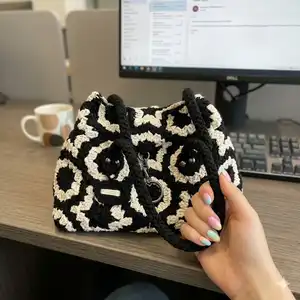
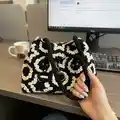
🧢 Beautiful ✨ Detailed πŸ’ Adorable

Paris Crochet Pattern

Paris Crochet Pattern
4.1β˜… Rating
12-15 Hours Time Needed
2.2K Made This
βœ‚οΈ

Intermediate Level

Ideal for those with basic crochet experience, featuring slightly more advanced stitches and techniques to expand your skills.

⏱️

Multi-Day Project

A rewarding 12+ hour journeyβ€”perfect for dedicated crafters who love detailed work.

✨

Stylish Touch

An elegant detail to elevate any look, combining traditional techniques with contemporary design sensibilities.

About This Paris Crochet Pattern

This pattern teaches you how to crochet a Paris-inspired hexagon granny bag using twisted raffia yarn. It includes step-by-step instructions for the hexagon motif, joining the canvas, creating and attaching handles, and making a fabric lining. The finished bag is structured, lined, and has a modern graphic look using two colors.

Paris Crochet Pattern crochet pattern - detailed view of completed project

Perfect for intermediate crocheters comfortable with color changes and joining motifs. The pattern includes clear photos and a diagram to help with assembly and finishing.

Why You'll Love This Paris Crochet Pattern

I absolutely love this pattern because it transforms simple hexagon motifs into a chic, modern handbag with a graphic look. I enjoy working with twisted raffia for its crisp structure and unique texture that makes each stitch pop. The process of joining hexagons and adding a custom lining always feels rewarding and professional. I take pride in the small finishing steps β€” steaming, hiding ends, and precise joining β€” because they turn handmade work into a durable, everyday accessory.

Paris Crochet Pattern step 1 - construction progress Paris Crochet Pattern step 2 - assembly progress Paris Crochet Pattern step 3 - details and accessories Paris Crochet Pattern step 4 - final assembly and finishing

Switch Things Up

I love experimenting with colorways; try switching the dark and light colors for a reversed graphic look that completely changes the bag's personality.

You can substitute the twisted raffia for cotton rope or heavy cotton yarn to make a softer, more flexible bag β€” just adjust your hook size and check gauge.

To make a mini version, use thinner yarn and a smaller hook; the hexagon motif will shrink and make a cute coin purse or small clutch.

For a chunkier, more sculptural bag, use a bulkier raffia or yarn with a larger hook which will create a thicker, more tactile hexagon.

I often add leather or faux-leather trim to the top edge for a refined finish and extra durability β€” sew or glue a narrow strip around the top before attaching handles.

Try different handle styles: make longer straps for a shoulder bag by adding more chain stitches, or use leather straps for a mixed-material look.

Consider embroidered initials or a small crochet flower on one hexagon to personalize the bag β€” I like to add subtle details to make each piece unique.

If you want a crossbody option, attach metal D-rings to the inside of the lining and use a detachable strap; it gives versatility and easy removal for cleaning.

I recommend playing with the joining order β€” arranging hexagons in alternate patterns or random mixes creates very different surface textures and visual effects.

When changing colors frequently, I keep a tidy workspace by clipping and labeling yarn ends so I can consistently reproduce the color sequences on other bags or sets.

Common Mistakes & How to Fix Them

βœ— Changing colors without twisting the yarn from the wrong side can leave loose loops and weak joins; twist the yarn from the wrong side when changing colors to secure the color join. βœ— Working raffia without unwinding and forming proper balls causes tangles and uneven tension; unwind twisted raffia into balls and secure them with a rubber band before starting. βœ— Pulling raffia loops too tight makes the motif narrow and rigid; keep a loose, steady tension and avoid tightening chain loops so the motif lies flat. βœ— Skipping steam blocking results in distorted hexagons that won’t join smoothly; steam each hexagon on both sides and shape it to the correct measurements before joining. βœ— Not hiding or strengthening ends at joins leads to unraveling over time; tie knots where indicated, strengthen the seam, and hide ends between loops to secure the canvas.

Paris Crochet Pattern

Make a stylish hexagon granny bag using twisted raffia yarn with this complete pattern. You will learn how to crochet decorative hexagon motifs, join them into a canvas, add a fabric lining and create sturdy raffia handles. Clear step-by-step photos and detailed assembly notes guide you from start to finish β€” perfect for crafters who love textured, handmade accessories.

Intermediate 12-15 Hours

Materials Needed for Paris Crochet Pattern

β€” Main Fabric

  • 01
    Paper twisted raffia yarn, 180-200 g (approx. 440 yards / 400 m) of each color (base color and additional color)
  • 02
    Base color (dark) - approx. 180-200 g twisted raffia
  • 03
    Additional color (light) - approx. 180-200 g twisted raffia
  • 04
    Fabric for lining - 40 x 40 inches (1 x 1 m) (use cotton or canvas for structure)

β€” Tools Required

  • 01
    Crochet hook size 3-3.5 mm
  • 02
    Any small lock or snap hook (60 x 20 mm) and snap hook ring (35 mm)
  • 03
    Plastic needle with large eyelet
  • 04
    Sewing needle and thread, color matched to yarn
  • 05
    Scissors
  • 06
    Fabric shears for lining
  • 07
    Iron/steamer for blocking and shaping hexagons

Progress Tracker

0% Complete

β€” Crochet the Granny Star (Hexagon) :

Infos :

Base color - dark. Additional color - light. The diagram for crocheting the granny star is in the appendix 1.

Round 1 :

Take the yarn of the base color. Crochet 5 CH. Join in a circle, SlSt. Pull the loop 20 mm. Twist the hook clockwise, then over the loop. Pull one more loop. Crochet two loops together, then two more. This is mock stitch and the first post of the row, 2 DC, CH. Next, (3 DC, CH)*4, 3 DC.

Info :

Crochet the end into this row, cut off the excess.

Round 2 :

Take the yarn of an additional color. Insert the hook under the 1st loop of the row. Pull the loop 20 mm. Make the mock stitch, 2 DC, CH, 3 DC, CH. Next, (3 DC, CH, 3 DC, CH)*4, 3 DC, CH, 3 DC, SlSt.

Round 3 :

Crochet in the base thread to this row. Crochet the end into the 1st cluster, cut off the excess. Pull the loop 20 mm. Make the mock stitch, 2 DC, change the color to the base one, CH. Next, (3 DC, CH, 3 DC, change the color to an additional one, CH, 3 DC, change the color to the base one, CH)*5, 3 DC, CH, 3 DC, SlSt.

Info :

Please note that when changing the thread, do not crochet in another color, but twist the yarn from the wrong side.

Info :

To prevent the yarn from twisting together, turn the work on the hook away from yourself after each color change.

Round 4 :

Pull the loop 20 mm. Make the mock stitch, 2 DC, CH, 3 DC, change the color to an additional one, CH. Next, (3 DC, CH, 3 DC, change the color to the base one, CH, 3 DC, CH, 3 DC, change the color to an additional one, CH)*5, 3 DC, CH, 3 DC, SlSt.

Round 5 :

Pull the loop 20 mm. Make the mock stitch, 2 DC, change the color to the base one, CH, 3 DC, change the color to an additional one, CH, 3 DC, change the color to the base one, CH. Next, (3 DC, CH, 3 DC, change the color to an additional one, CH, 3 DC, change the color to the base one, CH, 3 DC, change the color to an additional one, CH, 3 DC, change the color to the base one, CH)*5, 3 DC, CH, 3 DC, change the color to an additional one, CH.

Info :

Cut the thread, pull out the end. Insert the hook under the 1st loop of the row, pull the end. Insert the hook under the last loop of the row. Pull the end back to the wrong side. Tie the knot. Hide the ends between the loops.

Info :

Similarly crochet 10 more granny star (total 11 hexagons).

Info :

Steam each hexagon on the front and wrong side. The hexagon measures approximately 6 inches (15 cm).

β€” Sew the Canvas :

Info :

Take the two hexagons and turn on the wrong side.

Step 1 :

Take the yarn of the base color. Insert the hook on the back loops only in the corner. Pull the loop. Crochet 3 SlSt on the back loop only (BLO).

Step 2 :

Take the yarn of an additional color, crochet 4 SlSt BLO. Change the color to the base one, 4 SlSt BLO.

Step 3 :

Change the color to an additional one, 4 SlSt BLO.

Step 4 :

Change the color to the base one, 4 SlSt BLO. Crochet the last SlSt in CH in the corner (=15 SlSt).

Info :

Cut the thread, pull out the end. Strengthen all ends.

Info :

Join 8 hexagons in 4 pairs in the same way.

Step :

Then, join 2 pairs and 1 hexagon into the strip of 5 hexagons.

Step :

After that, take the strip of 5 elements and 1 pair. Place them parallel to each other. Begin to join from the left side.

Step :

Crochet 15 SlSt BLO, make the last SlSt in SlSt of the pair and CH in the corner.

Step :

Make 1 more SlSt in the corner to strengthen the seam. Cut the additional thread. Next crochet with the thread of the base color.

Step :

On the next sides of the hexagons, crochet 15 SlSt BLO + the additional SlSt in the corner. Add and cut off the additional thread at each side of the hexagons.

Step :

Then, join 1 more hexagon to the last pair.

Step :

On the other side of the strip of 5 elements, add the pair, and then the last hexagon. Strengthen and hide all ends.

Info :

Steam the canvas on the front and wrong sides.

Info :

Diagram of the hexagon join is provided in the pattern appendix.

β€” Lining :

Step 1 :

Fold the fabric in half and draw along the contour of the canvas. Make the lining from two halves if the fabric is not enough.

Step 2 :

Cut out the lining with 10-15 mm seam allowances. If desired, you can cut out a pocket.

Step 3 :

Sew the lining on the side seams. Then, fold the top edge. The shape of the lining repeats the shape of the bag and resembles a 3D trapezoid.

Info :

At this stage, you can give it to the atelier for professional finishing if desired.

β€” Assembly :

Step 1 :

Join the side seams of the bag in the same way as joined the canvas.

Step 2 :

Strengthen and hide all ends. Twist the towel into the roll. Steam the seams on the wrong side.

Step 3 :

Turn the bag inside out. Straighten the seams with your hands.

Info :

Diagram of the bag and the lining assembly is provided in the pattern appendix.

β€” Crochet the Handle (*2) :

Info :

Take the yarn of the base color.

Round 1 :

Crochet 76 CH. Don’t tighten the loops, crochet loosely.

Round 2 :

1 row. Crochet 75 SC from the 2nd loop from the hook, CH. Insert the hook through the last SC. Pull out the end. Crochet the end into the next row.

Round 3 :

2 row. 75 SC BLO, CH.

Round 4 :

3 row. 75 SC BLO and the front loop only (FLO) of the pre-previous row, CH.

Rounds 5-7 :

4-6 rows. 75 SC BLO and FLO of the pre-previous row, CH. 7 row. 75 SC BLO and FLO of the pre-previous row.

Info :

Cut the thread, pull out the end. Strengthen and hide the end.

β€” Base Trim and Join of the Handle :

Step 1 :

Turn the canvas of the handle with the other side to you.

Step 2 :

Count 4 SC from the left corner. Insert the hook in the 5th SC, pull the loop. Crochet 3 SC.

Step 3 :

Next crochet 3 SC in 1 in the corner, 3 SC, 3 SC in 1 in the corner, 3 SC.

Step 4 :

Turn the fabric with the wrong side facing up. Fold the handle in half lengthwise. Insert the hook on the 5th loops from the edge. Pull the loop.

Step 5 :

Next crochet 66 SlSt to the other end of the handle. Don’t tighten the loops, so as not to tighten the handle. Insert the hook on the loop of the chain and both loops of the SC of the last row to join.

Info :

Finish the handle joins, hide ends and secure well so the handle is comfortable and not tightened.

Assembly Instructions

  • Join two hexagons with SlSt in the back loops only following the color sequence: crochet 3 SlSt BLO in the corner, then 4 SlSt BLO in alternating colors to make a secure seam.
  • Create strips by joining pairs and single hexagons: make a strip of 5 hexagons then join it to a pair; begin joining from the left side and crochet 15 SlSt BLO across each joining side to strengthen seams.
  • Steam the entire canvas on both front and wrong sides after joining to flatten and shape the bag accurately before attaching the lining.
  • Cut and sew the lining from fabric tracing the canvas contour with 10-15 mm seam allowances; sew side seams and fold the top edge so the lining forms a 3D trapezoid that fits inside the crocheted canvas.
  • Insert the lining into the bag, secure side seams, then attach handles by aligning the crocheted handle ends to the bag top and reinforcing joins with extra SlSt and sewing if necessary.

Important Notes

  • πŸ’‘Unwind twisted raffia into balls before starting; raffia is sold in strands and can tangle if not wound into manageable balls.
  • πŸ’‘When changing colors, twist the yarn from the wrong side rather than crocheting with a new color over the stitch to keep joins neat and secure.
  • πŸ’‘Steam and shape each hexagon on both sides to the stated measurement (approx. 15 cm) before joining to ensure the canvas lays flat and joining lines match.

This Paris hexagon raffia bag pattern gives you a stylish, structured accessory built from classic granny-style hexagons and modern finishing techniques. Whether you make it in bold contrast or subtle tones, each bag becomes a statement piece full of handmade charm. Enjoy the detailed joining and lining steps to create a durable, gift-ready handbag. πŸ‘œβœ¨

You ask,

we answer.

FAQs

What size will the finished bag be?

The finished bag measures approximately 13 inches (33 cm) in length, 9 inches (23 cm) in height, and 8 inches (20 cm) in width when made with the recommended materials.

Can I use a different yarn instead of twisted raffia?

Yes, you can substitute another yarn, but the texture and structure will change; choose a yarn with similar thickness and adjust hook size and gauge accordingly.

Do I need sewing skills for the lining?

Basic sewing skills are helpful for cutting and sewing the lining; the pattern provides outlines and seam allowance recommendations to make the process straightforward.

How long does this project typically take to complete?

This is a multi-day project that typically takes around 12-15 hours, depending on your pace, experience with motif joining, and finishing details.