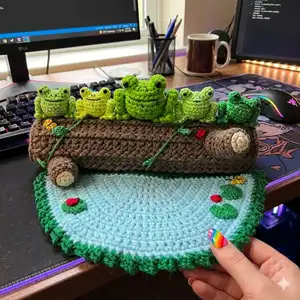
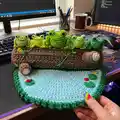
Create a charming Frog Play Set with five adorable frogs, a cozy log that opens for storage, a small pond with lily pads and bugs, and decorative vines and stumps. This pattern guides you through each piece with clear photos and step-by-step instructions so you can make a playful scene for imaginative play or display. Youll enjoy customizing colors and tiny details to make each frog unique.
Progress Tracker
0% Complete
— Frogs :
Info :
I like to make my frogs first, so when it comes time to make the log, I can seat all my frogs side-by-side and judge how long I need to make the log.
— Body :
Round 1 :
Magic circle with 6 scs. (6)
Round 2 :
Inc in each st. (12)
Round 3 :
(Sc, inc) x6. (18)
Round 4 :
(Sc x2, inc) x6. (24)
Rounds 5-9 :
Sc in each st. (5 rows) (24)
Round 10 :
(Sc x2, dec) x6. (18)
Round 11 :
(Sc, dec) x6. (12) Stuff.
Info :
Sl st in next st. Finish off with long tail to sew hole closed, finish off and weave in end.
— Speckles :
Infos :
There are a few different options for making speckles.
Speckled Yarn :
The most obvious way to make speckles would be to use speckled yarn. The example above/left was made with Red Heart Super Saver: Frosty Green Fleck.
Embroidery :
You can also embroider small straight stitches after you have your body assembled (see the example above with purple speckles). Just secure the beginning tail of thread or floss at the inside the body, and then make small straight stitches or French knots where you like. Secure your thread/floss after you are finished and clip end.
Crochet :
The third way would be to stitch them onto the body while you are crocheting (see example above with orange speckles). Instructions below.
Speckle Crochet Info :
Crocheting speckles is done with random patterning. Or ... you could count and make them even on each row. Join your speckle color on row 5, make 1 stitch, then change back to the main color. Carry the speckle colored strand along and crochet over it until you wish to make another speckle. Then change to the speckle color, make 1 stitch, and then change back to the main color. Sometimes the speckle color shows through where you are crocheting over it, but that just adds to the speckle effect throughout the body. Continue with speckles from rounds 5 thru 9, then drop your speckled color and finish up in the main color.
— Eyes :
Info :
Make 2. With green yarn. Work in continuous rounds.
Round 1 :
Magic circle with 6 scs. (6)
Round 2 :
(Sc, inc) x3. (9)
Round 3 :
Sc in each st. (9)
Info :
Sl st in next st and finish off with long tail for sewing. Using black embroidery floss, secure end inside eye bump. Sew a French knot or embroider a circle for an eye. Note: I have used a 4mm safety eye, but the eye bump is tight and it is difficult to get the back on the eye post. When I did use safety eyes, I had to trim down the post after attaching the washer so it would fit inside the eye bump.
— Feet and Legs :
Info :
Make 2. With green yarn.
Step 1 :
(Ch 3, sl st in the 2nd ch from hook and next ch) x3. (3 toes made)
Step 2 :
Ch 1. Sc in the base of each toe. (3)
Step 3 :
Ch 1, turn. Sc in the front loops of each st. Turn and sc in the 3 back loops on the other side of the same row. (6)
Info :
Begin working in continuous rounds.
Rounds 5-12 :
Sc in each st. (8 rows) (5) No need to stuff.
Info :
Sl st in the next st and finish off with a long tail. Thread the tail onto your yarn needle and sew the top of the leg opening closed.
Info :
Fold the leg in half and sew the top of the leg to the back of the ankle with a couple of stitches.
Info :
Position on the sides of the body and pin in place. Sew the leg to the body at the ankle, hip, and about halfway up the leg; on the front and back. Finish off and hide ends inside body.
— Face :
Infos :
Using black embroidery floss and yarn needle, secure yarn inside the body by sewing back and forth inside the body so it isn't visible. Embroider the mouth using the photos as your guide. Vary the mouth shape to produce different expressions. Use simple straight stitches; one long stitch for a straight mouth and 3 for the smile. For a frown, use one long straight stitch and tack a tiny stitch at the center top of the frown to hold it. After embroidering the mouth, add a couple of tiny vertical straight stitches for the nostrils. Secure your thread by sewing back and forth inside the body and then clip the end.
— Log :
Info :
Materials: Worsted Weight Yarn - Brown and Tan (I used Bernat Super Value in Taupe Heather and Oatmeal). Optional: Contrasting colors of embroidery floss or crochet thread for speckles (or consider using a brown speckled yarn). 3.75mm crochet hook. Plastic canvas, brown a 10.5" x 13.5" piece which is then cut to a size that will fit inside log. Scissors, yarn needle, straight pins, thin permanent marker. Optional: Sew-on magnet or Velcro dots to keep open end of log closed. Optional: Scrap piece of plastic canvas, or other stiff plastic like from a milk carton.
— Log Ends :
Info :
Each end of the log is worked a bit differently. You will be closing up one end, and the other end youll secure the disk on just at the top so it will hinge open so you can store your frogs inside the log. Youll be making two sets of 2 disks each and sandwiching them together with a piece of plastic between. This reinforces the disks so they will be nice and stiff.
— Hinged End (Inside) :
Round 1 :
Magic circle with 6 scs. (6)
Round 2 :
Inc in each st. (12)
Round 3 :
(Sc, inc) x6. (18)
Round 4 :
(Sc x2, inc) x6. (24) Finish off and weave in ends. Set aside.
— Hinged End (Outside / Joined rounds) :
Round 1 :
With Brown yarn: Magic circle with 6 scs. Join with sl st to first st. Join tan yarn. (6)
Round 2 :
With Tan yarn: Inc in each st. Join with sl st to first st. Join brown yarn. (12)
Round 3 :
With Brown yarn: (Sc, inc) x6. Join with sl st to first st. Join tan yarn. (18)
Round 4 :
With Tan yarn: (Sc x2, inc) x6. Join with sl st to first st, finish off and weave in ends. (24)
Info :
Optional: Cut a circle from a scrap piece of plastic canvas or other type of plastic that will fit between the 2 disks. Place the two disks together, with the wrong sides facing each other, and the optional piece of plastic canvas sandwiched between the two.
— Main Trunk of Log :
Info :
At the end of each row, join with sl st to the top of the beginning ch-3. Ch 3 and do not turn (the ch-3 counts as a stitch in each row). With brown or chosen yarn(s). Ch 33. Join with sl st in first ch to form a ring.
Row 1 :
Ch 3 and dc in each ch across. Join with sl st in top of the beginning ch-3. Join with sl st. (33)
Rows 2-27 :
Ch 3. Dc in next st, fpdc, (dc x2, fpdc) x 10. Join with sl st. (26 rows - see below*) (33)
Row 28 :
Ch 1. Beginning in the same st, (sc x2, fpsc) x11. Join with sl st. (33)
Info :
*Check the length of the log starting at about row 22 by placing your frogs lined up along the log to determine how long you're going to need to make it. Add more rows if you'd like it longer. Or subtract if you'd like it shorter. Do not finish off. Place a safety pin in your loop to keep from unraveling during the next steps. Weave in starting tail.
— Want to make it speckled? :
Infos :
It's easy enough to add speckles by embroidering some tiny straight stitches here and there throughout the log, the same way you did with the frogs. Or you could consider using a speckled yarn to begin with. Or maybe you'd like to crochet with 2 strands ... one with brown worsted, and a 2nd of thin crochet thread in a contrasting color. Little bits of the contrasting color would show through here and there, creating a speckled effect.
— Plastic Canvas Insert :
Info :
In order to cut your plastic canvas insert to the correct size, roll it up tightly and slide inside your log. Push against it from the inside a bit to stretch it out while still inside your log so you can get the best sizing. Take notice where the plastic canvas overlaps inside the log. Make a mark with your permanent marker at that point. Also make a mark on the plastic canvas at the point where it sticks out of the log. Remove the plastic canvas sheet and cut so it is 4-6 squares longer than the point where it overlapped when it was inside your log. Trim the length so it is the same length as the log.
Info :
Using your yarn needle and a 24" piece of brown yarn, use a running stitch to sew the tube together so the edges overlap by 4-6 rows. Start by stitching over your beginning tail to secure it on the outside of the log. You may want to pin it in place to hold it in together for your first few stitches. Note: It can be difficult getting your hand inside the tube for stitching, so just do the best you can for the center portion of the tube. You can try bending the plastic a bit and going in and out with one push of the needle. Also, you don't have to stitch into every square, I stitched in about every 3rd and it was tight enough. Secure the ending tail by sewing into the previous stitches on the outside of the log. Clip end.
— Log Assembly :
Attaching the Plastic Canvas Tube (Step 1) :
Place the plastic canvas tube inside the log, lining up the seam of the canvas tube to the seam of your crocheted log. That seam is considered the "bottom" of the log. You'll notice that the plastic canvas is a bit flatter where it overlaps, so be sure that that flat portion is positioned at the bottom of your log.
Attaching the Plastic Canvas Tube (Step 2) :
Thread your yarn needle with a long piece of brown yarn (about 24").
Attaching the Plastic Canvas Tube (Step 3) :
Start with the end of the log that you left off on (the same side where you have your safety pin - keep safety pin in place). This will be the "closed" end of the log.
Attaching the Plastic Canvas Tube (Step 4) :
Secure the yarn tail to the inside of the yarn log. Use a running stitch and sew the end of the yarn log to the plastic canvas sheet. Sew through the posts of the stitches, and into the first row on the plastic sheet. Note: By sewing into the posts, you are leaving the ends of the rows of the log free to work into when attaching the log-end disk.
Attaching the Plastic Canvas Tube (Step 5) :
Finish off, weave in end. Repeat for 2nd end (this will be the "hinged" end). This time, begin your stitches near the top of the log (opposite of the seam). Do not finish off. Continue on to securing the first log-end disk.
— Attaching the Log-End Disks :
Hinged End :
1. Continue from attaching the plastic canvas tube. If necessary, feed your yarn up to the top of the log (a few stitches to the right of center). 2. Using the disk that ends with brown stripe, line it up with the inside of the log. 3. At the top of the log, use the whip stitch to sew a hinge on the disk - just at the top of the log (about 4-5 stitches). Be sure to sew through all 3 layers: (1. disk, 2. plastic canvas, 3. crocheted log yarn). Test it as you go to make sure it flaps open and closed how you like it.
Hinged End (Finish) :
After securing the top of the disk to the end of the log, continue whip stitching around the end of the opening to give it a nice finish. Do this by whip stitching into both layers: the plastic canvas and the crocheted log yarn. Secure end and finish off.
Closed End (Info) :
Place the disk you made for the closed end (the one that ends with a tan stripe), inside the end of the log where you ended your stitching (your safety pin should still be in that last loop). Line up the stitches so you begin working in the last st made on the disk. Remove the safety pin and insert your crochet hook. With the outside of the log facing you, crochet through both layers (both loops of the last row of sts of the log and the BLO of the disk). Special Increases* are made as follows: Sc through next log st and next disk st, and then sc in next log st and same disk st.
Closed End (Round) :
(Sc x9, special inc*) x3 (33)
Closed End :
Secure ends and finish off.
— Adding the Magnet or Velcro Closure :
Info :
First, you will need to crochet a little stub to sew to the inside of your log to which you will attach the magnet or velcro.
Stub (With brown yarn) :
1. Magic circle with 6 scs. (6) 2. Sc in each st. (6) Finish off with long tail for sewing. Stuff with yarn ends.
To attach :
Sew one end of your magnet pair, or one side of the velcro to the stub. Hold the stub inside the opening of the log. Open and close the log, while peeking into the side to see where the flap will match up. Make note of that spot and pin the stub in place. Place the other side of the magnet/velcro against the flap. Pin or hold in place and try again to open and close, peeking inside to assure it matches up. Once happy with placement, sew the stub to the floor of the inside of the log and the other side of the magnet/velcro to the flap. If desired, attach a Ch-6 loop to the bottom of the flap so you can grab the loop to open the end of the log. Alternate idea: use a shank button and make a loop closure instead.
— Branch Stumps :
Start (Make 3) :
Use 3.75mm hook. Begin working in joined rounds. Start with Tan: 1. Magic circle with 6 scs. Join with sl st. (6) 2. Ch 1. Inc in each st. (12) Join with sl st and finish off. Change to brown: 3. Sl st loosely in each st. Sl st in BLO of first st. Ch 1. (12) 4. In BLO: Sc in same st as joining, and each st around. (12) Begin working in continuous rounds. 5-8. Sc in each st for 4 rows. (12) 9. Sl st in next st, ch 1, turn. Beginning in the next st: Sc x6, sl st. Leave remaining sts unworked. 10. Ch 1, turn. Beginning in the next st: (Sc, inc) x2, sc, sl st. (6) Finish off with a long tail for sewing. Stuff.
— Attaching the Branch Stumps :
Info :
Begin by pinning the stumps onto the log. I like to position two of the stumps towards the bottom of the log on each side so they add stability to the log and prevent it from rolling. I pin one towards the bottom of the left-front and one towards the bottom of the right-back. The 3rd stump is for appearances and can go anywhere you like (mine is towards the top front). Keep in mind that you'll want the stumps to all point in the same direction in the same way they would on a natural log (mine faced right). Test the log to make sure it doesn't roll and that it sits nice and flat. Once you have your stumps where you like them, whip stitch them in place, adding a bit more stuffing before you have the hole closed. Finish off and weave in ends.
— Pond/Pool :
Materials :
Worsted Weight Yarn - Light Blue and Green (I used Bernat Super Value in Cool Blue and Kelly). 3.75mm crochet hook. Scissors, yarn needle.
Instructions (With Blue) :
At the end of each row, ch 1 and turn. The chain does not count as a st.
Round 1 :
Magic circle with 3 scs (3)
Round 2 :
Inc in each st (6)
Round 3 :
(Sc, inc) x3 (9)
Round 4 :
(Sc x2, inc) x3 (12)
Round 5 :
(Sc x3, inc) x3 (15)
Round 6 :
Sc x2, inc, (sc x4, inc) x2, sc x2 (18)
Round 7 :
(Inc, sc x5) x3 (21)
Round 8 :
Sc x3, inc, (sc x6, inc) x2, sc x3 (24)
Round 9 :
(Sc x7, inc) x3 (27)
Round 10 :
Sc x4, inc, (sc x8, inc) x2, sc x4 (30)
Round 11 :
(Inc, sc x9) x3 (33)
Round 12 :
Sc x5, inc, (sc x10, inc) x2, sc x5 (36)
Round 13 :
(Sc x11, inc) x3 (39)
Round 14 :
Sc x6, inc, (sc x12, inc) x2, sc x6 (42)
Round 15 :
(Inc, sc x13) x3 (45)
Round 16 :
Sc x7, inc, (sc x14, inc) x2, sc x7 (48)
Round 17 :
(Sc x15, inc) x3 (51)
Round 18 :
Sc x8, inc, (sc x16, inc) x2, sc x8 (54)
Round 19 :
(Inc, sc x17) x3 (57)
Round 20 :
Sc x9, inc, (sc x18, inc) x2, sc x9. Ch 1, rotate mat clockwise and work along the flat edge. Sc in the same st and in the sides of each row across. Ch 1 and sl st in first st made. Finish off. (about 80 sts made + 1 ch at each corner)
Round 21 :
Sc across flat edge. At corner, sc, ch 1, sc in same st. Rotate mat clockwise and work the following all around the curved edge of the mat: (Ch 3, sc x2) all around the curve of the mat until you get to the corner. Sl st to join. Turn mat over and join green with sc in same corner.
Info :
If your stitches don't come out exactly even, just ease the last few sts of the pattern to fit. Finish off and weave in all ends.
— Embellishments :
Materials :
Crochet thread in yellow, red, black and green (I used #10 size cotton). Size 2 crochet hook (2mm) - adjust hook size to match your chosen materials. Scissors, yarn needle. Optional: Waterproof fabric glue.
Butterflies :
Make 2. Start with yellow: 1. Magic circle with: Sc, dc, sc, sl st, (sc, tr x2, sc, sl st) x2, sc, dc, sc, sl st. Sl st in first st and finish off with long tail for sewing. Pull circle closed, weave in starting tail. With black: Thread a 24" piece of black thread/yarn onto your yarn needle. Feed down through the top center of the butterfly's wings towards the back of the piece (starting where the body will go and leaving a long tail sticking up between the top 2 wings ... the starting tail will serve as one of the antennas). Sew through the wings from back to front where you'd like to place a few dots or lines. Sew a few small straight stitches or tie French knots on the wings and then come back up at the top center of the wings. To create a body, wrap black tightly around center of wings from top to bottom, 2 or 3 times, leaving the starting and ending tails at the top of the butterfly. Pull body tightly so the wings cinch a bit. Tie ends tightly in a square knot. Tie overhand knots evenly on both ends and trim. Use yellow tail to sew butterflies in place or glue them in place.
Ladybugs :
Make 3. Start with red: 1. Magic circle with 6 scs. Join with sl st to first st. Keep long red tail for sewing and change to black. 2. Ch 1. Sc in same st and next st. [Finish off with long tail for sewing. Thread the tail onto the yarn needle and sew through the base of the 2nd black st from front to back. Use the tail to make a few dots on the ladybug with either tiny straight stitches or French knots. Weave in tail and clip.]
Lily Pads :
Make 3. With Green: 1. Magic circle with 6 scs. Do not join. Ch 1, turn. (6) 2. Increase in each st. Do not join. Ch 1, turn. (12) 3. (Sc, inc) x6. Do not join. Ch 1, turn. (18) Finish off with long end for sewing. Pull magic circle closed and weave starting tail into the back. Position where you like them on the pond and sew in place. Or if desired, weave in tail and use waterproof glue to tack them in place.
Vine :
With green - Begin with a long starting tail. Ch 15. Sl st in 2nd ch from hook. In next chains, sc, hdc x2, sc, sl st. Rotate the piece and work on the opposite side of the leaf in the free loops of the foundation chain: Sl st, sc, hdc x2, sc, sl st in end and in the BLO in the first st on the other side. Ch 1. Repeat until the vine is the length you would like. Mine was about 18" long and had 17 leaves. Test it against your log and adjust length as needed. Finish off with long tail and tack down the beginning and end of the vine on the back or underside of the log. Weave tail into log and clip ends.
— Finishing :
Info :
After assembling all pieces, place frogs on the log to check spacing. Add any final embroidery details, tack on butterflies, ladybugs and lily pads, and add vine along the log exterior. Make sure magnets or velcro (if used) align and function properly. Weave in all ends and trim.
This Frog Play Set brings sweet, portable fun to life with tiny frogs, a cozy storage log and a pretty pond mat that fits together perfectly. 🧶 Create it as a unique gift, a special baby toy, or a delightful display piece that shows off your crochet skills. The set is customizable — change colors, add speckles, or swap embellishments to make it entirely your own. 🐸 Happy stitching and imaginative play!