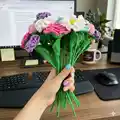
🧢 Beautiful ✨ Detailed πŸ’ Adorable

Crochet Flower Bouquet Amigurumi Pattern

Crochet Flower Bouquet Amigurumi Pattern
4.5β˜… Rating
12-15 Hours Time Needed
2.8K Made This
βœ‚οΈ

Intermediate Level

Ideal for those with basic crochet experience, featuring slightly more advanced stitches and techniques to expand your skills.

⏱️

Multi-Day Project

A rewarding 12+ hour journeyβ€”perfect for dedicated crafters who love detailed work.

🏑

Cozy Accent

A warm touch for your space that transforms ordinary corners into inviting nooks filled with handmade charm.

About This Crochet Flower Bouquet Amigurumi Pattern

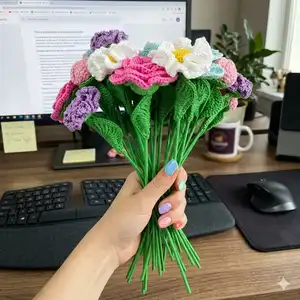
This pattern creates a full bouquet of 25 crocheted flowers with detailed instructions for roses, daisies, blue flowers, buds, carnations, leaves, sepals and stems. It uses cotton yarn and a 2 mm hook to make delicate, long-lasting flowers that hold their shape well. The pattern includes charts, photo steps and assembly guidance so you can follow along easily.

Crochet Flower Bouquet Amigurumi Pattern crochet pattern - detailed view of completed project

Perfect for gifting or decorating, the bouquet is fully customizable by color and yarn thickness. The pattern provides step-by-step instructions and assembly tips to help you finish a professional-looking bouquet.

Why You'll Love This Crochet Flower Bouquet Amigurumi Pattern

I absolutely love this pattern because it combines small, satisfying crochet motifs into a beautiful finished bouquet that looks far more intricate than it is to make. I enjoy the varietyβ€”each flower type has its own construction and charm, so you never get bored repeating the same step. The patterns are designed to be adaptable, so I can change yarn weight or colors to match seasons or decor. I also love that the finished flowers are durable, easy to assemble with floral wire and glue, and make thoughtful handmade gifts. Working through the petals and assembly always feels like a relaxing, creative reward.

Crochet Flower Bouquet Amigurumi Pattern step 1 - construction progress Crochet Flower Bouquet Amigurumi Pattern step 2 - assembly progress Crochet Flower Bouquet Amigurumi Pattern step 3 - details and accessories Crochet Flower Bouquet Amigurumi Pattern step 4 - final assembly and finishing

Switch Things Up

I love experimenting with color palettes for this bouquet; try pastel shades for a soft spring arrangement or jewel tones for a dramatic look.

I sometimes use a thicker yarn and a larger hook to make chunky, statement flowers that work well in a vase.

For tiny keychain-sized flowers, I switch to a thinner thread and a small hook to create mini versions that are portable and sweet.

I also like to embroider tiny veining on the leaves or add a dab of contrasting color to the petal tips for extra detail.

Try combining different flower types on one stem for a whimsical mixed bloom effect, or make all of one kind for a uniform bouquet.

If you want posable stems, consider inserting a thin wire inside the floral wire wrap or using florist tape for a different finish.

Adding beads or tiny button centers can create different focal points for daisies or small flowers.

Experiment with glues and adhesivesβ€”silicone glue gives a flexible bond, while craft glue provides a firmer hold for heavier yarns.

I often create matching accessories like a small bud bouquet or a corsage using the same motifs from this pattern.

Make a practice flower first to test tension and hole sizes so your final bouquet pieces fit perfectly during assembly.

Common Mistakes & How to Fix Them

βœ— Skipping the step to firmly glue the yarn to the wire before winding will make stems unravel; apply glue to the edge of the wire and fasten the yarn firmly before winding. βœ— Not tightening the magic ring enough causes loose centers and uneven petals; tighten the magic ring fully and check the hole size before continuing. βœ— Using inconsistent tension when making leaves or petals results in mismatched sizes; maintain even tension and practice a test motif to match the sample size. βœ— Forgetting to check hole size of the sepal or flower against the stem leads to poor fit; test the hole with the stem and slightly expand or tighten the magic ring as needed.

Crochet Flower Bouquet Amigurumi Pattern

Create a charming hand-crocheted bouquet of 25 flowers including roses, daisies, blue flowers, buds and carnations. This pattern walks you through each leaf, sepal, stem and petal so you can assemble a lasting handmade bouquet. You will love how versatile the pieces are for gifting or home decor.

Intermediate 12-15 Hours

Materials Needed for Crochet Flower Bouquet Amigurumi Pattern

β€” Main Fabric

  • 01
    Cotton yarn, brand YarnArt "Begonia" 169m/50g (used in tutorial)
  • 02
    Green yarn for leaves, stems and sepals - quantity as needed (used double for thin yarn leaves)
  • 03
    Bright pink yarn for roses - quantity as needed (5 roses in sample bouquet)
  • 04
    White and yellow yarn for daisies - small amounts for centers and petals
  • 05
    Two shades of blue yarn for blue flowers - small amounts
  • 06
    Soft pink yarn for buds - small amounts
  • 07
    Purple yarn for carnations (cloves) - small amounts
  • 08
    Note: two colors were used for photo tutorial: yellow and green

β€” Tools Required

  • 01
    Crochet hook size 2.0 mm
  • 02
    Flower wire 1.1 mm thick, 25 cm (10 inches) long for stems (0.8-0.9 mm also optional)
  • 03
    Scissors
  • 04
    Needle for sewing
  • 05
    Measuring tape
  • 06
    Pliers
  • 07
    Glue (silicone glue, universal glue or hobby glue)
  • 08
    Stitch markers (optional)

Progress Tracker

0% Complete

β€” Materials & Notes :

Info :

The bouquet includes 25 flowers: 5 roses, 5 daisies, 5 blue flowers, 5 buds and 5 carnations

Info :

colors used: for leaves, stems and sepals - green for roses - bright pink for daisies - white and yellow for blue flowers - two shades of blue for buds - soft pink for cloves - purple

Info :

Necessary materials: - yarn (two colors are used for photo tutorial - yellow and green) - hook - scissors - a needle - floral wire - measuring tape - pliers - glue

Info :

This bouquet is made of cotton yarn, brand YarnArt "Begonia" 169m/50g. The hook used is 2 mm in size. Stems 10 inches (25 cm) tall. The size of the flowers is from 1.7 inches (4.5 cm) to 2.3 inches (6 cm). For the stem, used a flower wire 1.1 mm thick and 10 inch (25cm) long. Silicone glue, universal glue or hobby glue are suitable for gluing parts.

β€” Stem Preparation :

Info :

I will make each flower 25 cm (10 inches) long. The length of the stem is selected according to the size of the flowers that will be planted on the stem. If the flowers are small, a stem length of 25 cm (10 inches) is fine, my flower heads are between 6cm (2.3 inches). If the volume of your flowers is larger, you can make the stem length 30 cm (12 inches). Using pliers, cut the required length of wire for the stem.

Info :

apply glue to the edge of the wire and fasten the yarn firmly

Info :

gradually apply glue to the wire and wind the yarn

Info :

firmly fix the yarn on the edge of the wire, cut the yarn

β€” Leaf :

Row 1 :

CH 7

Row 2 :

CH 1, SC 1 in the first chain (I perform the second row in the back side of the chains, it's just more convenient for me, you perform as convenient for you)

Row 3 :

HDC 1 in the second chain

Row 4 :

DC 1 in the third chain

Row 5 :

DC 2 in the fourth chain

Row 6 :

TR 2 in the fifth chain

Row 7 :

DTR 3 in the sixth chain

Row 8 :

DTR 7 in the seventh chain

Info :

then we perform stitches in the same chains, according to the stitches that have already been made

Row 9 :

DTR 3 in the same chain where DTR 3 have already been made

Row 10 :

TR 2 in the same chain where TR 2 have already been made

Row 11 :

DC 2 in the same chain where DC 2 have already been made

Row 12 :

DC 1 in the same chain where DC 1 have already been made, HDC 1 in the next chain, SC 1 in last chain

Row 13 :

CH 1

Row 14 :

ST in the first SC of this row

Info :

done

Info :

fasten and trim the ends of the yarn (the same leaves are made for each type of flower)

Info :

if cotton yarn is used, the leaf can be easily ironed

β€” Sepal :

Info :

Sepal - magic ring

Row 1 :

CH 1, SC 14 in the magic ring

Row 2 :

tighten the magic ring, ST in the first SC

Row 3 :

CH 3 from the first SC

Row 4 :

DC 1 in the first SC

Row 5 :

DC 2 in the second SC

Row 6 :

repeat, DC 2 in each SC

Row 7 :

ST in the third chain

Row 8 :

CH 4

Row 9 :

TR 3-cluster in the next DC 3

Row 10 :

CH 4

Row 11 :

ST in the next DC

Info :

repeating to make 5 more of the same leaves

Info :

ST in the beginning of this row

Info :

done

Info :

fasten and trim the ends of the yarn

Info :

check whether the size of the hole of the sepal is suitable for the thickness of the stem, if not, then the magic ring can be slightly expanded or, on the contrary, tightened

β€” Rose :

Row 1 :

CH 41

Row 2 :

CH 2, HDC 1 in the second chain (I perform the second row in the back side of the chains, it's just more convenient for me, you perform as convenient for you)

Row 3 :

HDC 1 in the third chain, HDC 1 in the fourth chain, HDC 1 in the fifth chain

Row 4 :

repeat until the end of the row, HDC 1 in each chain

Row 5 :

CH 2 from the first HDC

Row 6 :

HDC 1 in each HDC (since the second row began with CH 2, so the last (forty-fifth) HDC of the third row should be performed in the second chain of the beginning of the second row)

Row 7 :

CH 3 from the first HDC

Row 8 :

DC 1 in the first HDC

Row 9 :

CH 1

Row 10 :

skip the second HDC 1, DC 1 in the third HDC, CH 3

Row 11 :

DC 1 in the first HDC

Row 12 :

CH 3

Row 13 :

DC 1 in the first HDC

Row 14 :

CH 1

Row 15 :

repeat until the end of the row, 21 petals turn out

Row 16 :

(since the third row began with CH 2, make the last twenty-first petal in the second chain: DC 1, CH 3, DC 2 in the second chain of the beginning of the third row)

Row 17 :

CH 1

Row 18 :

SC 1 in the first DC

Row 19 :

DC 9 under the first arch of CH 3 (I call a chain of three chains an arch)

Row 20 :

SC 1 in the next chain

Row 21 :

DC 9 under the second arch of CH 3

Row 22 :

SC 1 in the next chain

Row 23 :

repeat until the end of the row, turn out a twisted ribbon

Info :

done

Info :

fasten and trim the ends of the yarn

Info :

all parts + glue

β€” Assemble Rose onto Stem :

Info :

determine the edge of the wire on which the yarn began to be wound (usually this edge looks worse than the edge where the thread ended), it is on this edge that I recommend winding the rose

Info :

apply glue to the first petal and on the areas shown here

Info :

start winding the ribbon on the stem, with the first petal, close the stem well so that it is not visible

Info :

then gradually wind the ribbon on the stem, apply glue and wind further

Info :

with the side where the edges of the yarn are fast, put the sepal on the stem, apply glue and stick to the flower

Info :

apply glue to the narrow edge of the leaf and glue to the stem

Info :

done

Info :

make roses in the colors you like, for my bouquet I made 5 pink roses

β€” Flower (small 5-petal) :

Info :

magic ring

Row 1 :

CH 1, SC 10 in the magic ring

Row 2 :

CH 3 from the first SC, TR 2 in the second SC, CH 2

Row 3 :

TR 2, CH 3, TR 2 in the next SC (first layer petal)

Row 4 :

repeat to make 5 petals

Info :

ST in the beginning of this row, done

Info :

fasten and trim the ends of the yarn

β€” Central Part of the Flower :

Row 1 :

magic ring

Row 2 :

CH 1, SC 6 in the magic ring

Row 3 :

tighten the magic ring, ST in the first SC of this row

Row 4 :

CH 1, SC 2 in the first SC, repeat, SC 2 in each SC (SC 12)

Info :

fasten and trim the edges of the yarn

β€” Flower Assembly :

Info :

check whether the size of the hole of the flower is suitable for the thickness of the stem, if not, then the magic ring can be slightly expanded or, on the contrary, tightened

Info :

put together petals, central part and sepal, glue and attach to the stem as shown

β€” Additional Small Flower/Bud & Leaf Notes :

Info :

the same leaves are made for each type of flower and can be ironed if cotton yarn is used

β€” Assembly :

Info :

Apply glue to the edge of the wire and fasten yarn, wind the stem, glue sepal under flower and glue leaf to stem. Repeat for all flowers and arrange into bouquet.

Assembly Instructions

  • Apply glue to the edge of the wire and fasten the yarn firmly, then wind yarn along the stem until the full length is covered.
  • Assemble each flower by gluing the central part to the petals, then glue the sepal on the underside and place the flower onto the stem through the sepal hole.
  • Wrap the rose ribbon around the stem starting at the chosen edge, gluing and closing the stem so that the start of the ribbon is not visible.
  • Attach the leaf to the stem by applying glue to the narrow edge and pressing it against the wrapped stem so it adheres securely.
  • Check hole sizes before final assembly; adjust the magic ring tension for the sepal or flower center so the stem fits snugly.

Important Notes

  • πŸ’‘Use stitch markers or a scrap of yarn to mark the start of rounds and rows for consistent shaping and stitch counts.
  • πŸ’‘Test the fit of the stem in the central hole of sepals and flowers before gluing to ensure a snug and neat finish.
  • πŸ’‘Work with even tension and check your gauge if you change yarn weight or hook size to maintain consistent flower sizes.
  • πŸ’‘Use suitable craft glue (silicone or hobby glue) and allow time to dry fully between assembly steps for best results.

This handmade bouquet pattern helps you create a charming collection of delicate crochet flowers that last a lifetime. 🌸 Follow the step-by-step photos and charts to make roses, daisies, and more with confidence. 🌿 Happy hooking β€” turn these motifs into beautiful gifts and home accents! 🧡

You ask,

we answer.

FAQs

What size will the finished flowers and bouquet be?

Individual flowers measure from approximately 1.7 inches (4.5 cm) to 2.3 inches (6 cm) across; stems are about 10 inches (25 cm) long as used in the tutorial.

Can I use different yarn weight than the pattern specifies?

Yes, you can use different yarn weights but this will change flower size; thicker yarn makes larger flowers and may require thicker floral wire and a larger hook.

Do I need advanced crochet skills for this pattern?

This pattern is rated intermediate; familiarity with basic stitches (sc, hdc, dc, tr, dtr) and working in chains and magic rings is recommended.

How long does it take to make the whole bouquet?

This multi-piece bouquet typically takes 12-15 hours total, depending on experience and number of flowers you make at once.