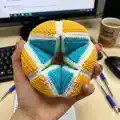
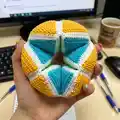
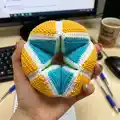
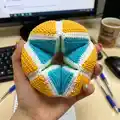
About This Crochet Flexagon Amigurumi Pattern
This pattern teaches you how to crochet a flexagon — a twistable, soft puzzle composed of small triangular panels sewn into pyramids. It includes step-by-step triangle shaping, edge finishing, and assembly instructions to create a functional, tactile toy. Ideal for experimenting with color and texture while practicing shaping and finishing techniques.
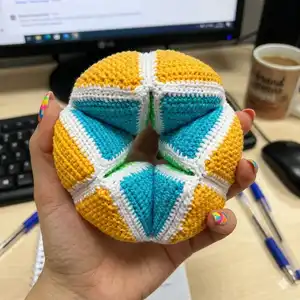
You will make 24 triangles in four colors, join them into pyramids, then sew the pyramids together to form the flexagon. The finished toy measures approximately 15 cm with the suggested materials.
Why You'll Love This Crochet Flexagon Amigurumi Pattern
I absolutely love this pattern because it transforms simple crochet triangles into a playful, interactive toy that delights both kids and adults. I enjoy how the repetitive triangle pieces are meditative to crochet yet assemble into a surprisingly clever mechanical form. The color possibilities make each flexagon unique and personal, and I always find joy in watching someone discover the twist-and-turn action for the first time. This project combines shaping, finishing, and sewing skills in a compact, satisfying make.
Switch Things Up
I love customizing the colors for each triangle — I often swap the bright palette for pastels for a softer look.
Try using a thicker yarn and larger hook to make a chunkier, more squishy flexagon that works great as a sensory toy.
If you want a tiny version, use thinner yarn and a smaller hook to create a pocket-sized flexagon perfect for keychains.
I sometimes embroider little faces or add small felt details to each triangle to give my flexagon character and personality.
For more structure, experiment with slightly firmer stuffing in the pyramids; for more flexibility, use less stuffing and softer fiberfill.
I also like to change the edge color to create a contrasting piping effect around each triangle for graphic impact.
You can sew a small loop into one seam to hang the flexagon as decor or to clip it onto a bag.
If you want to make the seams more visible, use a decorative contrasting yarn for the joining stitches.
I sometimes add a thin ribbon between paired pyramids to change the way the flexagon opens and to add tactile contrast.
Don’t be afraid to combine yarn textures — a mix of cotton and acrylic can give a pleasing hand and durability while keeping stitch definition.
I often make a whole set in different colorways — they look great displayed together and are fun to swap between hands for different fidgeting feels.
Common Mistakes & How to Fix Them
✗ Skipping the decrease technique properly can make triangle edges uneven; practice the single crochet decrease steps and keep consistent tension when decreasing.
✗ Not counting stitches after each row leads to incorrect triangle shape and stitch counts; count your stitches at the end of every row to ensure accuracy.
✗ Finishing the edge with too-tight stitches will distort the triangle; attach the white thread and work evenly spaced single crochets without pulling too tight.
✗ Sewing pyramids inconsistently will prevent clean seams and a working flexagon; pin pieces, use the half cross stitch on back loops, and sew slowly using the seam as a guide.