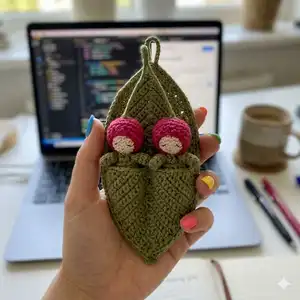
Make two tiny cherry babies tucked into a crocheted leaf cradle — a charming miniature amigurumi perfect for gifts and decorations. This pattern includes step-by-step instructions for heads, caps, bodies, arms, leaves, and assembly so you can recreate the sweet duo exactly. With clear charts for the leaves and close-up photos for tricky steps, you will enjoy stitching these adorable little characters.
Progress Tracker
0% Complete
— Notes :
Info :
This project is quite easy to crochet but to make the leaves, you have to be very careful and check the chart. If you use materials mentioned above, you will get result in dolls 5,4 cm (2,1 in) and a leaf-cradle 13 cm (5,1 in) high. The babies are crocheted in continuous rounds and the leaves worked back-and-forth in rows.
Infos :
NOTE#1 How decrease does: insert the hook into the next stitch and thread over. Pull a loop through so that there are now 2 loops on the hook. Insert the hook into the next stitch and thread over. Pull a loop through so that there are now 3 loops on the hook. Thread over again and pull the loop of thread through all 3 loops on the hook. NOTE#2 For crocheting of circles - pull the initial thread end out between rounds 2 and 3, it would serve as the marker and help you to count the rounds.
— Head :
Round 1 :
6 sc into magic ring (6 sts)
Round 2 :
(inc) X 6 (12 sts)
Round 3 :
(1 sc, inc) X 6 (18 sts)
Round 4-7 :
(4 rounds): sc around (18 sts)
Round 8 :
(1 sc, dec) X 6 (12 sts)
Round 9 :
(dec) X 6 (12 sts)
Info :
After R9 stuff the head tightly. Leave a tail.
Info :
In remaining 6 sc sew 6 stitches from inside to outside in sequence, pull the yarn, secure and hide it.
— Cap :
Round 1 :
6 sc into magic ring (6 sts)
Round 2 :
(inc) X 6 (12 sts)
Round 3 :
(1 sc, inc) X 6 (18 sts)
Round 4-8 :
(5 rounds): sc around (18 sts)
Info :
Put the cap on the doll's head and work
Round 10 :
(1 sc, dec) X 6 (12 sts)
Info :
Make 1 sc and 1 sl st more. Leave a tail.
Info :
Make clean fastening off.
Info :
How to do clean fastening off: insert the yarn into the first stitch after your last stitch. Insert the yarn back into this last stitch and repeat. Secure the yarn and hide inside.
— Body&Arms :
Round 1 :
6 sc into magic ring (6 sts)
Round 2-4 :
(3 rounds): sc around (6 sts)
Info :
Make 1 sl st more and leave short tail.
Round 1 :
6 sc into magic ring (6 sts)
Round 2 :
(inc) X 6 (12 sts)
Round 3 :
(inc, 5 sc) X 2 (14 sts)
Round 4 :
(inc, 6 sc) X 2 (16 sts)
Round 5 :
(inc, 7 sc) X 2 (18 sts)
Round 6-7 :
(2 rounds): sc around (18 sts)
Round 8 :
(dec, 7 sc) X 2 (16 sts)
Round 9 :
(dec, 6 sc) X 2 (14 sts)
Round 10 :
(dec, 5 sc) X 2 (12 sts)
Info :
Now place the one arm closely the body and join them together with 2 sc (these inner connecting sc will not be used in the next round). For the arm use its last stitch and the next following stitch. Work 4 sc and join the second arm with 2 sc, when 4 sc again. Now you have round 11.
Round 11 :
4 sc (arm), 4 sc (body), 4 sc (arm), 4 sc (body) (16 sts)
Round 12 :
(dec) X 8 (8 sts)
Info :
Make 1 sl st more and leave long tail for stitching.
Info :
Make clean fastening off. Lightly stuff the body (not the arms).
— Doll Assembly :
Info :
Place the head onto the body, pin it. It is comfortably to fix the head with a large thick needle, piercing the head and body through. Carefully sew on the head with small stitches.
— Face :
Info :
Embroider the eyes a few stitches with thin black thread, as shown further in the photos.
— Leaf-Cradle :
Info :
consist of 2 leaves - big and small worked back-and-forth in rows. Be sure to check the chart as you work, as some rows start and end differently! Green yarn
Row 1 :
2 ch, 1 dc, 1 sc into magic ring (4 sts), turn...
Row 2 :
2 ch, (1 sc,1 dc,1 sc in one loop – hereafter I refer to this set as "sds" for convenience, but it counts as three stitches! ), 1 sc (6 sts)
Row 3 :
2 ch, 1 sc, sds, 2 sc (8 sts)
Row 4 :
2 ch, 2 sc, sds, 3 sc (10 sts)
Row 5 :
2 ch, 3 sc, sds, 4 sc (12 sts)
Row 6 :
2 ch, 4 sc, sds, 5 sc (14 sts)
Row 7 :
2 ch, 5 sc, sds, 6 sc (16 sts)
Row 8 :
2 ch, 6 sc, sds, 7 sc (18 sts)
Row 9 :
2 ch, 7 sc, sds, 8 sc (20 sts)
Row 10 :
2 ch, 8 sc, sds, 9 sc (22 sts)
Row 11 :
2 ch, 9 sc, sds, 10 sc (24 sts)
Row 12 :
2 ch, 10 sc, sds, 10 sc (25 sts)
Row 13 :
2 ch, 10 sc, sds, 11 sc (26 sts)
Row 14 :
2 ch, 11 sc, sds, 11 sc (27 sts)
Row 15 :
2 ch, 11 sc, sds, 12 sc (28 sts)
Row 16 :
2 ch, 12 sc, sds, 12 sc (29 sts)
Row 17 :
2 ch, 12 sc, sds, 13 sc (30 sts)
Row 18 :
2 ch, 13 sc, sds, 13 sc (31 sts)
Row 19-26 :
(8 rows): 2 ch, 13 sc, sds, 12 sc, 1 dec (31 sts)
Row 27 :
2 ch, 13 sc, sds, 10 sc, 2 dec (30 sts)
Row 28 :
2 ch, 12 sc, sds, 10 sc, 2 dec (29 sts)
Row 29 :
2 ch, 12 sc, sds, 7 sc, 3 dec (27 sts)
Row 30 :
2 ch, 10 sc, sds, 7 sc, 3 dec (25 sts)
Row 31 :
2 ch, 10 sc, sds, 3 sc, 4 dec (22 sts)
Row 32 :
2 ch, 7 sc, sds, 3 sc, 4 dec (19 sts)
Info :
Make 1 ch more and leave short tail.
Info :
At the finish end of the leaf attach a new yarn (blue arrow in the photo) and work the leaf in a round with a edging of sc. To keep the edge of the leaf from pulling down, sometimes make increases. At the sharp end of the leaf make a prong - in one loop: sc, ch, dc, ch, sc. I got 100 sc -50 sc on one side of leaf and 50 sc on the other. Then work chain of 15, connect the round with sl st and make 2 sl st more. Leave a tail and make clean fastening off, hide the tail inside.
Row 1 :
2 ch, 1 sc, 1 dc, 2 sc into magic ring (6 sts), turn...
Row 2 :
2 ch, 1 sc, sds, 2 sc (8 sts)
Row 3 :
2 ch, 2 sc, sds, 3 sc (10 sts)
Row 4 :
2 ch, 3 sc, sds, 4 sc (12 sts)
Row 5 :
2 ch, 4 sc, sds, 5 sc (14 sts)
Row 6 :
2 ch, 5 sc, sds, 6 sc (16 sts)
Row 7 :
2 ch, 6 sc, sds, 7 sc (18 sts)
Row 8 :
2 ch, 7 sc, sds, 8 sc (20 sts)
Row 9 :
2 ch, 8 sc, sds, 9 sc (22 sts)
Row 10 :
2 ch, 9 sc, sds, 10 sc (24 sts)
Row 11 :
2 ch, 10 sc, sds, 11 sc (26 sts)
Row 12 :
2 ch, 11 sc, sds, 12 sc (28 sts)
Row 13 :
2 ch, 10 sc, dec (13 sts)
Row 14 :
2 ch, 11 sc (13 sts)
Row 15 :
2 ch, 8 sc, dec (11 sts)
Row 16 :
2 ch, 8 sc (10 sts)
Row 17 :
2 ch, 5 sc, dec (8 sts)
Row 18 :
2 ch, 5 sc (7 sts)
Row 19 :
2 ch, 2 sc, dec (5 sts)
Row 20 :
2 ch, dec (3 sts)
Info :
Make 1 ch more and leave short tail.
Info :
Now attach a new yarn according to the chart (blue arrow) and work second side:
Row 13 :
2 ch, 11 sc (13 sts)
Row 14 :
2 ch, 11 sc (13 sts)
Row 15 :
2 ch, dec, 8 sc (11 sts)
Row 16 :
2 ch, 8 sc (10 sts)
Row 17 :
2 ch, dec, 5 sc (8 sts)
Row 18 :
2 ch, 5 sc (7 sts)
Row 19 :
2 ch, dec, 2 sc (5 sts)
Row 20 :
2 ch, dec (3 sts)
Info :
Make 1 ch more and leave short tail.
Info :
Work the leaf in a round with a edging of sc (I got 72 sc). Leave long tail for stitching.
Info :
Iron the leaves gently through a damp cloth.
— Cradly Assembly :
Info :
Put a smaller leaf on top of a large, pin it. Carefully sew them together with small stitches over the edge. At the very beginning and finish, sew firmly, making several stitches on top of each other. Then make a neat seam exactly in the middle of the leaf.
— Petiole & Final Assembly :
Info :
Now make a petiole for the cherry berry. Take a 15 cm long piece of thin wire. Hook the wire on one sc on the top of the doll, twist it tightly. Bend the tail of the wire to the necessary distance (I made a 5 cm long petiole). Cut off the excess from the wire tail, so that there was 5 mm. Take a piece of green yarn 80 cm long, pull it along the wire, hook on the wire tail and start wrapping the petiole, very tightly, gently, coil by coil. (As you get closer to the cap, it will become harder to wrap, you have to try) After wrapping the entire petiole, tie both tails of yarn together very tightly.
Info :
Insert the tails into a thick needle, stick it near the petiole and pull it out the doll's neck. Pull the yarn. To be sure, once again pull the needle out near the petiole and back - at the doll's neck. Cut the end of the yarn.
Info :
When both dolls are ready, connect their petioles in the same way, wrapping them together at a distance of 5 mm. Insert the tails of the yarn into the needle and pull it through the winding, cut it off.
Info :
Your cute cherry babies are ready!
These tiny Cherry Babies are a delightful little project that bring joy in a pocket-sized package. They combine miniature shaping with a textured leaf cradle for a charming finish that looks great as a gift or ornament. Try different colorways and make a whole orchard of mini friends! 🧶🍒