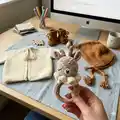
🧶 Beautiful ✨ Detailed 💝 Adorable

Biscuit (mini) Set Knitting Pattern

Biscuit (mini) Set Knitting Pattern
4.3★ Rating
5-7 Hours Time Needed
3.0K Made This
✂️

Intermediate Level

Ideal for those with basic crochet experience, featuring slightly more advanced stitches and techniques to expand your skills.

⏱️

Weekend Treat

Takes 5-7 hours, making it an enjoyable project to finish over a couple of days.

👕

Casual Chic

Relaxed style with a modern twist, perfect for everyday wear while maintaining that handcrafted uniqueness.

About This Biscuit (mini) Set Knitting Pattern

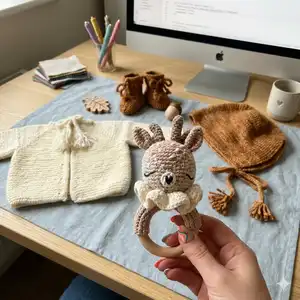
This pattern creates a three-piece baby set: a garter-stitch cardigan, a cosy bonnet and matching boots. It is written for multiple newborn sizes and worked in DK weight merino yarn for a soft, warm finish. Techniques include raglan shaping, I-cord ties and magic-loop construction for the booties.

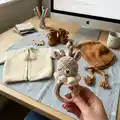
Biscuit (mini) Set Knitting Pattern crochet pattern - detailed view of completed project

Clear step-by-step instructions and helpful notes are provided for each piece, including buttonhole placement and finishing. Suitable for knitters familiar with basic shaping and working in the round.

Why You'll Love This Biscuit (mini) Set Knitting Pattern

I absolutely love this pattern because it combines simple stitches with thoughtful construction to create a timeless baby set. I designed the cardigan with raglan shaping to make fitting easy and to keep shaping elegant and minimal. The bonnet and boots are adorable, practical and quick to knit, which makes them perfect last-minute gifts. The DK merino gives a luxurious hand and squishy garter texture that I enjoy working with and gifting to new parents.

Biscuit (mini) Set Knitting Pattern step 1 - construction progress Biscuit (mini) Set Knitting Pattern step 2 - assembly progress Biscuit (mini) Set Knitting Pattern step 3 - details and accessories Biscuit (mini) Set Knitting Pattern step 4 - final assembly and finishing

Switch Things Up

I love suggesting ways to personalise this set: change the yarn color to create a bespoke gift, such as pastel tones for a soft nursery palette or bold contrasts for a modern look.

I often change the number of tassel plies or the length of the I-cord to make the ties longer or shorter depending on how much detail I want at the bonnet ends.

To make a smaller, pocket-sized version, I switch to a lighter yarn and smaller needles—this produces a delicate mini set perfect for gift tags or miniature displays.

For a chunkier cuddly version, I use a bulkier DK blend and larger needles to create a chunky, squishy finish that is wonderfully warm and quick to knit.

I sometimes add a subtle stripe on the cuffs or the bonnet edge by alternating two colors every few rows—this gives a bespoke, handmade look with minimal extra work.

I like to embroider tiny motifs on the bonnet or add a small crocheted flower sewn to the front edge for a sweeter, decorative finish.

If you prefer fewer buttons, you can make fewer buttonholes and use decorative toggles instead for a simpler closure that still looks charming.

I also recommend experimenting with seed stitch or ribbed cuffs for the sleeves if you want a different texture at the wrist without changing the overall construction.

To make the boots more secure, I sometimes knit a slightly longer I-cord link and thread it twice through the eyelets, then knot and hide the ends inside a tassel for added durability.

I encourage you to test small changes on a swatch first so you can see how the yarn, needle size and stitch alterations will affect the drape and final measurements.

Common Mistakes & How to Fix Them

✗ Skipping the placement markers during raglan shaping causes stitch distribution errors; place and double-check markers as you go to maintain correct shaping. ✗ Not checking gauge will result in a garment that is too large or too small; always knit and block a swatch to match 22 sts per 40 rows before starting. ✗ Forgetting to work buttonholes regularly makes them unevenly spaced; create buttonhole rows every 4 cm as instructed and measure placement carefully. ✗ Uneven picking up of sleeve stitches can create puckering at the underarm; pick up specified counts carefully and place stitches symmetrically around the underarm. ✗ Overstretching while blocking can distort measurements; block gently to the specified finished dimensions and avoid pulling too hard on the fabric.

Biscuit (mini) Set Knitting Pattern

Create a cozy three-piece baby set featuring a garter stitch cardigan, matching bonnet and tiny boots. This pattern is written for multiple newborn sizes and uses soft DK merino for a squashy, warm finish. You'll get clear instructions for raglan shaping, magic-loop booties and I-cord ties so you can make a thoughtful gift or a keepsake for your little one. Enjoy knitting a complete, classic set with beautiful finishing details.

Intermediate 5-7 Hours

Materials Needed for Biscuit (mini) Set Knitting Pattern

— Main Fabric

  • 01
    DK weight yarn (Merino DK) - Cardigan: 150, 200 (230, 300) 350 meters depending on size
  • 02
    DK weight yarn (Merino DK) - Bonnet: 50, 60 (80, 95) 110 meters depending on size
  • 03
    DK weight yarn (Merino DK) - Boots: 50, 60 (80, 95) 110 meters depending on size
  • 04
    Suggested quantity: 3, 3 (4, 5) 6 balls of base N°2 - Merino DK, Lolilafée
  • 05
    Yarn used for sample: Lolilafée base N°2 - Merino DK in 'Ecru' colourway

— Tools Required

  • 01
    4 mm / US 6 needles (circular recommended)
  • 02
    60 cm cable minimum for the magic loop (for booties/magic-loop work)
  • 03
    Stitch markers (at least 8)
  • 04
    Tapestry needle for weaving ends
  • 05
    Blocking tools (pins, mats)
  • 06
    Scissors
  • 07
    Buttons 12 mm (6 to 10 depending on size)
  • 08
    BORM (beginning of round marker)

Progress Tracker

0% Complete

— Cardigan :

Cast on :

CO 42, 42 (50, 50) 54 sts using the long tail cast on method. Do not join in the round.

Placement row :

k 10, 10 (12, 12) 13, PM, p1, PM, p2, PM, p1, PM, k 14, 14 (18, 18) 20, PM, p1, PM, p2, PM, p1, PM, k 7, 7 (9, 9) 10, sl3 wyif.

Raglan R1 (RS) :

k until M, *M1R, SM, k1, SM, M1L, k until M, repeat from * a total of 3 times, M1R, SM, k1, SM, M1L, k until 3 sts from EOR, sl3 wyib.

Raglan R2 (WS) :

p3, *k until M, SM, p1, SM, p until M, SM, p1, SM, repeat from * twice, k until 3 sts from EOR, sl3 wyib.

Info :

Work R1 & R2 a total of 12, 14 (14, 16) 17 times.

Buttonhole row :

work R1 until 5 sts from EOR, yo, k2tog, sl3 wyib.

Body/sleeves separation R3 (RS) :

k until M, RM, k1, RM, put the sleeve sts on hold, CO 2, 2 (2, 3) 4 sts, RM, k1, RM, k until M, RM, put the sleeve sts on hold, CO 2, 2 (2, 3) 4 sts, RM, k1, RM, k until 3 sts from EOR, sl3 wyib.

Body :

Continue working in garter st, repeating R5 & R6 below until the body is 13, 15 (16, 17) 19 cm long from the body/sleeve separation (measurement taken from the underarm). Keep in mind to continue creating the buttonholes every 4cm.

R5 (RS) :

k until 3 sts from EOR, sl3 wyib.

R6 (WS) :

p3, k until 3 sts from EOR, sl3 wyif.

Buttonhole row :

work R5 until 5 sts from EOR, yo, k2tog, sl3 wyib.

Info :

Once you reach the recommended body length, BO the sts as they come and cut the yarn.

Note :

While working on the raglan, work a buttonhole row every 4cm instead of a R1, starting from the second repeat.

Note :

It is common practice to place buttonholes on the right front for boys and on the left front for girls. We ourselves always create them on the right front, but you can easily place them on the left front by doing the yo at the beginning of the row if you wish to.

Sleeves :

Put back on the needles the 26, 30 (30, 34) 36 sts from the sleeve. Starting at the middle of the underarm, pick up 2, 2 (2, 3) 4 sts, k the sleeve sts, the pick up another 2, 2 (2, 3) 4 sts at the underarm and BORM.

Info :

Work 3 cm in stockinette st then, start working the decrease row.

DR :

k1, k2tog, k until 3 sts from BORM, SSK, k1.

Info :

Work RD every 2.5, 2.5 (3, 3) 2.5 cm a total of 2, 2 (3, 4) 5 times.

Info :

Continue working in stockinette st until the sleeve is 10, 12 (14, 16) 18 cm long from the underarm.

Cuff :

Work 2 cm in garter st in the round (knit one row, purl one row), then bind off the sts as they come and cut the yarn.

Info :

Work the second sleeve the exact same way.

Neckline :

CO 3 sts, leaving a 15cm tail and work a 12, 15 (15, 17) 20 cm long I-cord. Do not cut the yarn.

Neckline :

Using the 3 sts from the I-cord that are still on the needles, with the tail on the left, pick up a st on the right front. Move the sts to the left needle and BO into an I-cord.

Info :

Repeat this sequence until all sts from the neckline have been bound off into an I-cord.

Info :

Without cutting the yarn, work a 12, 15 (15, 17) 20 cm long I-cord.

Tassels :

Slip 1 st knitwise, k2tog, pass the slipped st over the second one. Using a new piece of yarn, create a 10 ply tassel and pass it through the remaining st to attach it to the I-cord. Weave in the end to secure the tassel.

Tassels :

On the second end of the I-cord, create a loop using the CO tail, attach a second 10 ply tassel and weave in the ends to secure it.

— Bonnet :

Cast on :

CO 60, 70 (80, 90) 100 sts using the long tail cast-on method. Do not join in the round.

R1 (RS) :

k until 1 st from EOR, sl1 wyif.

R2 (WS) :

k until 1 st from EOR, sl1 wyif.

Info :

Work R1 & R2 until the piece is 7, 8 (9, 10) 13 cm long from the CO row.

Decrease crown :

Place BORM and join to work in the round. On the next round, place M as follows: *k 6, 7 (8, 9) 10, PM, repeat from * until 6, 7 (8, 9) 10 sts from BORM, k until BORM.

R1 :

*k2tog, k until M, SM, repeat from * until BORM.

R2 :

k until BORM, slipping M as they come.

Info :

Work R1 & R2 until there are 2 sts in between the M.

R3 :

*k2tog, repeat from * until BORM, removing M as they come.

R4 :

*k2tog, repeat from * until BORM.

Ties :

Pick up 3 sts in the left corner of the bonnet and knit a 15, 15 (15, 20) 20 cm long I-cord. BO the sts, then create an 8 ply tassel and attach it to the end of the tie.

Info :

Work the second link the exact same way.

— Boots :

Setup :

CO 18, 22 (26, 30) 34 sts using the long-tail cast on method.

Info :

The boot is worked in magic-loop: Distribute 9, 11 (13, 15) 17 sts per needle and join to work in the round. The beginning of the round is on N1, meaning when the CO tail is on your right. You can PBORM if you want to. Working an entire round means knitting the sts on both needles (N1 & N2).

R0 :

p until BOR.

Leg R1 :

k until BOR.

Leg R2 :

p until BOR.

Info :

Work R1 & R2 a total of 3 times.

R3 :

N1: k1, *k2tog, yo, repeat from * until 2 sts from end of N1, k2. N2: k1, *yo, k2tog, repeat from * until end of N2.

R4 :

p until BOR.

Info :

Work R3 & R4 a total of 2, 2 (2, 3) 3 times.

Info :

You have 5, 7 (9, 9) 11 sts left on N2.

Gusset :

N2: k 5, 7 (9, 9) 11, turn you work 90° clockwise and pick up 4, 6 (6, 8) 9 sts on the raw edge. N1: p until end of N1. N2: turn you work 90° clockwise and pick up 4, 6 (6, 8) 9 sts on the raw edge, p until end of N2.

Gusset decreases R1 :

N1: k until end of N1. N2: SSK, k until 2 sts from end of N2, k2tog.

Gusset decreases R2 :

N1: p until end of N1. N2: p until end of N2.

Info :

Work R1 & R2 a total of 3, 4 (4, 5) 6 times.

Foot :

Continue working the foot in garter st until it is 5, 6 (7, 7) 8 cm long from the start of the heel.

Toe R1 :

N1: SSK, k until 2 sts from end of N1, k2tog. N2: SSK, k until 2 sts from end of N2, k2tog.

Toe R2 :

p all sts (N1 & N2).

Info :

Work R1 & R2 a total of 1, 2 (3, 3) 4 times, then close the toe using the Kitchener st.

Link :

CO 3 sts and knit a 30, 30 (30, 35) 35 cm long I-cord. BO the sts.

Info :

Pass the link through the eyelets at the top of the leg, then make two 8 ply tassels and attach them to the end of the I-cord.

Info :

Make a second boot the exact same way.

Finishing :

Your set is now all done, all you have left to do is weave in the ends, sew the buttons on and admire it!

Assembly Instructions

  • Weave in all ends on the wrong side of the project, trimming tails and securing them neatly so they do not unravel.
  • Sew the buttons on the front band aligned with the buttonholes that were created every 4 cm, spacing them evenly from the neckline down.
  • Attach the bonnet ties to each corner and secure the tassels to the I-cord ends; weave in ends to hide knots and secure tassels.
  • Thread the I-cord link through the eyelets at the top of each boot and attach two 8-ply tassels to each end; finish by securing knots and weaving in ends.
  • Block each finished piece gently to measurements, pinning to shape while drying for a polished final look.

Important Notes

  • 💡Use stitch markers to keep track of raglan markers and sleeve separation points so shaping stays accurate.
  • 💡Always knit and block a gauge swatch to ensure the final measurements match the pattern and the finished garment fits correctly.
  • 💡When picking up sleeve stitches, pick evenly around the underarm and use the counts provided to avoid puckering or gaps.
  • 💡Weave in ends before blocking when possible, or tuck them into the fabric after blocking to prevent distortion.

This Biscuit (mini) set pattern combines classic garter stitch with sweet finishing details to make a perfect newborn gift. It includes a raglan cardigan, cosy bonnet and tiny booties that are adorable and practical. Enjoy knitting each piece and creating a lovely handmade keepsake for someone special. 🧶🎀
You ask,

we answer.

FAQs

What sizes are included in this pattern?

The pattern includes sizes for Preemie, Newborn, 3 months, 6 months and 12 months with finished measurements listed in the sizing table.

What needle size should I use for the sample gauge?

The pattern gauge is achieved using 4 mm / US 6 needles; gauge is 22 sts per 40 rows = 10 cm in garter stitch after washing and blocking.

Can I use a different yarn weight?

Yes, but changing yarn weight will affect final size; if you use a different weight, adjust needles and be sure to knit and block a new gauge swatch.

How long will this project take to complete?

Most knitters finish the three-piece set in approximately 5-7 hours, though time varies with experience and knitting speed.