🧢 Beautiful ✨ Detailed πŸ’ Adorable

Succulent Turtle Amigurumi Pattern

Succulent Turtle Amigurumi Pattern
4.6β˜… Rating
5-7 Hours Time Needed
3.3K Made This
βœ‚οΈ

Intermediate Level

Ideal for those with basic crochet experience, featuring slightly more advanced stitches and techniques to expand your skills.

⏱️

Weekend Treat

Takes 5-7 hours, making it an enjoyable project to finish over a couple of days.

🧸

Cute Companion

An adorable friend to cherish, handcrafted with love to bring comfort and joy for years to come.

About This Succulent Turtle Amigurumi Pattern

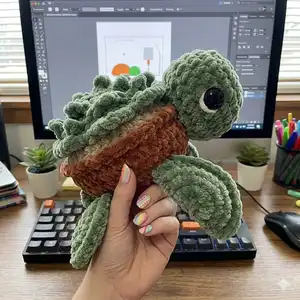
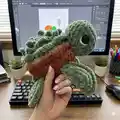
This pattern creates a plush Succulent Turtle with a textured shell and a spiral crochet succulent on top. It uses size 6 super bulky chenille yarn for a soft, squishy finish and 18mm safety eyes for expressive detail. The pattern teaches working in BLO/FLO, folding rounds for legs, and attaching pieces into a round for a clean finish.

Succulent Turtle Amigurumi Pattern crochet pattern - detailed view of completed project

You will make two front legs, two back legs, a tail, a head, and a shell/body with a detachable succulent top worked in the front loops. Clear round-by-round instructions guide you through assembly and finishing.

Why You'll Love This Succulent Turtle Amigurumi Pattern

I absolutely love this pattern because it combines the cozy appeal of super bulky chenille yarn with playful sculptural details like the spiral succulent. I enjoy how the succulent is built in the front loops β€” it creates a lovely 3D effect that feels very rewarding to make. The way the legs and tail are attached into a round keeps the finish neat, which is one of my favorite construction tricks. This project is satisfying to stitch in one or two sittings and makes a sweet handmade gift that always gets compliments.

Succulent Turtle Amigurumi Pattern step 1 - construction progress Succulent Turtle Amigurumi Pattern step 2 - assembly progress Succulent Turtle Amigurumi Pattern step 3 - details and accessories Succulent Turtle Amigurumi Pattern step 4 - final assembly and finishing

Switch Things Up

I love to customize this pattern by switching the yarn colors to create different succulent types; try dusty pinks, creams, or variegated yarns for unique looks.

You can make the turtle larger or smaller by changing yarn weight and hook size β€” bulky yarn with a larger hook makes a chunky toy while lighter yarn makes a petite version.

I often add embroidered spots or tiny leaves to the shell edge to personalize each turtle and give it a distinct personality.

For a keychain or bag charm, use thinner yarn and a smaller hook, and secure a keyring to the top before weaving in ends.

Try different succulent leaf patterns by changing the stitch sequence in the leaf repeat β€” fewer stitches give smaller leaves, more stitches create fuller leaves.

If you want posable limbs, add thin craft wire inside the legs before stuffing and be sure to wrap wire ends securely so they don't poke through the yarn.

Swap safety eyes for embroidered eyes for a softer, baby-safe version and embroider longer smiles or expressions to change character mood.

I sometimes add tiny felt accessories like hats or little flowers glued or sewn to the succulent to create seasonal versions or gifts.

Experiment with texture by using a mix of chenille and fuzzy boucle yarn for the succulent to get a more realistic plant texture.

If you want a sturdier shell, add a thin plastic canvas or felt insert cut to size between rounds before closing to help the turtle sit nicely on shelves.

Common Mistakes & How to Fix Them

βœ— Not using stitch markers when working with fluffy or chunky yarn can make rounds hard to find; place a marker at the start of each round and mark key loops so you always know where your rounds and front/back loops begin. βœ— Failing to fold and sew leg halves evenly can produce uneven legs; fold your circle exactly in half and count stitches as you work across both layers to keep the shape symmetrical. βœ— Skipping the suggested stitch marker in round 6 before working FLO can make the succulent and subsequent rounds misaligned; place a marker in the first back loop of round 6 to keep placement consistent. βœ— Stuffing the body too loosely or too tightly distorts the turtle shape; stuff gradually to your desired firmness, checking shape as you go and adding small amounts at a time for an even, firm result. βœ— Not securing safety eyes and leaving short tails for head sewing can lead to shifting; place eyes between rounds 5-6 with spacing checked and leave a long tail for sewing the head securely in place.

Succulent Turtle Amigurumi Pattern

Make a charming Succulent Turtle amigurumi using super bulky chenille yarn and simple crochet techniques. This pattern combines a soft plush turtle body with a spiral succulent top for a unique handmade friend. You will learn front- and back-loop work, attaching pieces in-round, and a fun leafy succulent spiral. Perfect as a decorative plush or a sweet gift for crochet lovers.

Intermediate 5-7 Hours

Materials Needed for Succulent Turtle Amigurumi Pattern

β€” Main Fabric

  • 01
    Size 6 Super Bulky Yarn (chenille) - Chenille Home Slim Terracotta (shell accent)
  • 02
    Size 6 Super Bulky Yarn (chenille) - Chenille Home Slim Sand (shell middle)
  • 03
    Size 6 Super Bulky Yarn (chenille) - Chenille Home Slim Agave (body, succulent, legs, head)
  • 04
    18mm safety eyes (2 pieces)
  • 05
    Poly-fil stuffing for body and head

β€” Tools Required

  • 01
    Crochet hook size 6.0mm
  • 02
    18mm safety eyes (2)
  • 03
    Tapestry needle for sewing and weaving ends
  • 04
    Scissors
  • 05
    Stitch markers
  • 06
    Poly-Fil for stuffing
  • 07
    Pins for assembly (optional)

Progress Tracker

0% Complete

β€” Front Legs :

Round 1 :

8SC in MR (8)

Round 2 :

Inc (16)

Round 3 :

SC, Inc (24)

Round 4 :

3SC, Inc (30)

Info :

Fold your circle in half to make a half circle.

Round 5 :

Working around the half circle and through both sides, SC through both stitches (about 15 SC)

Info :

Continue until you reach the end of the half circle. FO, there is no need to leave a tail for sewing, you will SC the legs into a round of the body.

β€” Back Legs :

Round 1 :

8SC in MR (8)

Round 2 :

Inc (16)

Round 3 :

SC, Inc (24)

Info :

Fold your circle in half to make a half circle.

Round 4 :

Working around the half circle and through both sides, SC through both stitches (about 12 SC)

Info :

Continue until you reach the end of the half circle. FO, there is no need to leave a tail for sewing, you will SC the legs into a round of the body.

β€” Tail :

Round 1 :

6SC in MR (6)

Round 2-3 :

SC (6)

Info :

FO, there is no need to leave a tail for sewing, you will SC the tail piece into a round of the body.

β€” Head :

Round 1 :

8SC in MR (8)

Round 2 :

Inc (16)

Round 3 :

SC, Inc (24)

Round 4-6 :

SC (24)

Round 7 :

SC, Dec (16)

Round 8 :

2SC, Dec (12)

Info :

FO, leave a long tail for sewing. I leave about 8-9 inches.

Info :

Add eyes and stuff the head. I added my eyes at around rounds 5-6 and about 8 stitches apart across the front of the face.

β€” Shell/Body :

Info :

Part of the top of the shell is worked in the BLO (back loops only) of the previous round. The succulent is formed in the front unworked loops once the top of the shell is completed.

Round 1 :

8 SC in MR (8)

Round 2 :

Working in BLO: Inc (16)

Info :

*I highly suggest stitch markers to mark your front loops, at least one in the front loop of the first stitch of each round.

Round 3 :

Working in BLO: SC, Inc (24)

Round 4 :

Working in BLO: 3SC, Inc (30)

Info :

Color change to Sand

Round 5 :

Working in BLO: 4SC, Inc (36)

Round 6 :

SC (36)

Info :

We will now make the succulent top. Drop your working yarn, the rest of the body will be finished after we complete the succulent top.

β€” Succulent :

To make the succulent, you will be working in a continuous spiral on top of the shell in the unworked front loops of each round.

Info :

Grab your Agave yarn and attach it with a SS in the very first unworked front loop of round 2.

Info :

Working into the remaining front loops repeat the following pattern: (Each stitch is placed into individual stitches)

Round Pattern :

[HDC, DC, CH2 SS into 2nd CH from the hook, DC, HDC, SS, HDC, TC, CH2 SS into 2nd CH from the hook, TC, HDC, SS] x 8 (creates leaves)

Info :

You should have 16 leaves at the end. If you do not and you missed or skipped some stitches that is ok as long as you are happy with how your succulent looks. Feel free to pull on the leaves and move them how you like them to look. FO, weave in the ends.

Info :

Picking up where you left off in round 6. Color change to Terracotta.

Round 7 :

Working in FLO of round 6:* SC (36)

Info :

*It will help for the next round to place a stitch marker in the first back loop of round 6

Round 8 :

Working in BLO of round 6, that were left behind from round 7: SC (36)

Round 9-10 :

SC (36)

Round 11 :

Grab your legs and tail, this is the round you will SC your pieces into. You place your pieces in front of the stitches of the body, pushing your hook through the leg/tail first then through the body stitch. (36)

Round 11 Steps :

4SC, Grab the first front (big) leg attach using 3SC (curve of the leg should be on your right), 5SC, Grab the first back (small) leg attach using 2SC (curve of the leg should be on your right), 3SC, Grab your tail and using 3SC attach the tail, 3SC, Grab the second back (small) leg attach using 2SC (curve on your left), 5SC, Grab the second front (big) leg attach using 3SC (curve on your left), 3SC.

Round 12 :

Working in BLO: 4SC, Dec (30)

Round 13 :

3SC, Dec (24)

Info :

Stuff the body to your desired firmness.

Round 14 :

SC, Dec (16)

Round 15 :

Dec (8)

Info :

SS, cut yarn leaving a short tail to sew the hole closed. Weave the yarn tail back and forth into the stitches around then pull tight to close. Tie to secure and weave the rest of the yarn tail into the body.

β€” Finishing Details :

Info :

Sew the head onto the body. I sew mine mostly over the bottom part of the body, around rounds 6-10 of the body.

Info :

Eye Detail: If you would like the white detail on the eye, grab your white yarn and embroider a line up the side of the eye. Insert your needle at the middle bottom of the safety eye and bring it up to the top middle of the safety eye, it will tend to curve around the safety eye when you pull it tighter.

Assembly Instructions

  • Attach legs and tail into Round 11 of the body by placing each piece in front of the body stitches, pushing your hook through the leg/tail first and then through the body stitch, working the specified number of SCs as described in Round 11.
  • Sew the head onto the body around rounds 6-10 of the body, centering the head over the lower portion of the shell and securing with a whipstitch or mattress stitch for a neat finish.
  • Add safety eyes at rounds 5-6 of the head, spaced about 8 stitches apart, then stuff the head before closing to ensure proper placement and shape.
  • Embroider white eye detail by inserting the needle at the middle bottom of the safety eye and bringing it up to the top middle to create a curved white highlight on the eye.
  • Weave in all ends and close openings by threading the tail through surrounding stitches, pulling tight to close, tying to secure, and tucking the remaining tail into the body for a clean finish.

Important Notes

  • πŸ’‘Use stitch markers to mark the start of each round and to mark front loops for the succulent β€” this helps you find the correct loops when working BLO/FLO sections.
  • πŸ’‘Stuff gradually and check the shape as you go; overstuffing can distort the turtle and under-stuffing will make it floppy.
  • πŸ’‘When folding circles for legs, line up the stitches carefully and work through both layers evenly so legs are symmetrical.
  • πŸ’‘Drop the working yarn before making the succulent top, then rejoin Terracotta to finish the body after the succulent is secured.
  • πŸ’‘There is no need to leave a long tail for sewing legs/tail β€” these are attached in-round to the body, but leave a long tail for the head.

This Succulent Turtle is a delightful combination of plush texture and sculptural detail, perfect for gifting or keeping on your shelf. It uses super bulky chenille yarn for a soft, huggable feel and an eye-catching succulent spiral on the shell. Happy stitching β€” make one for every plant-loving friend! 🧢🌿

You ask,

we answer.

FAQs

What size will the finished piece be?

The finished amigurumi measures approximately 7 inches long, 9 inches wide, and 4.5 inches tall when using the recommended size 6 super bulky yarn and a 6mm hook.

Can I use different yarn weights for this pattern?

Yes, you can use different yarn weights but the final size will change; if you use lighter yarn, use a smaller hook and expect a smaller turtle, and if you use bulkier yarn, use a larger hook for a bigger plush.

Do I need special experience to make the succulent top?

This pattern is intermediate: basic knowledge of SC, BLO, FLO, increases and decreases is helpful, and the succulent uses a repeated leaf motif worked into the front loops in a spiral.

How long does this project typically take to complete?

Most crocheters complete this project in 5-7 hours, though time may vary depending on experience and how much time you spend on assembly and finishing details.

Where should I place the safety eyes?

Place the safety eyes at about rounds 5-6 of the head, spacing them approximately 8 stitches apart across the front of the face for the look shown in the pattern.