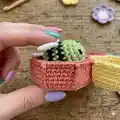
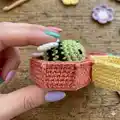
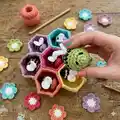
About This Sorting bees Amigurumi Pattern
This pattern creates a colorful educational sorting toy made of seven hexagon bowls, seven little bees and seven flowers with magnetic connections. It includes step-by-step round instructions, special increases for polygonal bowls, and guidance for inserting magnets safely. You will make each piece using simple stitches and assemble them into a compact, playful set suitable for kids and adults alike.
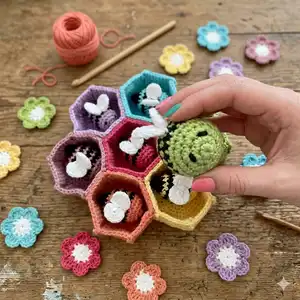
The pattern is written in US terminology and worked in continuous rounds with helpful photos and tips. Materials, abbreviations and safety notes are included so you can make a safe, durable toy set.
Why You'll Love This Sorting bees Amigurumi Pattern
I absolutely love this pattern because it combines simple amigurumi techniques with a playful, educational purpose that kids adore. I enjoy the color possibilities—making a rainbow of bowls and matching bees and flowers is so satisfying. The design uses small magnets for a tactile sorting experience, which adds an interactive element that brings the toy to life. I also love that the pattern teaches a special increase to form clean hexagon sides, a small technique that gives a big visual payoff.
Switch Things Up
I love how easy it is to customize this pattern by changing colors—try pastel shades for a soft nursery set or bright neons for a bold learning toy.
You can make it bigger or smaller by swapping yarn weight and hook size; bulky yarn and a larger hook create chunky toys while thinner yarn makes cute mini versions.
I often add embroidered faces or felt details to change the expression and personality of each bee, giving every toy a unique character.
Want to adapt it for non-magnetic play? Skip the magnets and use velcro dots or sew the bees directly into pockets for a stationary playboard.
I sometimes make matching activity cards with colored stickers to encourage color recognition and sorting games during playtime.
For a classroom set, use different textures of yarn for the bowls so children can explore tactile differences while sorting.
I recommend trying different magnet sizes and strengths; stronger magnets mean fewer pieces needed, while smaller magnets are better for compact designs.
You can also turn this into a keyring or bag charm by making a single bee with an added loop and attaching a keyring or clip.
If you enjoy sewing, try joining the hexagons in alternate layouts to make larger mats, coasters or decorative displays from the same basic bowl pattern.
I like to package mine as a travel set, sewing a small zip pouch that fits all bees and flowers securely for on-the-go play.
Common Mistakes & How to Fix Them
✗ Skipping stitch markers during rounds can cause you to lose track of the start of each round; place a stitch marker and move it each round to keep counting accurate.
✗ Not inserting magnets securely can create a choking hazard or loose parts; always sew the magnet cover firmly with several passes and test the magnet direction before final assembly.
✗ Forgetting to stuff evenly will produce lumpy bees or misshapen bodies; stuff gradually as you go and check shape frequently while adding small amounts of fiberfill.
✗ Changing colors incorrectly when making stripes can leave an awkward join; make the last half of the stitch with the old color and finish with the new color as described to create neat color changes.
✗ Overtightening your tension makes pieces stiff and hard to assemble; maintain consistent relaxed tension so hexagon bowls and bees fit together well.