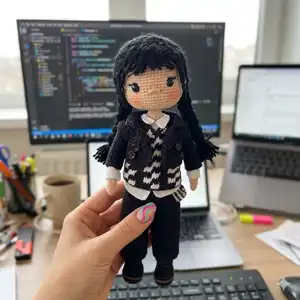
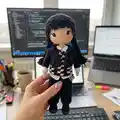
Make a charming Mimosa Doll with this detailed crochet amigurumi pattern. You will build the head, body, arms, legs and clothing step by step with clear rounds and finishing tips. The pattern includes eye and hair transplant techniques for a realistic, handcrafted look. Perfect for gifting or keeping as a cozy handmade companion.
Progress Tracker
0% Complete
— Materials :
Info :
2 pieces of peria baby soft cotton skin color 17. 1 piece of peria baby soft cotton white 13. 1 schachenmayr catania green 419. 1 schachenmayr catania purple 240. 1 gazzal baby cotton lilac 3422. 1 trade diva 55. Paper rope dark straw. 2 x viburnum etamine 840 for hair. Domino cotton perle 8 light blue K0028. Domino cotton perle 8 dark blue K00147. Domino cotton perle 8 brown K0035. Domino cotton perle 8 white. Domino cotton perle 8 black. Orenbayan cotton perle pink 465. 2.00 mm and 2.20 mm hook. 2,5 size skewer. Bead fiber. 3 x 8mm white buttons for the back of the t-shirt. 1 8mm purple button for the back of the dress. 7 6mm white buttons for the front of the dress. Etamine needle for sewing, society and quilt needle for eye embroidery. Pacifier chain rope parachute rope half meter for shoelaces. 70cm 2.5mm electrical wire to put on neck and arms. Dry crayon for make-up and aging.
— Abbreviations :
Info :
sh: magic ring. sc: single crochet. inc: increase. dec: decrease. *: repeat. hdc: half double crochet. hdcinc: half double crochet(increase). hdcdec: half double crochet(decrease). DC: double crochet. DCinc: double crochet (increase). DCdec: double crochet (decrease). Sl st: slip stitch. Ch: chain. blo: back loop knit. flo: front loop knit. M: Decrease by knitting 3 sc.
— Important Informations :
Infos :
After the row ending with sl st, pull 1 or 2 chains at the beginning of the row and rise to sc or. When we make DC, it is first dipped into the loop at the bottom of the chain. When the leg and arm are finished, sl st is done to close them. We will knit on the finished piece. When these sl sts are accepted as sc, sc is made on it. The ropes that we break off at the end of the rows and attach them to remove the loops. If you run the row in it while knitting, you will provide a neat appearance. Fill the pieces you have knitted in 5-6 rows. Knit tightly and pay attention to homogeneous filling. The baby's height is around 35cm, and the size may change depending on the hand difference. baby enough. The dress is short as it will be longer if it is knitted tightly and not well filled. may come. Therefore, the filling must be done very well. Copy the links given for eye and lip processing to the youtube search section. When you paste it, the corresponding video will open.
— Head :
Info :
Start with skin color.
Round 1 :
Magic ring into 6sc (6)
Round 3 :
(sc, inc)*6 (18)
Round 4 :
(2sc, inc)*6 (24)
Round 5 :
(3sc, inc)*6 (30)
Round 6 :
(4sc, inc)*6 (36)
Round 7 :
(5sc, inc)*6 (42)
Round 8 :
(6sc, inc)*6 (48)
Round 9 :
(7sc, inc)*6 (54)
Round 10 :
(8sc, inc)*6 (60)
Round 11 :
(9sc, inc)*6 (66)
Round 12 :
(10sc, inc)*6 (72)
Round 13-27 :
15 rows: 72sc (72)
Info :
***Go to eye processing. After the eye embroidery is finished, the head will continue to be knitted.
— Eye Processing :
Infos :
Determining the eye locations: Aligning the third increment loop on the 12th row of the head, aligning the 21. Mark with a pin between row and 22nd row. This is the middle between the eyes. Pin by counting 6 sc to the right, 5 sc to the left of the pin. Mark with . Pin the pins by placing dots in the designated places with a flying pen. Take it out. Pupils will be embroidered on the marked places. ***It's time to knit the head heads with marker. Please specify. *** There are 11 sc between the points we marked to embroider the pupils. Eye distance can be zoomed in and out optionally. *** The concept of tour will be used when processing the eye. The tour consists of two stages. First: In this stage, basting is done by sinking into the layers of the sc. Second step basting. The tour is completed by going through all the stitches made. 1- Circle with a flying pen so that the diameter of the pupils corresponds to two sc draw. Attach a single layer of black domino thread to the needle. Circle the circumference of the circle by sc. Complete the first step by basting by taking it from the folds. In the second stage round each of the stitches you have embroidered, from the outside to the inside, as in the image. Complete it. 2- Remove the needle from the upper part of the eye and pass under the opposite stitches and close the pupil. Please fill in. Horizontally down to the bottom, taking care not to overlap the threads while embroidering. ***If you could not provide an oval image to the pupil as in the image, it was surrounded by a few times. Try to get the right shape by sinking. Likewise, the other pupil process. 3- Make the iris a circle by leaving a sc around the pupil. Draw. Beginning from the upper part of the eye with a dark blue thread, wrap the loops around the iris. Process by basting from the floor. From the outside to the inside of each of the stitches you have worked. Complete the tour by passing under it as in the image. 4- Process the iris one more round. 5- Embroider the upper half of the iris with one more round of dark blue thread. *** The bottom half will be embroidered with light blue thread. 6- Make a round embroidery on the half part under the pupil with a double layer of light blue thread. *** The width and length of the iris is 4 sc. Similarly, the iris of the other eye. Process. If there are gaps in the processed areas, retouching the gaps by sinking into the head do it. 7- To process the white part of the eye, use a lower row of the inner side of the eye as in the image. Draw a circle starting at the top of the outer corner of the eye. The part of the circle on the nose side of the eye is one sc wide, the outer part slightly wider towards the top and a little more tapering towards the top required. ***Take care to draw in the same way, taking into account the drawings in the image. 8- Take the first stage by basting around the circle you have drawn, starting from the top. Complete it. At the end of the first stage, remove the needle from the starting point and Complete the tour by doing the next step. 9- Do one more round in the same way. 10- The upper white part of the eye is filled from the raw ground to the new round for starting one more round do it. *** 3 rounds of processing on the white part vacant places though if there is one more lap can be made Empty spaces can also be retouched. 11- A round will be made with the same technique between the blue and white parts of the eye with the black thread. *** Process the other eye in the same way.
Info :
Lash bottom line: 1- Plunge into the second row from the bottom of the outer part of the eye. Baste up to the corner of the eye. It sinks into the eye socket and exits from the starting point, over the basting stitches. Complete the tour. 2- One more round starting from the upper row of the lower lash line to the corner of the eye. Process it.
Info :
Eyelash: 1- One upper lash line come out of the queue as in the picture sink into the root of the eyelash. Same operation on the same eyelash again do it. 2- Determine the places of the other eyelashes as in the image. The technique of processing eyelashes is way. A small eyelash by sinking further than the point you set first will be processed. Then stick the needle under the small eyelash and insert the needle from the point we determined and sink into the root of the eyelash. Complete the other eyelashes with this technique. Eye shimmer: To the quilt needle Attach two layers of white thread. Both eyes as pictured. Process the sparkle in the same way.
Info :
***Eye processing is finished. The head will continue to be knitted.
Round 28-30 :
3 row: 72sc (72)
Round 31 :
2sc, dec, (10sc, dec)*5, 8sc (66)
Round 32 :
5sc, dec, (9sc, dec)*5, 4sc (60)
Round 33 :
(8sc, dec)*6 (54)
Round 34 :
2sc, dec, (7sc, dec)*5, 5sc (48)
Round 35 :
5sc, dec, (6sc, dec)*5, sc (42)
Info :
*** Fill in the head.
Round 38 :
2sc, dec, (5sc, dec)*5, 3sc (36)
Round 39 :
(4sc, dec)*6 (30)
Round 40 :
(3sc, dec)*6 (24)
Info :
*** Fill in the head. While filling the head, it is as round as possible without breaking its form. Fill it up. After the filling process is finished, filling to the sides If you do, the head will be more rounded.
Round 41 :
(sc, dec)*8, sl st (16)
Info :
***The head is finished, cut the rope.
Info :
Nose: Two rows below the eye, coinciding with the middle of the two eyes. sc will be processed with spacing. Separate the yarn into layers. 4-5 times as in the picture embroider the nose out.
Info :
Brow: One row above lashes, 5 sc wide and 9 sc between brows leave and process the eyebrows. Follow the images.
Info :
Lip: Lip with pins, leaving 3 sc spacing 4 sc down the nose. Determine your location. Attach the thread to the needle in two layers. Triangle shape for lip processing will be created. Enter through the neck space and exit from the designated point on the left. Dip into the line in the middle of the lip and exit from the determined point on the right. To form the edge, sink into the upper point and exit the neck gap. From the left of the lip enter and exit the neck cavity by sinking to the right.
Round 1 :
Lip shaping will be created by wrapping the triangle. Embroider by inserting the thread from the bottom and exiting from the top. Starting from the top left edge. Wrap the rope 5 times. Make sure that the rope you wrap does not overlap and that it is side by side. Make sure it stays regular. Do the same with the right edge of the upper lip. Complete the round by wrapping the bottom edge 6-7 times.
Round 2 :
In the second round, insert the needle from the outside to the inside and Make 3-4 loops on the lips, top this round not making the wraps made on the lips to the edges of the lips. If you make it towards the middle part, the lip volume is more proportional. Make 4-5 loops on the lower lip. Do the intensity in the middle of the lower lip. *** Lip augmentation optionally with the same technique can be increased. Lip line: Make the lip line by following the images. Sink, skipping a sc on the sides.
— Arm :
Info :
Start with skin color.
Round 1 :
Magic ring into 6sc (6)
Round 2 :
2inc, sc, 2inc, sc (10)
Round 3 :
2sc, inc, 4sc, inc, 2sc (12)
Round 4 :
3sc, inc, 5sc, inc, 2sc (14)
Round 5 :
4sc, inc, 9sc (15)
Round 6-8 :
3 rows: 15sc (15)
Round 9 :
4sc, dec, 6sc, dec, sc (13)
Round 11-36 :
26 rows: 12sc, sl st, finished, break yarn (12)
Info :
***The arms will not be filled with fiber. Knit the other arm in the same way.
— Foot :
Info :
Start with tan yarn. The two feet will be knitted with the same and the right and left legs will be continued with separate.
Round 1 :
Draw 9ch. Starting from 2ch, 2sc, 6sc into the first loop, 3sc, 7sc into the same loop (18)
Round 2 :
inc, 8sc, inc, 8sc (20)
Round 3-10 :
8 rows: 20sc (20)
Round 11 :
3sc, pull 7ch and skip 9sc, 8sc
Round 12 :
3sc, 7sc over 7 chains, 8sc (18)
Info :
*** It will be continued with the heel part.
Round 13 :
(sc, dec)*6 (12)
Round 14 :
6dec, heel over, leave a long string to gather the heel and break the string.
Info :
*** With the needle, collect the 6 sc from the flo loops and tighten well, knot the thread inside the foot and hide it. *** The foot is over, it will be passed to the leg. Knit the other foot in the same way.
— Leg :
Info :
MUST READ! *** Right and left leg nomenclature; represents the baby's right and left legs is doing. If this is not taken care of, the legs may fall out. *** The is the same until the knee cap on the right and left legs; The fact that the calf of the right leg protrudes to the right and the calf of the left leg to the left is completely related to the filling. While filling, try to obtain the form in the visuals by checking the image by putting the leg a little farther away. *** The shape of the legs depends on the regularity of the filling, and it is absolutely necessary to fill in every 5-6 rows.
— Left leg :
Info :
*** While filling, the left foot and leg should always be filled to the left of the leg, creating a protruding image on the calf and carefully filling. If the filling in the feet and legs is not done carefully and regularly, the crooked and protruding appearance of the heels, calves and knees may not be achieved.
Round 1 :
Turn the back of the foot and pull 7ch, attach the rope to the 4th loop of the loop, 4sc on the chain, one sc in the gap between the front part and the sole, 9sc in the front, one sc in the remaining space between the front part and the sole, 3sc on the chain (18)
Info :
*** This will be the top of the line.
Round 2 :
4sc, dec, 7sc from flo, dec, 3sc (16)
Info :
*** Fill the foot without disturbing the form.
Round 3-6 :
4 rows: 16sc (16)
Info :
*** Fill in the wrist. (Pay attention to the tricks written in the important notes in the leg filling.)
Round 9 :
sc, inc, 15sc (18)
Round 11 :
2sc, inc, 15sc (19)
Round 12 :
3sc, inc, 15sc (20)
Info :
*** Fill the leg. When we turn the toe to ourselves, the right part of the left leg will be the calf (blue arrow side) and this side will be protruded. Always add more filling to the protruding part. Keep the leg away and check the image frequently.
Round 14 :
4sc, inc, 15sc (21)
Round 16 :
5sc, inc, 15sc (22)
Round 18 :
6sc, inc, 15sc (23)
Round 19-23 :
5 rows: 23sc (23)
Info :
***The side indicated by the arrow should be filled with a more oval and the other side should be left more vertical. More filling should be done on the arrow side.
Round 24 :
5sc, dec, sc, dec, 13sc (21)
Round 26 :
4sc, dec, sc, dec, 12sc (19)
Round 27 :
5sc, dec, 5sc, 4inc, 3sc (22)
Info :
*** It is the 4inc kneecap made in the 27th row. If there is a shift in the raises due to the hand difference, you can scroll the knee raises. Change the head of the line accordingly and continue with the .
Round 29 :
11sc, 4dec, 3sc (18)
Round 30 :
4sc, inc, sc, inc, 11sc (20)
Round 32 :
6sc, inc, 13sc (21)
Round 34 :
6sc, inc, sc, inc, 12sc (23)
Round 36 :
8sc, inc, 14sc (24)
Round 38 :
9sc, inc, 14sc (25)
Round 40 :
10sc, inc, 14sc (26)
Round 42 :
11sc, inc, 14sc (27)
Round 44 :
12sc, inc, 14sc (28)
Round 45 :
4sc with tan thread, 24sc with white thread (28)
Info :
*** White rope is used for the leg part of the shorts.
Round 47 :
4sc, sl st, finish, break thread. Left leg done.
— Right leg :
Info :
*** When filling, the right foot and leg should always be filled to the right of the leg to create a protruding image on the calf. The right leg is knitted with the same as the left leg until the 26th row. The difference in appearance in the two lower legs is all about filling.
Round 1 :
Turn the back of the foot and pull 7ch, attach the rope to the 4th loop of the loop, 4sc on the chain, one sc in the gap between the front part and the sole, 9sc in the front, one sc in the remaining space between the front part and the sole, 3sc on the chain (18)
Info :
*** This will be the top of the line.
Round 2 :
4sc, dec, 7sc from flo, dec, 3sc (16)
Info :
*** Fill the foot without disturbing the form.
Round 3-6 :
4 rows: 16sc (16)
Round 9 :
sc, inc, 15sc (18)
Round 11 :
2sc, inc, 15sc (19)
Round 12 :
3sc, inc, 15sc (20)
Round 14 :
4sc, inc, 15sc (21)
Round 16 :
5sc, inc, 15sc (22)
Round 18 :
6sc, inc, 15sc (23)
Round 19-23 :
5 rows: 23sc (23)
Round 24 :
5sc, dec, sc, dec, 13sc (21)
Round 26 :
4sc, dec, sc, dec, 12sc (19)
Round 27 :
5sc, dec, 7sc, 4inc, sc (22)
Info :
*** It is the 4inc kneecap made in the 27th row. If there is a shift in the raises due to the hand difference, you can scroll the knee raises. Change the head of the line accordingly and continue with the .
Round 29 :
13sc, 4dec, sc (18)
Round 30 :
4sc, inc, sc, inc, 11sc (20)
Round 32 :
6sc, inc, 13sc (21)
Round 34 :
7sc, inc, sc, inc, 11sc (23)
Round 36 :
8sc, inc, 14sc (24)
Round 38 :
9sc, inc, 14sc (25)
Round 40 :
10sc, inc, 14sc (26)
Round 42 :
11sc, inc, 14sc (27)
Round 44 :
12sc, inc, 14sc (28)
Round 45 :
23sc with tan thread, 5sc with white thread (28)
Info :
*** White rope is used for the leg part of the shorts.
Round 47 :
23sc, don't break the string, it will be continued into the stem. Right leg done.
— Body :
Info :
IMPORTANT READ! Feet will be bent inward and legs will be turned towards each other (crooked). If the desired crookedness is not achieved even though you have combined the legs according to the due to the hand difference, combine the legs by aligning them at the desired skewness. Then continue with the same schedule. ***Continue with the white rope. Baby's shorts are made.
Round 1 :
Continue on the right leg, pull 4ch, sink into the first loop next to the sl st loop we closed on the left leg, and make 14 sc, a Raise, 13 sc into the left leg. Make 4sc on the 4ch. Switching to right leg, make 13 sc, one Raise, 14 sc. Do 4sc on Ch. (66) (This will be the headland)
Round 2-7 :
6 rows: 66sc (66)
Info :
*** Fill the baby's body and leg joints well. If this area is not filled well, the legs and hips will look frail.
Round 8 :
15sc, dec, 31sc, dec, 16sc (64)
Round 9 :
14sc, dec, 31sc, dec, 15sc (62)
Round 10 :
13sc, dec, 31sc, dec, 14sc (60)
Round 11 :
12sc, dec, 31sc, dec, 13sc (58)
Round 12 :
11sc, dec, 31sc, dec, 12sc (56)
Round 13 :
10sc, dec, 31sc, dec, 11sc (54)
Round 14 :
9sc, dec, 31sc, dec, 10sc (52)
Round 15 :
8sc, dec, 31sc, dec, 9sc (50)
Round 16 :
7sc, dec, 31sc, dec, 8sc (48)
Round 17 :
6sc, dec, 31sc, dec, 7sc (46)
Round 18 :
5sc, dec, 31sc, dec, 6sc (44)
Round 19 :
4sc, dec, 31sc, dec, 5sc (42)
Round 20 :
3sc, dec, 31sc, dec, 4sc, shorts over, tan to be continued. (40)
Info :
*** For a good view of the hips and hips, fill the fiber towards the hips by pushing. Be careful not to leave any unfilled spaces.
Round 21-41 :
21 row: 40sc (40)
Info :
*** At this time, arm joining will be started. Align the ends of the arms to face the body. (The remaining thread at the end of the arms should remain under the arm.) ***If there is a slip due to hand difference, align the arms according to yourself, arrange the loop head loop accordingly and continue knitting according to the .
Round 42 :
12sc, sinking arm and body together 3sc, 17sc, sinking arm and body together 3sc, 5sc (40)
Round 43 :
12sc, 9sc on arm, 17sc, 9sc on arm, 5sc (52)
Round 44 :
10sc, dec, 9sc, dec, 13sc, dec, 9sc, dec, 3sc (48)
Round 45 :
10sc, dec, 7sc, dec, 13sc, dec, 7sc, dec, 3sc (44)
Round 46 :
9sc, dec, 2sc, m, 2sc, dec, 11sc, dec, 2sc, m, 2sc, dec, 2sc (36)
Round 47 :
7sc, dec, 2sc, m, 2sc, dec, 7sc, dec, 2sc, m, 2sc, dec (28)
Info :
*** Prepare the wires to be put on the arms by cutting them about 3 cm longer than the arm and taping them as in the image. The end of the wire should be bent in half and taped. *** Fill in the form without disturbing the body. Place the wires on the arms as in the image.
Round 48 :
dec, 3sc, dec, 2sc, m, 2sc, dec, 3sc, dec, 2sc, m, 2sc (20)
Round 49 :
(3sc, dec) *4 (16)
Round 50-53 :
4 row: 16sc (16)
Round 54 :
2sc, sl st, body done. Leave a long thread to sew the head. Lightly fill the groin and shoulders.
Info :
Sewing the Head to the Body: Fold the wire you cut about 35 cm long and tape the ends. Putting half on the body and half on the head; Sew head and body together.
— Hair Transplant :
Infos :
Hair transplantation technique: The hair rope is wrapped in a book so that the length of a hair strand is about 50 cm and the hair is prepared. (When the hair is folded, it will be around 25 cm.) The hair is transplanted with the technique shown in the photos below. Double layers of rope will be used in hair transplantation. 1- Facial hair transplantation; The hair on the forehead will be planted eight rows above the eyebrow. Find the midpoint on the forehead, aligned with the nose. Draw the forehead line with the flying pen, counting 6 sc from the midpoint to the right and left. Plant 11-12 strands of hair on the forehead. ***The sides of the face are aligned under the eyes; nine on the right between the eye and the hair (right side when the baby is facing us); hair is planted on the left side, leaving ten sc spacing. Straight planting is done in vertical lines up to the highest point of the eyebrow. Afterwards, the hair is attached by sliding towards the forehead like a ladder. ***10 hair transplants were performed on the vertical lines on the side of the face. *** 8 hair strands were attached by scrolling. 2- Hair transplant on the nape; Create the nape line by drawing straight on the back of the head. Beginning from the right of the head, enter the line and exit from the upper row to perform the hair transplantation. 3- Planting of the midline; When the hair is divided into two in the middle and tied, double-sided hair will be planted from the forehead to the nape in order to maintain the image. Take the middle line from the middle to the magic ring; Draw straight from the magic ring to the neck as in the image. 4- Hair transplantation to the empty parts; sow by skipping three rows one sc apart. Plant more frequently, skipping two rows at the top. *** When the planting is over, comb the hair with your hands and straighten them and cut them to the same length. *** Lightly color the cheeks, under the eyebrows, above the nose and knees with dry crayons.
— T-Shirt :
Info :
Start with the white rope.
Round 1 :
40ch, starting chain 2 5sc, inc, 8hdcinc, inc, 9sc, inc, 8hdcinc, inc, 5sc, back
Info :
*** It means that the 1st row hdcinc will be increased by making a handrail.
— Mimosa Baby Clothing :
Round 3 :
1ch, 6sc, inc, 16hdc, inc, 11sc, inc, 16hdc, inc, 6sc, back
Round 5 :
1ch, 7sc, inc, 5hdc, 3hdcdec, 5hdc, inc, 13sc, inc, 5hdc, 3hdcdec, 5hdc, inc,7sc, return
Round 6 :
1ch, 9sc, 3ch and jump 13hdc, 17sc, 3ch and 13hdc Skip, 9sc, back
Round 7 :
1ch, 3sc, inc, 5sc, 3sc to a multiple of 3 chains, 17sc, 3sc to a multiple of 3 chains, 5sc inc, 3sc, back (41)
Info :
*** Make 3sc using a multiple of 3 chains. For the sleeve end of the t-shirt, sc will be passed to the other floor.
Round 9 :
1ch, 4sc, inc, 31sc, inc, 4sc back (43)
Round 10-14 :
5 rows: 1ch, 43sc, back (43)
Round 15 :
1ch, 5sc, inc, 31sc, inc, 5sc, back (45)
Round 16-22 :
7 rows: 1ch, 45sc, back (45)
Round 23 :
1ch, 45sc, turning the side of the shirt without breaking the thread to make the buttonholes of the shirt; 1ch, 6sc, 7ch (1st buttonhole), 7sc, 7ch (2nd buttonhole), 7sc, 7ch (3rd buttonhole), 2sc, sl st, break thread.
Info :
Attach the rope to the other side of the t-shirt from the collar and make 22sc, sl st, break the rope. *** If the t-shirt is tight when dressed, a few rows can be knitted on 22sc.
Info :
The right sleeve of the T-shirt; When you turn the back of the t-shirt, start with the arm on the right. Attach the string to the junction of the body and arm parting on the back of the t-shirt. 1ch, sc where arm and body meet, 13sc over arm, sc where arm and body meet, 3sc over the chain we pulled while knitting the body, sl st, break yarn (18)
Info :
The left sleeve of the T-shirt; Attach the string to the junction of the body and arm parting on the back of the t-shirt. 1ch, sc where the arm and body meet, 3sc over the chain we pulled while knitting the body of the dress, sc where the arm and body meet, 13sc over the arm, sl st, break the rope. (18) *** The t-shirt is finished, sew the buttons.
— Salopet :
Info :
Start with the purple yarn. In the salopette, the reverse direction of the knitting will be used.
Round 1 :
Pull 59ch, make 52sc starting from 8ch, break the rope. *** The 7ch left at the beginning of the chain will be the buttonhole.
Info :
*** In order for the baby to be dressed comfortably, the rope will be cut up to the 16th row and reattached to the beginning of the row. Walk the remaining threads that we cut at the beginning and end of the row in knitting. Knit these sc more tightly so that the sc you are now carrying the ropes do not look wider.
Round 2 :
Attach the yarn to the first loop. (Insert the buttonhole side.) 1ch, 52sc, break the yarn.
Round 3 :
Attach the thread to the first loop. 1ch, 52sc, break thread.
Round 4 :
Attach the thread to the first loop. 1ch, sc, inc, 10sc, inc, 26sc, inc, 10sc, inc, sc. (56)
Round 5-6 :
2 rows: Attach the thread to the first loop. 1ch, 56sc, break thread.
Round 7 :
Attach the thread to the first loop. 1ch, 13sc, inc, 28sc, inc, 13sc. (58)
Round 8 :
Attach the thread to the first loop. 1ch, 58sc, break thread.
Round 9 :
Attach the yarn to the first loop. 1ch, sc, inc, 54sc, inc, sc break yarn. (60)
Round 10 :
Attach the thread to the first loop. 1ch, 60sc, break thread.
Round 11 :
Attach the yarn to the first loop. 1ch, 14sc, inc, 30sc, inc, 14sc, break thread. (62)
Round 12 :
Attach the yarn to the first loop. 1ch, 62sc, break thread.
Round 13 :
Attach the thread to the first loop. 1ch, sc, inc, 58sc, inc, sc break yarn. (64)
Round 14 :
Attach the yarn to the first loop. 1ch, 15sc, inc, 32sc, inc, 15sc, break thread. (66)
Round 15 :
Attach the thread to the first loop. 1ch, sc, inc, 62sc, inc, sc break yarn. (68)
Round 16 :
Attach the thread to the first loop. Join the row by making 1ch, 68sc, sl st. *** After this row, the rope will be continued without breaking.
Info :
Since the baby's size is different due to the hand difference in knitting, if you try the salopette but it does not work, the can be continued by breaking a few more rows of yarn. *** Since the reverse direction of the knitting will be used, the scs will be knitted in reverse. Rows will be knitted counterclockwise by inserting the crochet from the inside of the knitting.
Round 17 :
1ch, 68sc, sl st
Round 18 :
1ch, 17sc, inc, 33sc, inc, 16sc, sl st (70)
Round 19-21 :
3row: 1ch, 70sc, sl st
Round 22 :
1ch, 18sc, inc, 34sc, inc, 16sc, sl st (72)
Round 23-25 :
3row: 1ch, 72sc, sl st
Round 26 :
1ch, 19sc, inc, 36sc, inc, 15sc, sl st (74)
Round 27-30 :
4 rows: 1ch, 74sc, sl st
Info :
*** The ruffle of the salopette will be made.
Round 31 :
1ch, 74inc from flo, sl st (148)
Round 32-33 :
2 rows: 1ch, 148sc, sl st, break thread.
Info :
*** The skirt part of the salop is finished. Skirt length can be changed upon request.
Info :
The front part of the salopette; Start counting from the non-buttoned side of the salopette and attach the thread to 21.sc. Rows 1-8 (8 rows): 1ch, 14sc, back. Row 9: 1ch, skip one sc and 11sc, skip one sc and sl st, break the string.
Info :
Hangers: Attach the thread to the first loop of the buttonhole side of the salopette; Pull 1ch and pull 4 sl st, 33ch (hanger) starting from the first stitch on the side. From the 2nd chain, make 32hdc on the hanger and knit into the next loop with sl st. Salopete 12 sl st, 8sc next to front piece, inc front of front piece, 10sc, inc, next to front piece 8sc, salope 13 sl st, 33ch(hanger), 2nd from chain 32hdc, sl st into next loop with sl st, make 6sl st. Turning to the side, make 15sc until the middle parting, because the edge of the salopette made by breaking the rope is not regular, close it by making a sl st. Since the other edge is regular, the sc is not crossed. ***The length of the straps can be adjusted according to the baby and the number of chains can be changed. Sew so that the ends of the straps are under the corners of the front piece.
Info :
Pockets: Row 1: pull 9ch, 8sc from chain 2, back. Row 2-3 (2 rows): 1ch, 8sc, back. Row 4: 1ch, skip 1sc, 7sc, back. Row 5: 1ch, 7sc, back. Row 6: 1ch, skip 1sc, 6sc back. Row 7: 1ch, 6sc, back. Row 8: 1ch, skip 1sc, 5sc, done. Leave thread for sewing. Knit the other pocket.
Info :
*** Sew the front buttons of the salopette and the back button as in the image. Starting to count the pockets from the flock at the hem, sew in 7 rows with 11 sc between them. Wear dry crayon on the front part, pocket and pocket tops and touch it lightly with your finger.
This Mimosa Doll pattern brings a lovely handmade baby doll to life with planted hair, embroidered eyes and tiny clothing. Follow the step-by-step rounds and finishing tips to create a cherished keepsake that looks both realistic and adorable. Whether for a gift or your own collection, you will enjoy the careful shaping and sweet details. 🧶 Sew, plant, and love your Mimosa Doll! 🧵