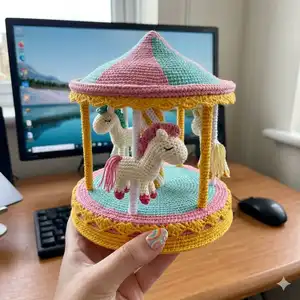
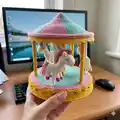
Make a charming handmade carousel with three little horses — a bright, detailed amigurumi project that mixes crochet with simple hardware assembly. You will create the base, striped central post, a conical roof, and three mini horses for a playful rotating display. This pattern combines sewing, gluing, and crocheting for a rewarding, decorative keepsake you can proudly display or gift.
Progress Tracker
0% Complete
— Horses :
Info :
For horse body use ivory Alize Cotton Gold Hobby 01. For hooves and mane with tail, use bright shades of the same color: darker for hooves and lighter for mane and tail. Use a contrasting yarn piece as a marker for easier rounds counting. Start crocheting with ivory yarn.
Round 3 :
(1 sc, inc)*6=18 sc
Rounds 4-6 :
3 rounds of 18 sc. Finish with a sl st, leave a long end. Set aside the detail (this is the muzzle of a horse).
Info :
Chain 7 with ivory yarn to make muzzle base.
Round 1 (muzzle) :
3 sc in the second loop from the hook, 4 sc along the chain, 3 sc in the last loop of the chain. Turn the work and crochet along the bottom side of the chain 4 sc = 14 sc around.
Round 2 :
inc*3, 4 sc, inc*3, 4 sc = 20 sc
Round 3 :
(1 sc, inc)*3, 4 sc, (1 sc, inc)*3, 4 sc = 26 sc
Round 4 :
(1 sc, inc, 1 sc)*3, 4 sc, (1 sc, inc, 1 sc)*3, 4 sc = 32 sc
Rounds 5-8 :
4 rounds of 32 sc. Finish with a sl st, leave a long end. Set aside the detail (muzzle).
Round 9 :
Work only 14 sc (begin forming the neck opening)
Rounds 10-12 :
Do not continue the round, but go right to the first st of the round (the first one after the marker) and work spiral rounds of the 14 sc. Sc 3 rounds up - it should be the neck.
Info :
Thread the end of the yarn from the muzzle into the needle and sew to the neck. To do this sew together 2 sc of the neck (right in the center of the neck front) and 2 sc of the muzzle.
Round 13 :
Work around both parts 28 sc.
Round 14 :
Make a decrease at the junction of the neck with the muzzle on both sides, it turns out 26 sc.
Round 15 :
Make 1 more decrease on both sides in the same place, 24 sc remain.
Round 17 :
(2 sc, dec)*6=18 sc. Stuff the neck and the muzzle of the horse.
Round 18 :
(1 sc, dec)*6=12 sc
Round 19 :
Dec every st until the opening closes, adding fiberfill if necessary. Cut the yarn and hide the end.
Info :
Stuff the body and sew the opening on the back.
— Legs :
Info :
Start crocheting with colored yarn: 6 sc in AR, then sc one more round of 6 sc with colored yarn and 4 rounds of ivory yarn. Finish with a sl st. Do not stuff, leave a long end. Make 4 pcs.
Info :
Sew the legs to the body.
— Ears :
Info :
For ears crochet small triangles with ivory yarn. Chain 5.
Round 2 :
Do not make a turning ch, insert the hook right into the second st = 3 sc
Round 3 :
Do not make a turning ch, insert the hook right into the second st = 2 sc
Round 4 :
Do not make a turning ch, insert the hook right into the second st = 1 sc. Leave a long end.
Info :
Thread the end of the yarn into the needle and sew together the 2 corners of the triangle. Sew the ear to the horse head. Crochet and sew the second ear in the same way.
— Mane and Tail :
Info :
Crochet the mane with yarn a little lighter than the hooves. Attach the yarn to the forehead of the horse, crochet 3 ch and 2 dc in the same point. Next, crochet along the neck for 3 dc from each point, inserting the hook under the posts along an imaginary line. At the end, crochet 2 dc and 3 ch, finish with a sl st. Cut the yarn and hide the end. For the tail, cut 4 pieces of yarn 10 cm each. Fasten one thread at a time.
Info :
Embroider eyes with thin black yarn. Crochet 2 more horses in other colors following the same instructions.
— Carousel Frame Assembly :
Info :
For the frame, you will need 2 round plywood blanks for clocks with a diameter of 20 cm. Also grab wooden beads with a diameter of 1 cm (8 pcs). You will need a screw 8 mm * 100 mm, 3 nuts suitable for it (8 mm), 2 large washers and 1 small one. Plastic pipe couplings 5 pcs * 20 mm (inner diameter) or a cardboard tube with 28 mm outer diameter for the central post. Glue in this project must be used for structural strength.
Step :
Glue 5 plastic sleeves together with ordinary tape (or cut a cardboard/plastic tube with a diameter of 28 mm and a length of about 17.5 cm).
Step :
Glue 4 beads on one of the wooden circles at the same distance. Glue 4 more beads between them on the other side.
Step :
Insert the screw into the hole and fix it with a nut on the reverse side, applying a drop of superglue under the nut.
Step :
Put washers on the screw in this order: large, small, large. Put a second wooden circle on the screw. Check that it should spin freely without touching the beads. At the same time, the beads will not allow it to fall sideways.
— Base Crochet :
Info :
Let's start crocheting the base. Work spiral rounds with turquoise yarn using a marker. I use a contrasting color piece of yarn.
Round 1 :
Chain 12, sl st in the 1st loop.
Round 2 :
(1 sc, inc)*6=18 sc
Round 3 :
1 sc, inc, (2 sc, inc)*5, 1 sc=24 sc
Round 4 :
(3 sc, inc)*6=30 sc
Round 5 :
2 sc, inc, (4 sc, inc)*5, 2 sc=36 sc
Round 6 :
(5 sc, inc)*6=42 sc
Round 7 :
3 sc, inc, (6 sc, inc)*5, 3 sc=48 sc
Round 8 :
(7 sc, inc)*6=54 sc
Round 9 :
4 sc, inc, (8 sc, inc)*5, 4 sc=60 sc
Round 10 :
(9 sc, inc)*6=66 sc
Round 11 :
5 sc, inc, (10 sc, inc)*5, 5 sc=72 sc
Round 12 :
(11 sc, inc)*6=78 sc
Round 13 :
6 sc, inc, (12 sc, inc)*5, 6 sc=84 sc
Round 14 :
(13 sc, inc)*6=90 sc
Round 15 :
7 sc, inc, (14 sc, inc)*5, 7 sc=96 sc
Round 16 :
(15 sc, inc)*6=102 sc
Round 17 :
8 sc, inc, (16 sc, inc)*5, 8 sc=108 sc
Round 18 :
(17 sc, inc)*6=114 sc
Round 19 :
9 sc, inc, (18 sc, inc)*5, 9 sc=120 sc
Round 20 :
(19 sc, inc)*6=126 sc
Round 21 :
10 sc, inc, (20 sc, inc)*5, 10 sc=132 sc
Info :
Change yarn to the pink and continue crocheting to the edge of the wooden circle. Keep in mind that due to varying gauges, you may need more or fewer rounds in the base circle.
Round 22 :
(21 sc, inc)*6=138 sc
Round 23 :
11 sc, inc, (22 sc, inc)*5, 11 sc=144 sc
Round 24 :
(23 sc, inc)*6=150 sc
Round 25 :
12 sc, inc, (24 sc, inc)*5, 12 sc=156 sc. Finish with a sl st. Do not fasten off.
Round 26 :
156 sc through the back loops.
Rounds 27-31 :
3 rounds of 156 sc through both loops. Finish with a sl st. Cut the yarn.
Info :
Join yellow yarn to the 25th round and work through the front loops: skip 2 st, (3 dc, 1 ch, 3 dc) in the third st. Skip 2 st, 1 sc in the 6th st. Repeat around. Cut the yarn and fix the end.
Info :
Join yellow yarn to the end of the last pink round and sc in the pink st capturing the ch loop on the top of the yellow corners. At these points, crochet 2 sc in 1 st. It turns out alternation (5 sc, inc)* until the end of the round.
Info :
Crochet 3 more rounds without inc. Put the crocheted canvas on the base, gluing it to the plywood around the screw by about half the radius.
— Frame Finishing :
Info :
Tighten the 2 nuts in such a way that there is a gap of about 1-2 mm between the floor and the lower nut so that the top circle can rotate. Glue nuts with superglue.
— Central Post (Striped) :
Info :
Crochet the central post with yellow and white colors. Chain as long as necessary to wrap around the pipe. Sl st in the 1st loop. The example used 24 loops. You will calculate the stripes pattern. The author used an alternation of 2 yellow and 3 white sc. For even stripes, 25 sc in a round will need; in order for the strips to twist, the author used 24 loops (one less). If you get a different amount of ch, try another pattern such as 2 yellow and 2 white sc, then the number of loops should be a multiple of 4 minus 1 (23 or 27), or 3 yellow and 3 white then multiple of 6 minus 1 (23 or 29).
Instruction :
Crochet 2 yellow sc, 3 white sc. Change the yarn color in this order: leave the second yellow sc incompleted (2 loops on the hook). Finish the yellow st with white yarn and continue crocheting with white. Due to the lack of one loop the colored stripes will shift and spiral. Crochet as high as the pipe is, insert the pipe inside. Cut the yarn and hide the ends.
Info :
Glue the lower edge of the pipe to the base with a hot glue gun. Be careful not to get glue on the screw and nuts otherwise it will interfere with rotation. For reliability, also sew the bottom of the pipe to the base using white and yellow yarn alternately.
— Roof (Fishing Line Reinforced) :
Info :
Let's crochet the roof. To keep the roof in shape, we will crochet it with fishing line. Need ordinary fishing line with a diameter of 1 mm. Clamp the skein with a hairpin to avoid tangling. First, melt the tip of the fishing line with a lighter to form a small ball at the end so it doesn't slip out of crocheting.
Round 1 :
Start crocheting with pink yarn. 6 sc in AR
Round 2 :
inc*6=12 sc. Starting from the second round, apply the fishing line to the previous round and crochet so that it passes under the stitches.
Round 3 :
(1 sc, inc)*6=18 sc
Round 4 :
Join turquoise yarn and crochet in this order: (pink 2 sc, inc, turq 2 sc, inc)*3=24 sc. Do not forget to change the yarn color correctly.
Round 5 :
(pink 3 sc, inc, turq 3 sc, inc)*3=30 sc
Round 6 :
(pink 4 sc, inc, turq 4 sc, inc)*3=36 sc
Round 7 :
(pink 5 sc, inc, turq 5 sc, inc)*3=42 sc
Round 8 :
(pink 6 sc, inc, turq 6 sc, inc)*3=48 sc
Info :
Important! The roof scheme corresponds to the usual flat circle. Its shape will depend on the tension of the fishing line. In the beginning, try to pull the line a little more to get a conical shape. Further from the middle, the fishing line should lie looser so the shape becomes flatter toward the edges. Crocheting should not be too loose, otherwise the fishing line will freely crawl; the stitches should hold it tightly.
Round 9 :
(pink 7 sc, inc, turq 7 sc, inc)*3=54 sc
Round 10 :
(pink 8 sc, inc, turq 8 sc, inc)*3=60 sc
Round 11 :
(pink 9 sc, inc, turq 9 sc, inc)*3=66 sc
Round 12 :
(pink 10 sc, inc, turq 10 sc, inc)*3=72 sc
Round 13 :
(pink 11 sc, inc, turq 11 sc, inc)*3=78 sc
Round 14 :
(pink 12 sc, inc, turq 12 sc, inc)*3=84 sc
Round 15 :
(pink 13 sc, inc, turq 13 sc, inc)*3=90 sc
Round 16 :
(pink 14 sc, inc, turq 14 sc, inc)*3=96 sc
Round 17 :
(pink 15 sc, inc, turq 15 sc, inc)*3=102 sc
Info :
Crochet as high as necessary to form the roof cone. Insert fishing line through rounds as you work so it is hidden beneath stitches and forms the structure. Cut yarn and hide ends when finished. Optionally add a scalloped yellow edging as described in the base instructions by joining yellow yarn to round 25 of base and crocheting corners.
— Final Assembly :
Step :
Glue the crocheted canvas to the plywood base around the screw by about half the radius. Ensure the canvas is centered and glued smoothly.
Step :
Insert the striped pipe (central post) into the base and glue the lower edge of the pipe to the base with a hot glue gun. Avoid getting glue on the screw and nuts. Sew the bottom of the pipe to the base using white and yellow yarn alternately for reliability.
Step :
Glue or attach the roof to the top circle so that the fishing-line-coned roof sits centered over the post. Attach horses to the plastic sleeves or wooden posts around the central post at equal distances. Secure horses by sewing or gluing their long yarn ends into the sleeves/pipe supports. Add any final decorations and weave in all ends.
Info :
Check rotation: tighten nuts allowing approx 1-2 mm clearance between the floor and lower nut so the top circle rotates freely. Glue nuts with superglue to fix position.
This whimsical Merry-go-round combines amigurumi charm with clever structural details to create a keepsake carousel full of personality. Follow the step-by-step rounds, color changes, and assembly tips to make a rotating display your family will adore. Perfect as a decorative gift or nursery accent — have fun stitching every little horse and detail! 🧶✨🎠