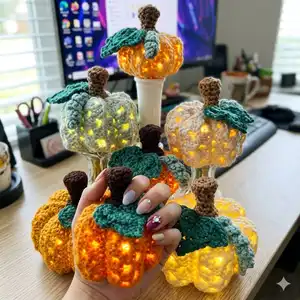
Make charming lighted pumpkins using a simple granny-cluster technique that creates beautiful texture and glowing centers. This pattern includes three sizes so you can create a coordinated display for fall decor, parties, or gifts. You will love the quick shaping and the way the battery fairy lights shine through the stitches. Perfect for adapting colors and adding leaves, stems, or vines for a personalized touch.
Progress Tracker
0% Complete
— How to Make a Magic Circle :
Infos :
1. Form the yarn into a circle. 2. Cross the top thread under the circle and pull through as though you�re about to create a slip knot, but do not tighten the circle. 3. Insert hook into the loop. 4. While pinching the yarn tail and circle firmly together, ch 1. This chain helps secure the yarn, and does not count as a stitch. 5. Crochet the first row�s stitches (ex: 6 sc) into the circle, being sure to crochet over both strands of yarn. 6. Pinch the yarn tail firmly between your thumb and forefinger, and pull tightly until circle closes. 7. Finished! The first round of the pattern is now complete with a clean, tight center. Look! No hole!
Info :
All instructions are in Standard/US terms.
— Large Pumpkin :
Info :
Hook size: US H8/5.00mm. Yarn: Caron One Pound in Cream or Red Heart Super Saver in Gold. Turning chains do not count as stitches.
Round 0 :
Begin by working ch 14.
Round 1 :
sc in second chain from hook and in next st, 2 sc, sc, [2 sc in next 2 st, sc] 2 times, 2 sc, sc in last 2 st. Ch 1, turn. (19 st) (Fig. L-1)
Round 2 :
sc in first two st, ch 1, sk st, [3 dc in next st, ch 1, sk 2 st] 4 times, 3 dc in next st, ch 1, sk st, sc in last 2 st. Ch 1, turn. (2 sc on each end + 5 granny clusters) (Fig. L-2)
Round 3 :
sc in first two st, ch 1, dc in first ch-1 space, ch 1, [sk 3 st, 3 dc in next ch-1 space, ch 1] 4 times, sk 3 st, dc in last ch-1 space, ch 1, sc in last two st. Ch 1, turn. (2 sc on each end + 4 granny clusters) (Fig. L-3)
Round 4 :
sc in first two st, ch 1, sk first ch and dc st, [3 dc in next ch-1 space, ch 1, sk 3 st] 4 times, 3 dc in next ch-1 space, ch 1, sk last dc and ch-1 space, sc in last 2 st. Ch 1, turn. (2 sc on each end + 5 granny clusters) (Fig. L-4)
Round 5 :
sc in first two st, ch 1, dc in first ch-1 space, ch 1, [sk 3 st, 3 dc in next ch-1 space, ch 1] 4 times, sk 3 st, dc in last ch-1 space, ch 1, sc in last two st. Ch 1, turn. (2 sc on each end + 4 granny clusters) (Fig. L-5)
Round 6 :
— (for this decrease row, do not count ch-1 spaces as stitches; skip over them as though they don�t exist) — sc in first 2 st, [sc2tog, sc] 5 times, sc in last st. Ch 1, turn. (13 stitches) (Fig. L-6)
Round 7 :
— working in front loops only — sc in first 2 st, 2 sc, sc, [2 sc in next 2 st, sc] 2 times, 2 sc, sc in last 2 st. Ch 1, turn. (19 st)
Round 8 :
— working in both loops from now on — sc in first two st, ch 1, sk st, [3 dc in next st, ch 1, sk 2 st] 4 times, 3 dc in next st, ch 1, sk st, sc in last 2 st. Ch 1, turn. (2 sc on each end + 5 granny clusters)
Round 9 :
sc in first two st, ch 1, dc in first ch-1 space, ch 1, [sk 3 st, 3 dc in next ch-1 space, ch 1] 4 times, sk 3 st, dc in last ch-1 space, ch 1, sc in last two st. Ch 1, turn. (2 sc on each end + 4 granny clusters)
Round 10 :
sc in first two st, ch 1, sk first ch-1 space and dc st, [3 dc in next ch-1 space, ch 1, sk 3 st] 4 times, 3 dc in next ch-1 space, ch 1, sk last dc and ch-1 space, sc in last 2 st. Ch 1, turn. (2 sc on each end + 5 granny clusters)
Round 11 :
sc in first two st, ch 1, dc in first ch-1 space, ch 1, [sk 3 st, 3 dc in next ch-1 space, ch 1] 4 times, sk 3 st, dc in last ch-1 space, ch 1, sc in last two st. Ch 1, turn. (2 sc on each end + 4 granny clusters)
Round 12 :
— (for this decrease row, do not count ch-1 spaces as stitches; skip over them as though they don�t exist) — sc in first 2 st, [sc2tog, sc] 5 times, sc in last st. Ch 1, turn. (13 stitches) (Fig. L-7)
Round 13 :
— working in front loops only — sc in first 2 st, 2 sc, sc, [2 sc in next 2 st, sc] 2 times, 2 sc, sc in last 2 st. Ch 1, turn. (19 st)
Round 14 :
— working in both loops from now on — sc in first two st, ch 1, sk st, [3 dc in next st, ch 1, sk 2 st] 4 times, 3 dc in next st, ch 1, sk st, sc in last 2 st. Ch 1, turn. (2 sc on each end + 5 granny clusters)
Round 15 :
sc in first two st, ch 1, dc in first ch-1 space, ch 1, [sk 3 st, 3 dc in next ch-1 space, ch 1] 4 times, sk 3 st, dc in last ch-1 space, ch 1, sc in last two st. Ch 1, turn. (2 sc on each end + 4 granny clusters)
Round 16 :
sc in first two st, ch 1, sk first ch-1 space and dc st, [3 dc in next ch-1 space, ch 1, sk 3 st] 4 times, 3 dc in next ch-1 space, ch 1, sk last dc and ch-1 space, sc in last 2 st. Ch 1, turn. (2 sc on each end + 5 granny clusters)
Round 17 :
sc in first two st, ch 1, dc in first ch-1 space, ch 1, [sk 3 st, 3 dc in next ch-1 space, ch 1] 4 times, sk 3 st, dc in last ch-1 space, ch 1, sc in last two st. Ch 1, turn. (2 sc on each end + 4 granny clusters)
Round 18 :
— (for this decrease row, do not count ch-1 spaces as stitches; skip over them as though they don�t exist) — sc in first 2 st, [sc2tog, sc] 5 times, sc in last st. Ch 1, turn. (13 stitches)
Round 19 :
— working in front loops only — sc in first 2 st, 2 sc, sc, [2 sc in next 2 st, sc] 2 times, 2 sc, sc in last 2 st. Ch 1, turn. (19 st)
Round 20 :
— working in both loops from now on — sc in first two st, ch 1, sk st, [3 dc in next st, ch 1, sk 2 st] 4 times, 3 dc in next st, ch 1, sk st, sc in last 2 st. Ch 1, turn. (2 sc on each end + 5 granny clusters)
Round 21 :
sc in first two st, ch 1, dc in first ch-1 space, ch 1, [sk 3 st, 3 dc in next ch-1 space, ch 1] 4 times, sk 3 st, dc in last ch-1 space, ch 1, sc in last two st. Ch 1, turn. (2 sc on each end + 4 granny clusters)
Round 22 :
sc in first two st, ch 1, sk first ch-1 space and dc st, [3 dc in next ch-1 space, ch 1, sk 3 st] 4 times, 3 dc in next ch-1 space, ch 1, sk last dc and ch-1 space, sc in last 2 st. Ch 1, turn. (2 sc on each end + 5 granny clusters)
Round 23 :
sc in first two st, ch 1, dc in first ch-1 space, ch 1, [sk 3 st, 3 dc in next ch-1 space, ch 1] 4 times, sk 3 st, dc in last ch-1 space, ch 1, sc in last two st. Ch 1, turn. (2 sc on each end + 4 granny clusters)
Round 24 :
— (for this decrease row, do not count ch-1 spaces as stitches; skip over them as though they don�t exist) — sc in first 2 st, [sc2tog, sc] 5 times, sc in last st. Ch 1, turn. (13 stitches)
Round 25 :
— working in front loops only — sc in first 2 st, 2 sc, sc, [2 sc in next 2 st, sc] 2 times, 2 sc, sc in last 2 st. Ch 1, turn. (19 st)
Round 26 :
— working in both loops from now on — sc in first two st, ch 1, sk st, [3 dc in next st, ch 1, sk 2 st] 4 times, 3 dc in next st, ch 1, sk st, sc in last 2 st. Ch 1, turn. (2 sc on each end + 5 granny clusters)
Round 27 :
sc in first two st, ch 1, dc in first ch-1 space, ch 1, [sk 3 st, 3 dc in next ch-1 space, ch 1] 4 times, sk 3 st, dc in last ch-1 space, ch 1, sc in last two st. Ch 1, turn. (2 sc on each end + 4 granny clusters)
Round 28 :
sc in first two st, ch 1, sk first ch-1 space and dc st, [3 dc in next ch-1 space, ch 1, sk 3 st] 4 times, 3 dc in next ch-1 space, ch 1, sk last dc and ch-1 space, sc in last 2 st. Ch 1, turn. (2 sc on each end + 5 granny clusters)
Round 29 :
sc in first two st, ch 1, dc in first ch-1 space, ch 1, [sk 3 st, 3 dc in next ch-1 space, ch 1] 4 times, sk 3 st, dc in last ch-1 space, ch 1, sc in last two st. Ch 1, turn. (2 sc on each end + 4 granny clusters)
Round 30 :
— (for this decrease row, do not count ch-1 spaces as stitches; skip over them as though they don�t exist) — sc in first 2 st, [sc2tog, sc] 5 times, sc in last st. Ch 1, turn. (13 stitches)
Round 31 :
— working in front loops only — sc in first 2 st, 2 sc, sc, [2 sc in next 2 st, sc] 2 times, 2 sc, sc in last 2 st. Ch 1, turn. (19 st)
Round 32 :
— working in both loops from now on — sc in first two st, ch 1, sk st, [3 dc in next st, ch 1, sk 2 st] 4 times, 3 dc in next st, ch 1, sk st, sc in last 2 st. Ch 1, turn. (2 sc on each end + 5 granny clusters)
Round 33 :
sc in first two st, ch 1, dc in first ch-1 space, ch 1, [sk 3 st, 3 dc in next ch-1 space, ch 1] 4 times, sk 3 st, dc in last ch-1 space, ch 1, sc in last two st. Ch 1, turn. (2 sc on each end + 4 granny clusters)
Round 34 :
sc in first two st, ch 1, sk first ch-1 space and dc st, [3 dc in next ch-1 space, ch 1, sk 3 st] 4 times, 3 dc in next ch-1 space, ch 1, sk last dc and ch-1 space, sc in last 2 st. Ch 1, turn. (2 sc on each end + 5 granny clusters)
Round 35 :
sc in first two st, ch 1, dc in first ch-1 space, ch 1, [sk 3 st, 3 dc in next ch-1 space, ch 1] 4 times, sk 3 st, dc in last ch-1 space, ch 1, sc in last two st. Ch 1, turn. (2 sc on each end + 4 granny clusters)
Round 36 :
— (for this decrease row, do not count ch-1 spaces as stitches; skip over them as though they don�t exist) — sc in first 2 st, [sc2tog, sc] 5 times, sc in last st. Ch 1, turn. (13 stitches)
Info :
Finish off, leaving 14" yarn tail. (Fig. L-8 & L-9) See assembly instructions beginning on page 27.
— Medium Pumpkin :
Info :
Hook size: US H8/5.00mm. Yarn: Caron One Pound in Off White or Pale Green. Turning chains do not count as stitches.
Round 0 :
Begin by working ch 12.
Round 1 :
sc in second ch from hook and in next st, 2 sc, sc, 2 sc in next 3 st, sc, 2 sc, sc in last 2 st. Ch 1, turn. (16 st) (Fig. M-1)
Round 2 :
sc in first two st, ch 1, sk st, [3 dc in next st, ch 1, sk 2 st] 3 times, 3 dc in next st, ch 1, sk st, sc in last 2 st. Ch 1, turn. (2 sc on each end + 4 granny clusters) (Fig. M-2)
Round 3 :
sc in first two st, ch 1, dc in first ch-1 space, ch 1, [sk 3 st, 3 dc in next ch-1 space, ch 1] 3 times, sk 3 st, dc in last ch-1 space, ch 1, sc in last two st. Ch 1, turn. (2 sc on each end + 3 granny clusters) (Fig. M-3)
Round 4 :
sc in first two st, ch 1, sk first ch and dc st, [3 dc in next ch-1 space, ch 1, sk 3 st] 3 times, 3 dc in next ch-1 space, ch 1, sk last dc and ch-1 space, sc in last 2 st. Ch 1, turn. (2 sc on each end + 4 granny clusters) (Fig. M-4)
Round 5 :
— (for this decrease row, do not count ch-1 spaces as stitches; skip over them as though they don�t exist) — sc in first 2 st, sc2tog, sc, sc2tog 3 times, sc, sc2tog, sc in last two st. Ch 1, turn. (11 stitches) (Fig. M-5)
Round 6 :
— working in back loops only — sc in next 2 st, 2 sc, sc, 2 sc in next 3 stitches, sc, 2 sc, sc in last 2 st. Ch 1, turn. (16 st)
Round 7 :
— working in both loops from now on — sc in first two st, ch 1, sk st, [3 dc in next st, ch 1, sk 2 st] 3 times, 3 dc in next st, ch 1, sk st, sc in last 2 st. Ch 1, turn. (2 sc on each end + 4 granny clusters)
Round 8 :
sc in first two st, ch 1, dc in first ch-1 space, ch 1, [sk 3 st, 3 dc in next ch-1 space, ch 1] 3 times, sk 3 st, dc in last ch-1 space, ch 1, sc in last two st. Ch 1, turn. (2 sc on each end + 3 granny clusters)
Round 9 :
sc in first two st, ch 1, sk first ch-1 space and dc st, [3 dc in next ch-1 space, ch 1, sk 3 st] 3 times, 3 dc in next ch-1 space, ch 1, sk last dc and ch-1 space, sc in last 2 st. Ch 1, turn. (2 sc on each end + 4 granny clusters)
Round 10 :
— (for this decrease row, do not count ch-1 spaces as stitches; skip over them as though they don�t exist) — sc in first 2 st, sc2tog, sc, sc2tog 3 times, sc, sc2tog, sc in last two st. Ch 1, turn. (11 stitches) (Fig. M-6)
Round 11 :
— working in front loops only — sc in next 2 st, 2 sc, sc, 2 sc in next 3 stitches, sc, 2 sc, sc in last 2 st. Ch 1, turn. (16 st)
Round 12 :
— working in both loops from now on — sc in first two st, ch 1, sk st, [3 dc in next st, ch 1, sk 2 st] 3 times, 3 dc in next st, ch 1, sk st, sc in last 2 st. Ch 1, turn. (2 sc on each end + 4 granny clusters)
Round 13 :
sc in first two st, ch 1, dc in first ch-1 space, ch 1, [sk 3 st, 3 dc in next ch-1 space, ch 1] 3 times, sk 3 st, dc in last ch-1 space, ch 1, sc in last two st. Ch 1, turn. (2 sc on each end + 3 granny clusters)
Round 14 :
sc in first two st, ch 1, sk first ch-1 space and dc st, [3 dc in next ch-1 space, ch 1, sk 3 st] 3 times, 3 dc in next ch-1 space, ch 1, sk last dc and ch-1 space, sc in last 2 st. Ch 1, turn. (2 sc on each end + 4 granny clusters)
Round 15 :
— (for this decrease row, do not count ch-1 spaces as stitches; skip over them as though they don�t exist) — sc in first 2 st, sc2tog, sc, sc2tog 3 times, sc, sc2tog, sc in last two st. Ch 1, turn. (11 stitches)
Round 16 :
— working in back loops only — sc in next 2 st, 2 sc, sc, 2 sc in next 3 stitches, sc, 2 sc, sc in last 2 st. Ch 1, turn. (16 st)
Round 17 :
— working in both loops from now on — sc in first two st, ch 1, sk st, [3 dc in next st, ch 1, sk 2 st] 3 times, 3 dc in next st, ch 1, sk st, sc in last 2 st. Ch 1, turn. (2 sc on each end + 4 granny clusters)
Round 18 :
sc in first two st, ch 1, dc in first ch-1 space, ch 1, [sk 3 st, 3 dc in next ch-1 space, ch 1] 3 times, sk 3 st, dc in last ch-1 space, ch 1, sc in last two st. Ch 1, turn. (2 sc on each end + 3 granny clusters)
Round 19 :
— (for this decrease row, do not count ch-1 spaces as stitches; skip over them as though they don�t exist) — sc in first 2 st, sc2tog, sc, sc2tog 3 times, sc, sc2tog, sc in last two st. Ch 1, turn. (11 stitches)
Round 20 :
Finish off, leaving 14" yarn tail. (Fig. M-7) See assembly instructions beginning on page 27.
— Small Pumpkin :
Info :
Hook size: US H8/5.00mm. Yarn: Red Heart Super Saver in Gold or Cornmeal. Turning chains do not count as stitches.
Round 0 :
Begin by working ch 8.
Round 1 :
sc in second chain from hook, 2 sc in next 2 st, sc, 2 sc in next 2 st, sc in last st. Ch 1, turn. (11 st) (Fig. S-1)
Round 2 :
sc, ch 1, sk st, [3 hdc in next st, ch 1, sk 2 st] 2 times, 3 hdc in next st, ch 1, sk st, sc in last st. Ch 1, turn. (1 sc in each end + 3 granny clusters) (Fig. S-2)
Round 3 :
sc in first st, ch 1, hdc in first ch-1 space, ch 1, [sk 3 st, 3 hdc in next ch-1 space, ch 1] 2 times, sk 3 st, hdc in last ch-1 space, ch 1, sc in last st. Ch 1, turn. (1 sc on each end + 2 granny clusters) (Fig. S-3)
Round 4 :
sc, ch 1, sk first ch-1 space and hdc, [3 hdc in next ch-1 space, ch 1, sk 3 st] 2 times, 3 hdc in next ch-1 space, ch 1, sk last hdc and ch-1 space, sc in last st. Ch 1, turn. (1 sc in each end + 3 granny clusters) (Fig. S-4)
Round 5 :
— (for this decrease row, do not count ch-1 spaces as stitches; skip over them as though they don�t exist) — sc in first st, sc2tog 2 times, sc, sc2tog 2 times, sc in last st. Ch 1, turn. (7 stitches) (Fig. S-5)
Round 6 :
— working in back loops only — sc, 2 sc in next 2 st, sc, 2 sc in next 2 st, sc in last st. Ch 1, turn. (11 st)
Round 7 :
sc, ch 1, sk st, [3 hdc in next st, ch 1, sk 2 st] 2 times, 3 hdc in next st, ch 1, sk st, sc in last st. Ch 1, turn. (1 sc in each end + 3 granny clusters)
Round 8 :
sc in first st, ch 1, hdc in first ch-1 space, ch 1, [sk 3 st, 3 hdc in next ch-1 space, ch 1] 2 times, sk 3 st, hdc in last ch-1 space, ch 1, sc in last st. Ch 1, turn. (1 sc on each end + 2 granny clusters)
Round 9 :
sc, ch 1, sk first ch-1 space and hdc, [3 hdc in next ch-1 space, ch 1, sk 3 st] 2 times, 3 hdc in next ch-1 space, ch 1, sk last hdc and ch-1 space, sc in last st. Ch 1, turn. (1 sc in each end + 3 granny clusters)
Round 10 :
— (for this decrease row, do not count ch-1 spaces as stitches; skip over them as though they don�t exist) — sc in first st, sc2tog 2 times, sc, sc2tog 2 times, sc in last st. Ch 1, turn. (7 stitches)
Round 11 :
— working in front loops only — sc, 2 sc in next 2 st, sc, 2 sc in next 2 st, sc in last st. Ch 1, turn. (11 st)
Round 12 :
sc, ch 1, sk st, [3 hdc in next st, ch 1, sk 2 st] 2 times, 3 hdc in next st, ch 1, sk st, sc in last st. Ch 1, turn. (1 sc in each end + 3 granny clusters)
Round 13 :
sc in first st, ch 1, hdc in first ch-1 space, ch 1, [sk 3 st, 3 hdc in next ch-1 space, ch 1] 2 times, sk 3 st, hdc in last ch-1 space, ch 1, sc in last st. Ch 1, turn. (1 sc on each end + 2 granny clusters)
Round 14 :
— (for this decrease row, do not count ch-1 spaces as stitches; skip over them as though they don�t exist) — sc in first st, sc2tog 2 times, sc, sc2tog 2 times, sc in last st. Ch 1, turn. (7 stitches)
Info :
Finish off, leaving 14" yarn tail. See assembly instructions beginning on page 27.
Create a glowing autumn display with these sweet lighted pumpkins that work beautifully as table centerpieces or mantel decor. They�re quick to make, fully customizable, and perfect for mixing colors and sizes to match your home. Make a set to gift or decorate your own space this season — they�re tiny wonders that shine! 🎃🧶✨