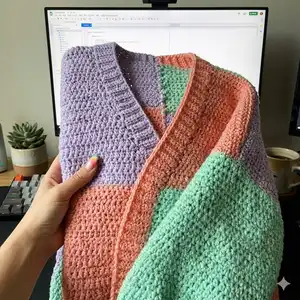
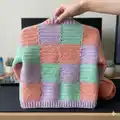
Make an oversized, slouchy Cumulus Cardigan that features dramatic bishop sleeves and a comforting ribbed texture. This graded pattern guides you through creating separate panels and sleeves, joining them with a flat SLST granny join, and finishing with crisp ribbed edges. You will learn how to shape roomy panels, create neat ribbing with BLO/FLO techniques, and assemble the pieces for a polished, wearable result.
Progress Tracker
0% Complete
— Overview :
Info :
The cardigan is composed of a total of 5 pieces worked separately: one back panel, two front panels, and two sleeves. Each piece will end with a row of SLST(s) and will be joined together using the flat SLST granny join method.
Info :
Foundation Chain and totals per size: Back Panel Foundation Chain: (111,121,131). Back Panel Number of Rows: (153,175,197). Front Panel Foundation Chain: (111,121,131). Front Panel Number of Rows: (57,67,77). Sleeves Foundation Chain: 76. Sleeves Number of Rows: (113,129,145).
— Front/Back Panel and Ribbing :
Info :
Each row is divided into 2 sections, the ribbing and the body section. The ribbing will be worked using SLST(s) and SLST BLO stitches, while the body will be worked using SC(s) and SC BLO stitches.
Round 1 :
Foundation Chain: CH (111,121,131). For custom sizing: CH until you reach your Front and Back Panel Foundation Chain length and CH 1.
Round 2 :
Row 1: Starting from the 2nd CH from the hook SLST 15, SC until the end of the row. You should end with a total of (110,120,130) ST(s). CH 1, and turn.
Round 3 :
Tip: Insert your hook into the back ridge of the CH for a neater look.
Round 4 :
Row 2: SC 1, SC BLO across until 15 CHS REM, SLST BLO 14, SLST 1, CH 1, and turn.
Round 5 :
Tip: Turn your work in the same direction every time you reach this point in the piece, this will ensure that the ends of your ribbing have a consistently nice and straight edge.
Round 6 :
Row 3: SLST 1, SLST BLO 14, SC BLO across until 1 CH REM, SC 1, CH 1, and turn your work.
Round 7 :
Repeat rows 2 and 3 until you complete (153,175,197) rows for the back panel and (57,67,77) for the front panels.
Round 8 :
Info: For custom sizing: repeat rows 2 and 3 until the width of top portion of your cardigan meets your Back Panel width and make sure you end with an odd number of rows. When measuring your panels make sure that your panels are on a flat surface and that it is not stretched out vertically.
Round 9 :
Edging: This is done in preparation for the joining of pieces and to ensure minimal to no visible gaps in the seams. You will need to SLST into each stitch of the top side of your panel.
Round 10 :
After ending your last row with a CH1, do not turn your work and SLST into each space of the top edge of your work starting from the first space of the last stitch of your last row. (See photo 5.1 in page 5 or watch the quick tutorial here: https://youtu.be/BVaC3kG85Ns)
Round 11 :
For the back panel and just one of the front panels, do not fasten off, instead secure the last stitch with a stitch marker and leave a trail of yarn that is at least 4 times as long as the width of your piece, that will be used to join the pieces/panels together.
— Cuff and Sleeve :
Round 1 :
Foundation Chain: CH 76. For custom sizing: CH until you reach your Sleeve Foundation Chain length and CH 1.
Round 2 :
Row 1: Starting from the 2nd CH from the hook SLST 15, SC across the row until 1 CH REM, SC 1. You should end with a total of 75 ST(s). CH 1 and turn.
Round 3 :
For custom sizing: Instead of making 15 SLST(s), make as much as you would like the height of the cuff to be, and then make SC(s) on the rest of the remaining ST(s) of the row. CH 1 and turn.
Round 4 :
Tip: Insert your hook into the back ridge of the CH for a neater look.
Round 5 :
Rows 2: SC 1, SC BLO 58, SC 1. You should end with a total of 60 ST(s). CH 1, and turn.
Round 6 :
Row 3: Repeat row 2.
Round 7 :
Row 4: SC 1, SC BLO 58, On CH 60 insert your hook through the last ST of the 3rd, 2nd, and 1st row, yarn over and pull through 2 CH(s), and then yarn over and pull through 2 loops. SLST BLO 14, SLST 1. You should end with a total of 75 ST(s). CH 1 and turn. (See photos 1-11 in page 6 or watch the quick tutorial here: https://youtu.be/NCWktH0rmvQ)
Round 8 :
Tip: Turn your work in the same direction every time you reach this point in the piece, this will ensure that the ends of your ribbing have a consistently nice and straight edge.
Round 9 :
Row 5: SLST 1, SLST BLO 14, SC 1, SC BLO 58, SC 1. You should end with a total of 75 ST(s). CH 1, and turn.
Round 10 :
Repeat rows 2-5 until you have a total of (113,129,145) rows on your sleeve section.
Round 11 :
For custom sizing - Row 5: Repeat rows 2-5 until you meet your desired cuff width and make sure you end with an odd number of rows. When measuring your cuff make sure that your cuff lays on a flat surface and is not overly stretched out vertically.
Round 12 :
Edging: After ending your last row with a CH 1, do not turn your work and SLST into each space of the top edge of your work starting from the first space of the last stitch of your last row. Do not fasten off, instead secure unfinished ST with a stitch marker and leave a trail of yarn that is at least 4 times as long as the length of your sleeve, this will later on be used to close up the sleeves.
Round 13 :
Info: Sleeves Right Side: The right side of the sleeves shows the braided side of the SLST. Sleeves Wrong Side: The wrong side of the sleeves shows "bumps" that separate the sleeve from the cuff.
— Seaming and Ribbing :
Info :
To join the pieces we will be using the flat SLST granny join method. The right side of the front and back panels, and the sleeves should show the braided side of the SLST.
— Attaching the Left Front Panel to the Back Panel :
Step 1 :
In this step you will be joining the front panel with the excess yarn from the edge of the to the back panel. The excess yarn from the front panel's edge will act as the working yarn to join the pieces together. Lay your pieces, right sides facing up.
Step 2 :
Taking the front panel, re-insert your hook into the last unfinished stitch of the edge, and make sure that your working yarn is under the pieces. Insert your hook into the 2nd CH from the hook and through the 1st SLST of the back panel. Yarn over and pull through both ST(s) and through the first loop on your hook. (See photos 1-8 in page 8 or watch the quick tutorial here: https://youtu.be/KRNf1KvQDI8)
Step 3 :
On the next stitch, insert your hook into the loop nearest the back panel and through the loop nearest front panel, yarn over and pull through all loops. Repeat this step until you only have one stitch left on the front panel. (See photos 1-4 in page 9)
Step 4 :
On the last stitch insert your hook through the last SLST from the front panel and on the next stitch from the back panel, yarn over and pull through both stitches and the last loop, CH1 and fasten off. Make sure to leave a trail long enough to weave in.
— Attaching the Right Front Panel to the Back Panel :
Step 1 :
In this step you will be joining the back panel to the front panel. The excess yarn from the back panel's edge will act as the working yarn to join the pieces together. Lay your pieces, right sides facing up.
Step 2 :
Taking the back panel, re-insert your hook into the last unfinished stitch of the edge, and make sure that your working yarn is under the pieces. Insert your hook into the 2nd SLST from the hook and through the 1st SLST of the front panel. Yarn over and pull through both ST(s) and through the first loop on your hook.
Step 3 :
On the next stitch, insert your hook into the loop nearest the front panel and through the loop nearest back panel, yarn over and pull through all loops. Repeat this step until you only have one stitch left on the front panel.
Step 4 :
On the last stitch insert your hook through the SLST from the back panel and on the last stitch from the front panel, yarn over and pull through both stitches and the last loop, CH1 and fasten off. Make sure to leave a trail long enough to weave in.
— Attaching the Sleeves to the Front and Back Panel :
Step 1 :
Before the sleeves are attached to the front and back panels you must create an edge across the entire length of the body. If you are working on the left side of the body, start the edge from the bottom of the front piece, and if you are working on the right side start from the bottom of the back piece.
Step 2 :
Edging of the body piece: create a slip knot and SLST into each ST across the body starting from the very first ST of the row. (See photos 10.1-10.4 in page 10) Once you reach the seam between the back and front panel SLST into the last ST before the seam and SLST into the first ST after the seam and SLST into the first ST after the seam and across the entire row, CH 1. Do not fasten off, secure unfinished ST with a stitch marker. (See photos 10.5-10.8 in page 10) and across the entire row, CH 1. Do not fasten off, secure unfinished ST with a stitch marker. (See photos 10.9-10.12 in page 10)
Step 3 :
To ensure that your sleeve is centered you need to subtract the number of SLST(s) on the edging of the sleeves from the edging of the body pieces, divide the difference by 2 to determine the number of STS you need to skip on the body piece. Example: Number of STS across the body piece's edge (STS BPE) is = 240. Number of STS across the sleeve's edge (STS SE) is = 146. Difference = 94. Quotient = 94/2 = 47. Start joining your sleeve on the 48th ST of the body piece's edge.
Step 4 :
To join the body piece to the sleeves follow photos in page 8 and 9 (or watch the quick tutorial here: https://youtu.be/UH6PLdM5hpl). The excess yarn from the sleeve's edge will act as the working yarn to join the pieces together. At the end of the sleeve do not fasten off, instead secure unfinished ST with a stitch marker and make sure to leave a trail 4 times as long as the length of your sleeve, this will later on be used to close up the sleeves.
— Closing up the sides of the cardigan and the sleeves :
Step 1 :
In this step you will be using the excess yarn from the edge of the body piece and the excess yarn from the sleeves' and the body piece's seam. Follow photos in page 8 and 9 to start joining the body piece together.
Step 2 :
Once you reach the last ST before the sleeves section, insert your hook into the unfinished stitch of the sleeve's seam, pull through the loop and continue joining the sleeves. (See photos 1-4 in page 12)
— Ribbing :
Round 1 :
The ribbing consists of SLST(s) across the inner sides of the front panels and the neck line starting from the bottom of the right panel. For custom sizing: Increase/decrease the number of rows for a thicker/thinner ribbing.
Round 2 :
Row 1: Create a slip knot and SLST into each ST across the body starting from the very first ST of the row. Once you reach the front and back panel seam, SLST into the next available CH after the seam (See photos page 13), continue to SLST across the front panel and then CH1, and turn.
Round 3 :
Row 2: SLST 1, SLST FLO across until 1 REM, SLST, CH1, and turn.
Round 4 :
Row 3: SLST 1, SLST BLO across until 1 REM, SLST CH1, and turn. Repeat to achieve your desired thickness. Fasten off and weave in ends.
Round 5 :
Optional - Adding front ties Row 4: SLST BLO until the closing point where you would like to have the ties, CH until it measures 13 inches or your desired length, skip 1 CH and SLST on each CH across, SLST BLO until you reach the same closing point on the opposing side, CH the same number as on the right side, skip 1 CH and SLST on each CH across, SLST BLO across until 1 REM, SLST1, CH1 and fasten off.
Info :
Info: The pattern includes photo references labelled on pages 5-13 to guide insertion points and joining steps; follow the photos where indicated for visual guidance.
This Cumulus Cardigan pattern gives you a roomy, modern silhouette with cozy ribbed textures and dramatic bishop sleeves. It is thoughtfully graded and easy to customize to your measurements, making it a satisfying multi-day project. Whether you choose pastels or bold color blocks, this cardigan will be a standout addition to your handmade wardrobe. 🧶👕