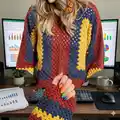
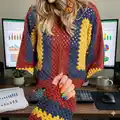
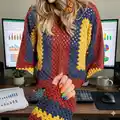
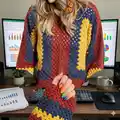
About This Crochet Hexi Hooded Pullover Pattern
This pattern creates a relaxed, striped Hexi Hooded Pullover worked from two large hexagons that are folded and seamed to form the body and sleeves. It uses a simple Stripe Pattern with three color contrasts to create bold geometric lines and texture. The hood and sleeve shaping are worked in double crochet cluster groups for a satisfying, rhythmic stitch pattern.
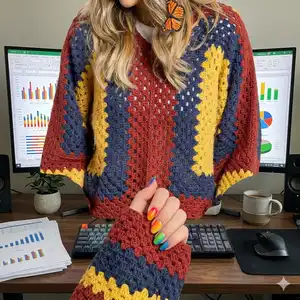
Designed as an easy, beginner-friendly project, the pullover uses repeatable rounds and clear diagrams to guide assembly. Finished measurements and full yarn quantities are included for multiple sizes to help you plan your project.
Why You'll Love This Crochet Hexi Hooded Pullover Pattern
I absolutely love this pattern because it turns a simple repeat stitch into a striking geometric garment with so little fuss. Working the hexagon panels is relaxing and rewarding — each round builds the shape in a predictable way. Folding and seaming the hexagons into a pullover is a clever construction that makes assembly straightforward yet interesting. The stripe pattern with three contrasting colors gives you a lot of creative freedom to customize the look, which I always enjoy.
Switch Things Up
I love customizing the stripe sequence to change the mood of this pullover; try reversing the stripe order or using tonal shades for a subtle look.
To make a chunkier version, I switch to a bulkier weight yarn and a larger hook which creates a warm, cozy pullover perfect for cold weather.
If you want a daintier, smaller pullover, I sometimes use sport weight yarn and a 3.5 mm hook to reduce the finished size and make a lightweight layer.
I often add embroidered motifs or surface crochet along the front lapels to personalize the cardigan and add visual interest between the hexagon points.
Try using gradient or variegated yarn for one of the contrasts to give the stripes a soft, blended effect without changing colors every few rounds.
For a fitted look, reduce the number of stripe repeats or use a smaller hook and wear a closer-fitting garment underneath to control the drape.
I sometimes add buttons or toggles to the front opening for a more structured closure — just mark your button positions before finishing the front seam.
Want a cropped version? Simply stop increasing the hexagon earlier and shorten the sleeve length by working fewer sleeve rounds from the underarm measurement.
For playful sleeves, change the stripe sequence only on the sleeve panels, or add a decorative picot edge to the cuffs for a delicate finish.
I also like to experiment with pocket placement: stitch small square panels into the front lower hexagon segments for handy, built-in pockets.
Common Mistakes & How to Fix Them
✗ Skipping the Magic of the Stripe Pattern; make sure to follow the 5 rnds of A, 7 rnds of B, and 5 rnds of C sequence so your stripes line up correctly.
✗ Failing to check gauge before starting the hexagon panels; measure 16 sc and 20 rows = 4" [10 cm] to ensure the finished pullover fits as intended.
✗ Ignoring the note about the hexagon not laying flat; do not try to flatten it early — fold and seam as instructed for the correct finished shape.
✗ Not leaving long seaming tails for the hood and seams; leave the specified 20" [51 cm] tail so you have enough yarn to seam flat and securely.
✗ Sewing seams without pinning or marking; use stitch markers and pin the top sleeve seams and front/back seams to keep edges even before sewing.