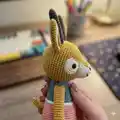
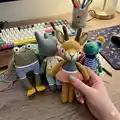
🧢 Beautiful ✨ Detailed πŸ’ Adorable

Animal Friends of Pica Pau Amigurumi Pattern

Animal Friends of Pica Pau Amigurumi Pattern
4.0β˜… Rating
2-3 Hours Time Needed
2.3K Made This
βœ‚οΈ

Beginner Friendly Level

Perfect for those just starting their crochet journey, with clear instructions and simple techniques

⏱️

Bite-Sized Project

Finishes in 2-4 hoursβ€”perfect for an afternoon of creative relaxation.

🧸

Cute Companion

An adorable friend to cherish, handcrafted with love to bring comfort and joy for years to come.

About This Animal Friends of Pica Pau Amigurumi Pattern

This pattern set teaches you how to crochet small amigurumi animal friends using basic stitches and simple shaping. It focuses on tight stitches and step-by-step construction to keep stuffing from showing. You will learn fundamental techniques like the magic ring, increases, decreases and simple embroidery for facial features. The patterns are designed to be approachable and rewarding for new crocheters.
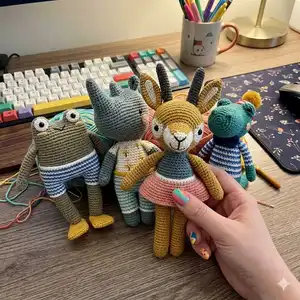
Animal Friends of Pica Pau Amigurumi Pattern crochet pattern - detailed view of completed project

Follow the photographed steps and clear stitch instructions to build each character piece by piece. Includes tool recommendations, yarn guidance and finishing tips to complete neat, durable toys.

Why You'll Love This Animal Friends of Pica Pau Amigurumi Pattern

I absolutely love this pattern because it celebrates simple shapes and bold colors that give each toy a lot of personality. I enjoy how quickly a small amigurumi comes together β€” it feels so satisfying to finish one in an afternoon. The instructions and photos make the techniques accessible, and I love encouraging others to try amigurumi because it builds confidence. Every time I finish one of these little characters I feel proud to give or display it.

Animal Friends of Pica Pau Amigurumi Pattern step 1 - construction progress Animal Friends of Pica Pau Amigurumi Pattern step 2 - assembly progress Animal Friends of Pica Pau Amigurumi Pattern step 3 - details and accessories Animal Friends of Pica Pau Amigurumi Pattern step 4 - final assembly and finishing

Switch Things Up

I love how versatile these amigurumi patterns are for personalization; swap colors to create your own unique characters.

You can change yarn weight and hook size to make larger or smaller versions; try bulky yarn with a larger hook for a cuddly oversized friend.

For a mini keychain, use fingering weight yarn and a 2.0–2.5 mm hook to make tiny portable pals.

I often add embroidered eyelashes, freckles or tiny accessories like scarves and hats to give each toy a distinct personality.

Mix fibers for texture contrast β€” cotton bodies with wool scarves or felted details can be very charming.

Try surface embroidery or duplicate stitch to add stripes, hearts or initials to clothing sections for personalization.

Make themed sets by changing color palettes β€” pastel for nursery, bold for modern decor, or seasonal palettes for holidays.

Use safety eyes for finished toys, or embroider eyes for a softer, child-safe toy suitable for babies.

Add wire inside limbs for posable toys, or sew in a flat base to help a character stand unaided.

I sometimes create tiny props like a crocheted ball or a felt leaf to give each friend a playful accessory and a storytelling element.

Common Mistakes & How to Fix Them

βœ— Skipping stitch markers when working in rounds can lead to losing track of the start of the round; place a marker at the beginning of each round to maintain consistency. βœ— Overstuffing the toy will stretch the stitches and show the filling through the fabric; stuff gradually and evenly, adding small amounts until you achieve a firm but not bulging shape. βœ— Using the recommended hook size for garments rather than for toys will create a loose fabric; choose a hook two or three sizes smaller than recommended for garments to produce dense amigurumi fabric. βœ— Not counting stitches after increases and decreases causes uneven shaping; count your stitches regularly, especially after shaping rounds, to ensure the correct stitch total. βœ— Failing to weave in ends securely can result in loose tails or unraveling; weave ends through several rows inside the fabric and trim close after securing.
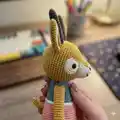
Animal Friends of Pica Pau Amigurumi Pattern

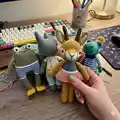
This collection guides you through making charming amigurumi animal friends inspired by Pica Pau. You will find clear, photographed instructions and practical tips to help you create small stuffed characters with personality. The patterns emphasize tight tension, neat finishing, and playful color combinations to make each toy unique. Perfect for gifting, decorating, or building a delightful handmade collection.

Beginner Friendly 2-3 Hours

Materials Needed for Animal Friends of Pica Pau Amigurumi Pattern

β€” Main Fabric

  • 01
    Cotton yarn (recommended for toys) - fingering to sport weight options mentioned throughout the introduction
  • 02
    Wool yarn (various weights) - used for warmer textured toys and blends
  • 03
    Alpaca yarn (animal fibers) - superfine, soft and expensive alternative
  • 04
    Acrylic yarn - widely available, many colors, suitable for toys
  • 05
    T-shirt yarn / thicker materials (for chunky versions)
  • 06
    Sheep's wool roving (for specialty uses)
  • 07
    Other materials mentionable for experimentation: ribbon, leather, wire, plastic bags, paper (can be used as unconventional threads)
  • 08
    General yarn weight guidance: lace/fingering/sport/DK/worsted categories listed with m/100g ranges in the fiber weight chart (examples: 200-400 m/100 g for thin yarns; 100-200 m/100 g for medium yarns)

β€” Tools Required

  • 01
    Crochet hooks sizes 2.00 mm to 10.00 mm (table lists 2 mm, 2.25 mm, 2.5 mm, 2.75 mm, 3 mm, 3.25 mm, 3.5 mm, 3.75 mm, 4 mm, 4.5 mm, 5 mm, 5.5 mm, 6 mm, 6.5 mm, 7 mm, 8 mm, 9 mm, 10 mm)
  • 02
    Yarn needle / tapestry needles (numbers 16 or 18 recommended)
  • 03
    Safety eyes (various sizes)
  • 04
    Pins for assembly (plastic or glass-headed preferred)
  • 05
    Scissors (small, lightweight sharp scissors recommended)
  • 06
    Stitch markers (or paper clips, safety pins, hair clips)
  • 07
    Polyester stuffing (fiberfill)
  • 08
    Measuring tape or ruler
  • 09
    Optional: wire for posable limbs (if desired)
  • 10
    Optional: glue for securing safety eyes (for added safety)

Progress Tracker

0% Complete

β€” Hold the hook and yarn (hand position) :

Info :

In many years of teaching, I’ve seen almost as many ways of holding the hook and yarn as students. Usually, we handle the hook with the same hand we use to write, but it’s not a rule. There are no hard rules and there’s no β€œbest way” to hold this tool.

Pencil grip :

Hold the hook as you would a pencil, grasping the hook between your thumb and index finger, in the middle of the flat section (the thumb rest).

Knife grip :

Hold the hook in the same manner as you would hold a knife, grasping it between your thumb and index finger, resting the end of the hook against your palm.

Hold the yarn :

The free hand is used to control the thread and hold the work. You can weave the yarn through your fingers or place the thread between your palm and two or three fingers to maintain steady tension.

β€” Stitches :

Info :

All crochet stitches are made from the combination of two or three movements: wrap the yarn from back to front over the hook (yarn over), insert the hook into the stitch, draw the yarn through one or more loops on the hook. The book explains the basic stitches used throughout.

Slip knot :

Almost all crochet works begin with this knot. The slip knot is the first loop you'll need to make on your hook.

Slip knot steps :

1 Make a loop shape with the tail end of the yarn. 2 Insert the hook into it and draw another loop through it. 3 Pull the yarn tail to tighten the loop around the hook. (The slip knot does not count as a stitch.)

β€” 01 Chain stitch (abbreviation: ch) :

Info :

This stitch is the basis for most crochet works and is used for foundation chains and turning stitches.

Chain stitch steps :

1 Holding the slip knot, wrap the yarn from back to front around the hook (yarn over). 2 Draw the hook backward to pull the yarn through the loop on the hook (the slip knot). 3 You will form a new loop, which is your first chain stitch. Repeat to form as many chain stitches as required.

Foundation chain :

This is the string of chain stitches you have to crochet if you want to make a flat fabric worked in rows; it is the equivalent of casting on when you start knitting. Note: To help maintain an even foundation chain, keep changing your grip on the crocheted chains so you are always holding them near the hook.

Turning chain :

When crocheting in rows, these are the chain stitches you have to make in order to move to the beginning position. Each stitch has a corresponding number of turning chains: single crochet = 1 turning chain; half double crochet = 2 turning chains; double crochet = 3 turning chains. Note: When you work half double crochet or longer stitches, the turning chain counts as the first stitch.

β€” 02 Slip stitch (abbreviation: slst) :

Info :

The slip stitch is used to join rounds, move along a row without adding height, and tidy edges. Insert hook, yarn over, pull through stitch and loop on hook.

β€” 03 Single crochet (abbreviation: sc) :

Info :

Single crochet creates a dense fabric, ideal for amigurumi; insert hook, yarn over, pull up a loop, yarn over and pull through both loops on the hook.

β€” Foundation techniques and tips :

Infos :

Work with a hook two or three sizes smaller than garment recommendations to obtain dense fabric for toys. Keep tension steady and count stitches frequently. Use stitch markers to mark the first stitch of a round. Use polyester fiberfill for stuffing and avoid overstuffing.

β€” Reading a pattern and abbreviations :

Info :

The index and introductory section list abbreviations such as ch (chain), slst (slip stitch), sc (single crochet), hdc (half double crochet), dc (double crochet), inc (increase) and dec (decrease). Parentheses and bracket conventions and notes about when the turning chain counts are explained in the reading section.

Assembly Instructions

  • Attach head to body by aligning the neck opening and sewing with a yarn needle using a whipstitch; hide and weave in the tail inside the body.
  • Position the arms on either side of the body and sew them between the indicated rounds for natural placement; pin before sewing to check symmetry.
  • Sew legs to the bottom of the body, spacing them evenly and ensuring stitches are secure for stability when the toy sits or stands.
  • Attach ears and small appendages to the head at the recommended positions; use pins to check placement and stitch through several rows to secure.
  • Add facial features by embroidering the mouth and nose before final assembly; attach safety eyes between specified rounds and consider using glue for extra security if the toy is for small children.

Important Notes

  • πŸ’‘Use stitch markers to keep track of the start of each round and after increases or decreases to maintain correct stitch counts.
  • πŸ’‘Stuff pieces gradually and evenly to avoid lumps and to maintain the intended shape; avoid overstuffing which stretches the fabric.
  • πŸ’‘Work with consistent tension and use a smaller hook than usual for amigurumi to create a dense fabric that does not show stuffing.
  • πŸ’‘Weave in yarn ends as you go to keep finishing tidy and prevent long tails from getting trapped or pulled out later.

This charming amigurumi collection invites you to make playful animal friends that brighten any room. Each design uses simple shaping and clear steps so you can enjoy the creative process. Whether for gifts or for your own shelf, these little companions are made with love and a lot of personality. 🧢🧡

You ask,

we answer.

FAQs

What size will the finished piece be?

Finished sizes vary by yarn weight and hook size; most small amigurumi in this book measure roughly 12–25 cm tall when made with sport or DK weight yarn and the recommended hooks.

Can I use different yarn weights for this pattern?

Yes, you can change yarn weight, but it will affect final size and fabric density. Use a smaller hook for denser fabric if using a thicker yarn or adjust hook size to maintain the desired firmness.

Do I need prior crochet experience for this pattern?

This book is beginner friendly and includes step-by-step photos for basic techniques; basic knowledge of chain, single crochet and slip stitch will be helpful, and the instructions guide you through the rest.

How long does this project typically take to complete?

Most small amigurumi projects in this book can be completed in 2–4 hours depending on experience and complexity of details; more detailed characters may take longer.